7 Best SocialBee Alternatives With a Real API (2026)
SocialBee has no public API, in its own words. Here are seven social media alternatives that do, compared on API access, MCP, n8n and multi-tenant support.

Most posts about SocialBee alternatives open by calling SocialBee expensive. That is the wrong complaint. Its category-based recycling is the best implementation of that idea in the category, and at $29 a month it is not overpriced.
People leave for two quieter reasons. Agencies hit a seat and workspace ceiling that profile add-ons cannot lift, and builders discover there is no public API to automate against, which SocialBee states plainly in its own help center. Underneath both sits a third problem nobody advertises: the recycling engine can stall without telling you.
Six of the seven tools below expose a public API you can actually buy at a normal price. The seventh, SocialPilot, has one but keeps it behind an Enterprise conversation, and the table says so rather than making you find out later. Where an API sits on a higher tier, that tier is named in the cell.
I am the founder of Blotato, so judge my entry on the specifics. It is my top pick here and the wrong answer for one large group of SocialBee users, and I say exactly who below.
Quick Comparison: 7 SocialBee Alternatives
| Tool | Best For | Starting Price | Public API | MCP server | n8n / Make | Multi-tenant | Key Strength |
|---|---|---|---|---|---|---|---|
| Blotato | Builders running social through an AI agent | $29/mo | Yes, paid plans, not on trial | Hosted, 36 tools | Official n8n node, native Make app | No, accounts you connect yourself | Publishing, comments, DMs and analytics behind one hosted API and MCP key |
| RecurPost | SocialBee users who want the recycling without the seat cap | $9/mo | Yes, tier not documented | Local npm, free on every plan | Community n8n node, no Make app | Workspaces you own, no client OAuth | Evergreen re-queueing plus $4 per extra account and $20 flat per teammate |
| Publer | Solo creators who want recycling at the lowest credible price | $5/mo | Yes, Business tier from $10/mo | Enterprise beta only | Zapier only | No, one login and workspaces | Spintax-powered post recycling on a $10 tier that also unlocks the API |
| Metricool | Anyone whose real bottleneck is reporting, not posting | Free, then $25/mo | Yes, Advanced tier from $67/mo | Hosted, every plan including Free | Native Make app, no official n8n | No, brands under one login | Organic, paid and web analytics in one view, with MCP on every plan including free |
| Zernio | Agencies whose account count swings month to month | Free for 2 accounts | Yes, every account including the 2 free | Hosted, 496 tools | Official n8n node, Make undocumented | Yes, white-label OAuth per end user | Graduated per-account billing that falls to $1 per account past 100 |
| Buffer | Someone leaving SocialBee for something simpler | Free, then $6/mo per channel | Yes, GraphQL, every plan including Free | Hosted, all plans | Official n8n node and Make app | No, key acts on your account only | A real free tier and API access on every plan, including free |
| SocialPilot | Agencies that need many client seats before many profiles | $30/mo | Enterprise only, on request | Hosted, all paid plans | Zapier only | Not documented publicly | Unlimited users and 50 accounts at $200/mo, plus bulk CSV scheduling for clients |
The Recycling Engine Is Also the Failure Point
SocialBee’s model is category-based scheduling. Posts go into buckets like Promotions or Tips, and your weekly schedule assigns slots to categories rather than to individual posts. Each slot pulls the next post from its bucket, and evergreen categories loop back to the top when they reach the end. It is genuinely clever, and it is why people sign up.
It is also why they leave. If one post in a category has a problem, the whole queue for that category stalls, and nothing tells you. A Trustpilot reviewer running SocialBee for over a year described it directly: “if a single post in a queue has a problem then the whole queue will stall stopping that timeslot or slots. And there is no indication which post within the category has the problem. You have to check them all.” The same review notes that errors are flagged clearly while you write a post, but a problem that appears later, after you have already clicked confirm, is not surfaced anywhere.
Two reviews above it on the same page praise the evergreen queues for keeping content consistent without manual work. Both things are true. The feature is excellent when it runs and invisible when it stops, and an automation you have to audit weekly is not really automation.
SocialBee sits at 3.8 out of 5 across 57 Trustpilot reviews, which is a respectable score with a real minority of unhappy operators inside it. I went deeper on how its model compares to mine in Blotato vs SocialBee.
The second reason is structural. Ask SocialBee whether you can build on it and the answer in their own help documentation is: “Does SocialBee have a public API? At the moment, no, we don’t.” That article, last updated in December 2025, also confirms there is no white-label version.
There is a trap worth naming here, because it has fooled other roundups. The host api.socialbee.io resolves and returns HTTP 200, so a tool that checks whether the host is alive will tell you SocialBee ships an API. It does not, at least not one you can use. The root serves a marketing page rather than developer docs, and every documentation path on it redirects to a login screen. It is the plumbing behind SocialBee’s own mobile app and integrations, not a product you can buy. Automation runs through Zapier, Make or Pabbly, or it does not run at all.
SocialBee Alternatives Ranked by What You Are Replacing
I ranked these by what a SocialBee user is actually trying to replace: the recycling behavior first, then the ceiling they hit on seats, profiles, or programmatic access.
1. Blotato: Best for builders running social through an AI agent
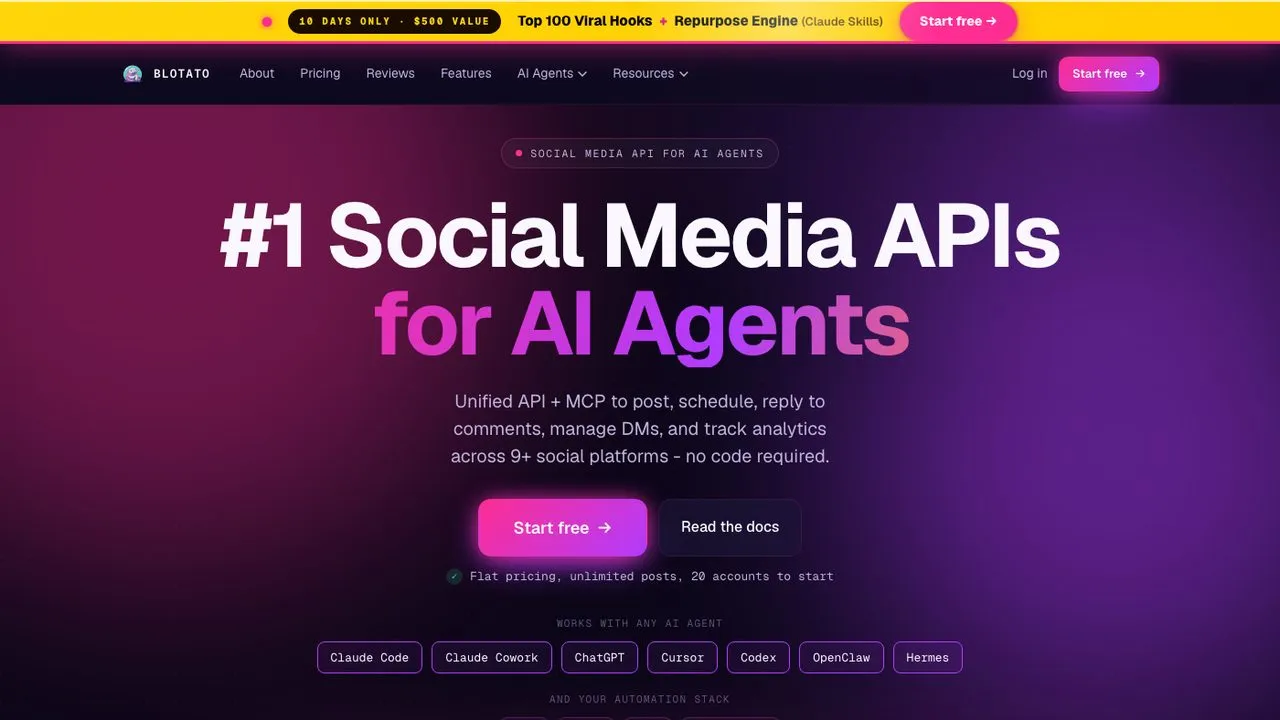
Blotato’s homepage, positioned around one API and MCP surface for AI agents.
I built Blotato because the tools I was using could publish but could not be driven by anything except me clicking in a dashboard. It is one hosted API and MCP endpoint at mcp.blotato.com/mcp covering publishing to 9 platforms, plus comments, DMs and analytics, so an agent in Claude Code or Claude Desktop can run the whole loop without five vendor integrations behind it. Starter is $29 a month for 20 connected accounts, which is four times SocialBee’s Bootstrap count at the same price.
Here is the honest disqualifier, and I will only say it once: Blotato has no category-based evergreen recycling, so if your entire workflow is a library of evergreen posts looping on a category schedule, you should buy a tool built for that job instead of this one, like the recycling-first schedulers I ranked as MeetEdgar alternatives. Blotato generates net-new content and publishes it programmatically, which is a different problem.
One more limit matters specifically if you are coming from SocialBee: Blotato does not publish to Google Business Profile, and SocialBee does. For a multi-location business that is disqualifying on its own. Analytics also covers 8 of the 9 platforms, and the 7-day trial excludes API access, so an API key ends the trial and starts billing on the spot.
If that is your shape, you can start on a Blotato plan and point your agent at the MCP endpoint the same day. Plan on subscribing rather than trialing, for the reason above.
Pros:
- One hosted API and MCP key covers publishing, comments, DMs and analytics
- 20 connected accounts at $29/mo, and the bill does not move with post volume
- Real platform APIs rather than browser automation, so nothing breaks on a UI change
- Generates the content itself, including images and video
Cons:
- No Google Business Profile publishing, which SocialBee has and multi-location businesses rely on
- No category-based evergreen recycling
- The trial excludes the API, so testing MCP means starting a paid plan on day one
- Analytics covers 8 of 9 platforms, LinkedIn excluded
Pricing: Starter $29/mo (20 accounts), Creator $97/mo (40 accounts), Agency $499/mo (100 accounts).
Ideal for: Builders and lean teams who want an agent to run social end to end rather than a calendar to fill in by hand.
Bottom line: The right pick if the content itself is your bottleneck and you want it published programmatically, and the wrong one if you just need a queue rotated.
2. RecurPost: Best for SocialBee users who want the recycling without the seat cap
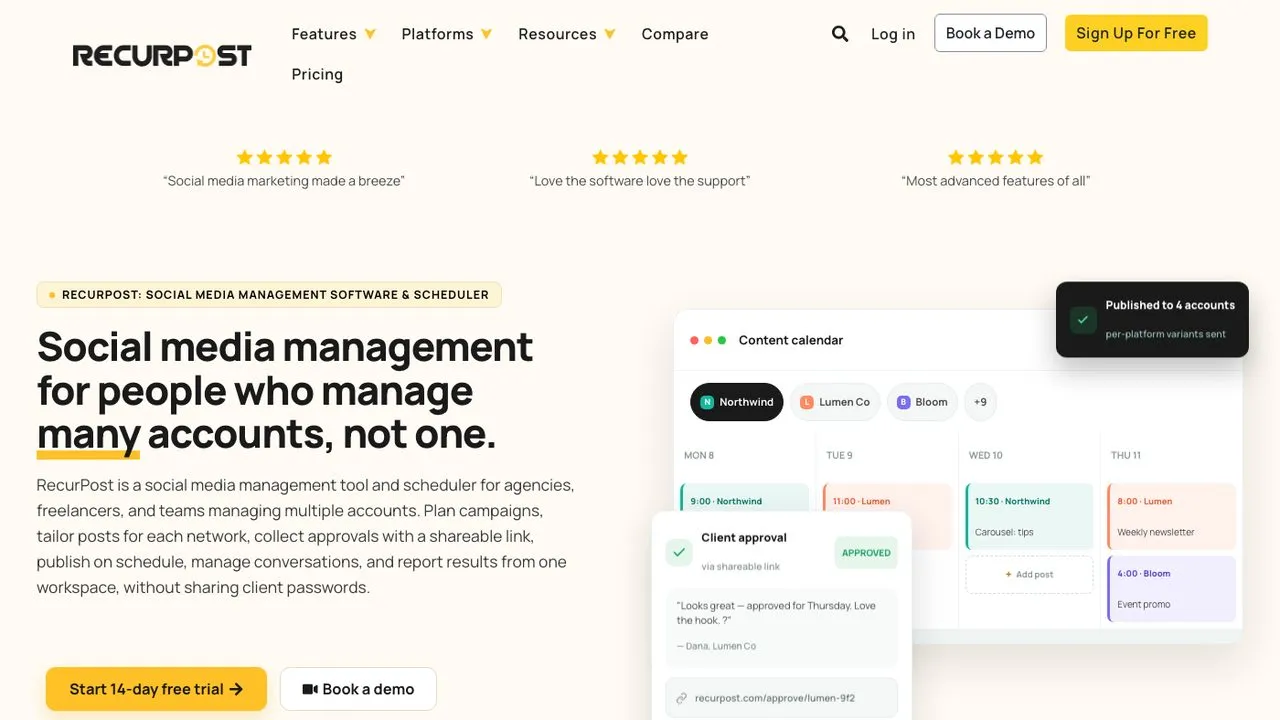
RecurPost positions itself for people managing many accounts rather than one.
RecurPost is the closest functional match to what SocialBee actually does. It ships evergreen recycling and content libraries, so the workflow you built survives the move. The difference is what happens as you grow: extra social accounts are $4 a month each and a teammate is a flat $20 a month, on top of a $79 Agency plan that already includes 20 accounts and 3 users. SocialBee’s Pro plan holds you at 3 users and 5 workspaces no matter how many profile blocks you buy, so a fourth teammate is where its shape starts working against you.
It also closes the automation gap, though not in the same shape as Blotato. There is a documented public API underneath, covering publishing, content libraries and posting history, authenticated per request with a key you generate in account settings rather than an OAuth token. On top of it RecurPost ships an MCP server as an npm package, recurpost-mcp, that runs locally and exposes 10 tools to Claude Desktop or Claude Code. That is a local bridge you install rather than a hosted endpoint you point at, so it fits an individual operator better than an unattended production system. If that distinction matters to your setup, I ranked how the hosted servers compare on that.
Pros:
- Evergreen recycling and content libraries, the feature most SocialBee users are protecting
- Per-account and per-seat add-ons rather than a tier jump
- A 9-tool MCP server for Claude, which SocialBee has no equivalent to
- Google Business Profile support, which SocialBee users often depend on
Cons:
- The MCP server runs locally via npm rather than as a hosted endpoint
- Daily post caps per account (10 on Starter, 80 on Agency)
- Smaller analytics depth than Metricool at a comparable price
Starter is $9 a month for 2 accounts, Personal $25 for 5, and Agency $79 for 20 accounts and 3 users, with a 14-day trial and no card required. The number that matters against SocialBee is the pair underneath: $4 per extra account, $20 per extra teammate, both flat.
Bottom line: The safest lateral move if you love the recycling and only resent the ceiling, and the obvious first stop if you have run out of seats before running out of profiles.
3. Publer: Best for solo creators who want recycling at the lowest credible price

Publer’s dashboard covers scheduling, drafts and recycling across accounts.
Publer is the price answer, and unusually for a cheap tool it holds a 4.8 rating on Trustpilot. Its pricing is tiered per account rather than flat, which matters more the more accounts you connect: Professional starts at $5 a month for the first account and $4 for each additional one, and Business starts at $10 with each extra account at $7. Spintax-powered post recycling, the feature closest to SocialBee’s evergreen loop, sits on Business along with API access.
Pros:
- A 4.8 Trustpilot rating across 999 reviews, the highest here
- Unlimited scheduling and drafts from $5/mo for the first account
- Recycling and API access both unlock on the $10 Business tier
- Genuine free tier for 3 accounts
Cons:
- Analytics are shallow compared to Metricool or SocialPilot
- Per-account pricing compounds quickly, at $4 or $7 for every account after the first
- Recycling and API sit on Business, not the entry tier
Bottom line: The best value here if your account count is small and stays small, which makes it the natural home for a solo creator or consultant who wants recycling without an agency bill.
4. Metricool: Best for anyone whose real bottleneck is reporting
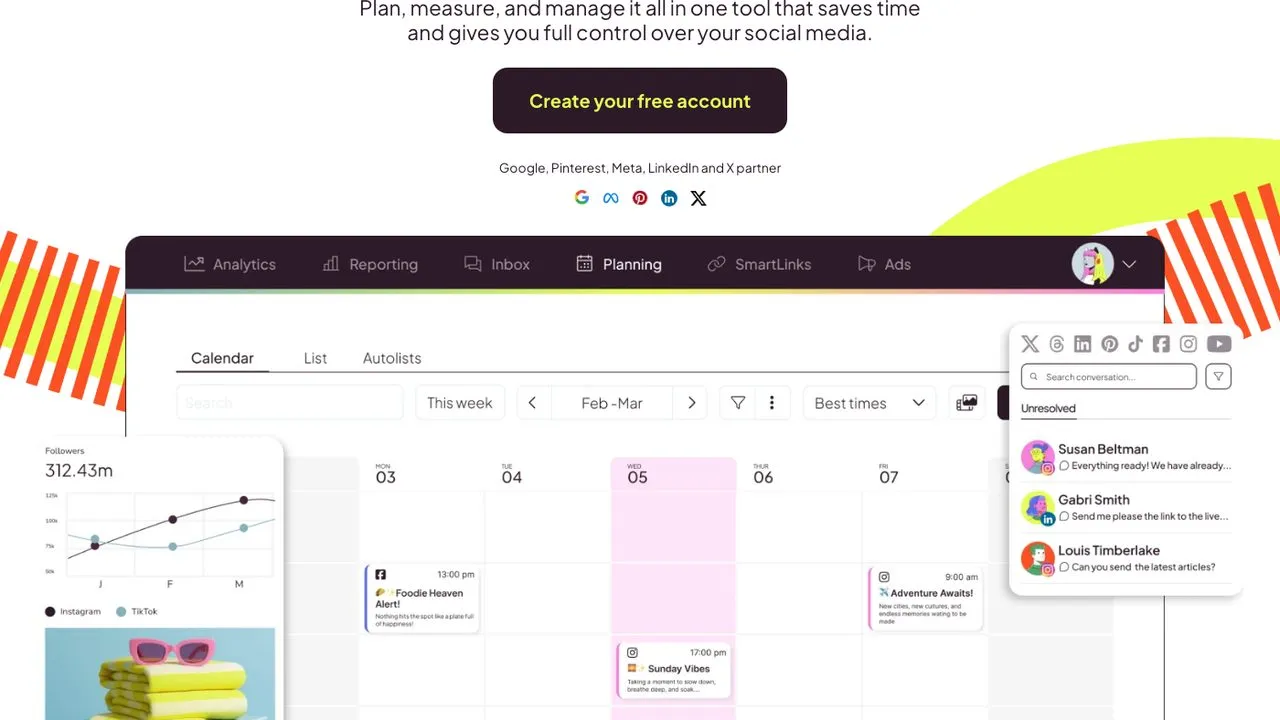
Metricool combines analytics, planning and reporting in a single view.
Some people shopping for SocialBee alternatives are not unhappy with the posting at all. They just cannot produce the reports a client is asking for. Metricool is the answer to that specific problem, pulling organic, paid and web data into one view. Worth knowing for anyone automating: Metricool’s MCP runs on every plan including the free one, while the HTTP API that Zapier and Make use requires Advanced, which is $67 a month on monthly billing. Those are two separate products gated differently, not a contradiction.
Pros:
- Organic, paid and web analytics in one view, on a plan that starts at $25
- MCP available on every plan, including free
- Free tier is genuinely usable for a single brand
- Competitor benchmarking built in
Cons:
- Publishing reliability is the weaker half of the product, and the reason to pair it rather than rely on it
- The HTTP API needs the Advanced tier, $67 a month
- Free tier excludes LinkedIn and X connections
Pricing: Free (1 brand), Starter from $25/mo (5 brands) or $45/mo (10 brands), Advanced from $67/mo (15 brands) up to $210/mo (50 brands), on monthly billing.
Bottom line: Buy it for the reporting, keep your expectations about publishing modest, and treat it as the answer when a renewal conversation hinges on a monthly report.
5. Zernio: Best for agencies whose account count swings month to month
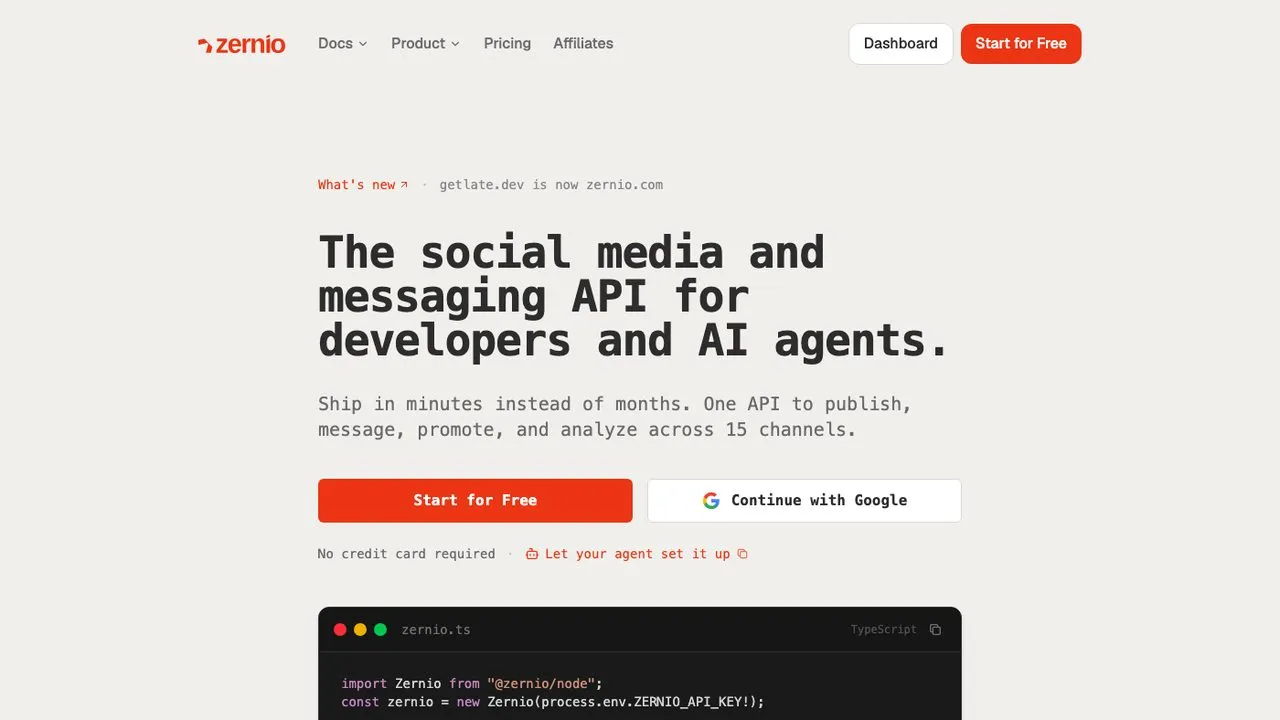
Zernio is built around a developer-facing API across 15 channels.
Zernio prices per connected account on a graduated curve rather than by plan, which matters if you onboard and offboard clients regularly. The first 2 accounts are free, accounts 3 to 10 are $6 each, 11 to 100 are $3 each, and past 100 the rate falls to $1. Twenty accounts works out to $78 a month with every feature included, and there are no tiers to cross. Its engagement surface is also wider than mine: Zernio reads and sends DMs on 8 platforms and handles comments on 9, where Blotato covers Instagram and Facebook.
Pros:
- Billing tracks your actual account count with no tier cliffs
- Every feature included on every account, nothing gated behind a plan
- Messaging and comments across a wide platform set
- Free for the first 2 accounts, no card required
Cons:
- Developer-facing by design, with no evergreen recycling workflow
- X API costs are passed through per call, which needs watching
- Thin public review corpus compared to the incumbents
Pricing: Accounts 1 to 2 free, 3 to 10 $6/mo each, 11 to 100 $3/mo each, 101+ $1/mo each.
Bottom line: The fairest billing shape here if you were never using the recycling, and the only one that follows a churning client roster down as well as up.
6. Buffer: Best for someone leaving SocialBee for something simpler
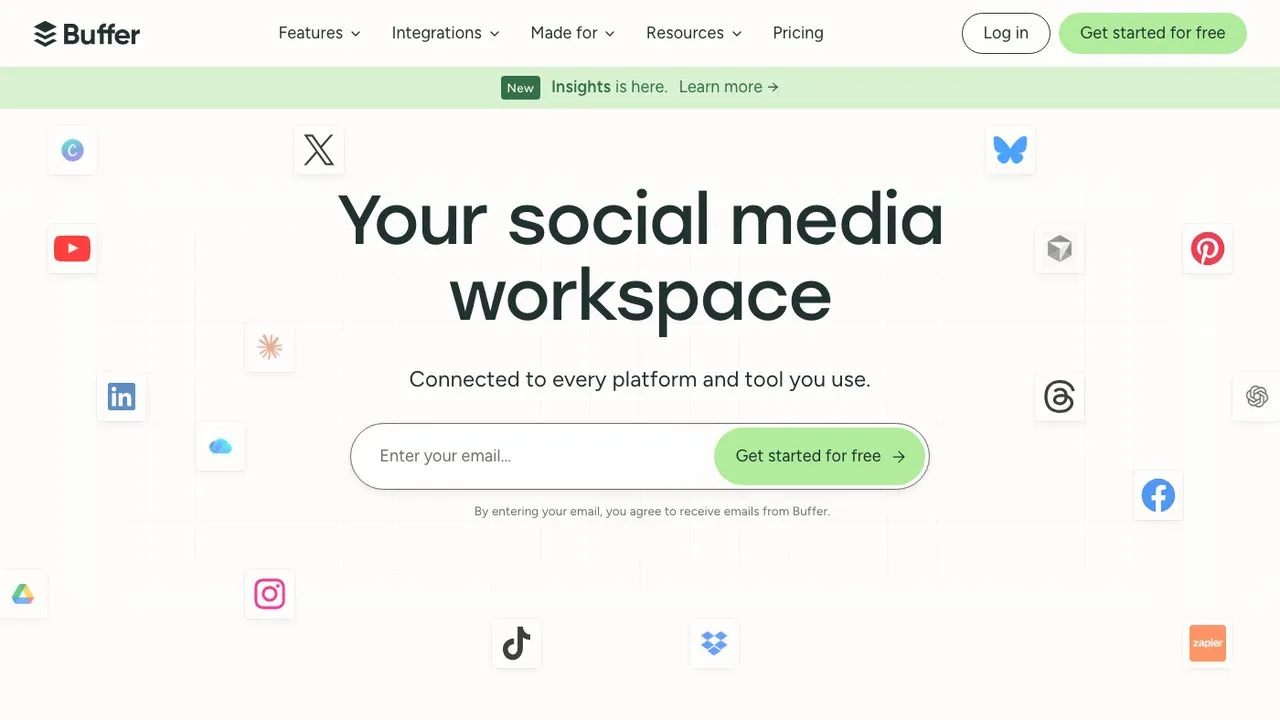
Buffer’s workspace connects across platforms with a free tier available.
Some people leave SocialBee because category scheduling turned out to be more machinery than they needed. Buffer is the deliberate step down: three channels free, a clean interface, and API access on every plan including the free one, which is rarer than it sounds. The catch is per-channel pricing that compounds quietly. Essentials is $6 per channel per month on monthly billing and $5 on annual, so ten channels is $60 a month. If that is where the per-channel bill lands you, there are cheaper shapes.
Pros:
- A genuinely simple interface and a real free tier for 3 channels
- API access on every plan, including free, plus a hosted MCP server
- Per-channel rates fall with volume, down to $1 per channel past 50 on Essentials
- Long operating history and a large public review base
Cons:
- No evergreen recycling, which is the whole reason many people chose SocialBee
- Per-channel pricing gets expensive between roughly 8 and 25 channels
- Trustpilot sits at 3.4 across 116 reviews, weaker than Publer or Metricool
Pricing: Free (3 channels), Essentials from $6/mo per channel, Team from $12/mo per channel, both on monthly billing. Annual is $5 and $10.
Bottom line: Simpler than SocialBee on purpose, so move here only if the complexity was the problem and you want to stop thinking about the tool.
7. SocialPilot: Best for agencies that need many seats before many profiles

SocialPilot targets agencies managing many client accounts.
SocialPilot solves the seat problem from the other end. SocialBee includes 3 users on Pro and charges $10 a month for each one after that, with no ceiling in sight, while SocialPilot’s Ultimate plan at $200 a month simply includes unlimited users alongside 50 accounts. On pure seat cost SocialBee stays cheaper until about your fourteenth teammate, so the reason to move here is the 50 included accounts and the client tooling around them, not the seats alone.
Be clear-eyed about two things. API access is Enterprise and contact-sales only, so this is not a route to automation. And its Trustpilot rating is 2.3 across 39 reviews, with most of the criticism concerning billing conduct rather than the product, which is worth reading before you commit annually.
Pros:
- Unlimited users on the $200 Ultimate plan
- Bulk and CSV scheduling built for high client volume
- Extra accounts are a flat $4/mo, with no tier cliff
- White-label reports and client approvals from $100/mo
Cons:
- API access requires an Enterprise contact-sales conversation
- Trustpilot 2.3 across 39 reviews, concentrated on billing and refunds
- No evergreen recycling equivalent
Ideal for: An agency adding people faster than it adds clients.
Pricing: Essentials $30/mo (7 accounts), Standard $50/mo (15), Premium $100/mo (25), Ultimate $200/mo (50, unlimited users), on monthly billing. Extra accounts $4/mo, extra users $5/mo.
Bottom line: The right shape for seat-heavy teams, if you go in with the billing reputation in mind.
Two Numbers to Read Carefully
Every price above is the month-to-month rate. These pricing pages default to annual and print the annual rate with a per-month label, so if a figure here looks higher than the one on the vendor’s site, check which toggle you are looking at.
The second is per-unit pricing. Publer and Buffer both charge less for later accounts than for the first, so a single per-account number overstates what you will actually pay at ten accounts.
Where the SocialBee Money Actually Goes
The pricing complaint about SocialBee is usually aimed at the wrong number. Its plans are Bootstrap $29 for 5 profiles, Accelerate $49 for 10, and Pro $99 for 25, on monthly billing. People see Pro’s 25-profile cap sitting next to the $179 Agency plan and assume the 26th profile costs an extra $80.
It does not. SocialBee sells profiles as an add-on block of 5 for $15 a month, so the 26th profile takes you from $99 to $114. Buying to 50 profiles this way costs $174, which is actually less than the $179 Agency plan.
The real cost is the part the add-on ladder cannot fix. Pro includes 3 users and 5 workspaces, and buying profile blocks never raises either. Extra users and workspaces are $10 a month each. An agency running 50 profiles that also needs 5 users and 10 workspaces pays $244 a month building it out of Pro, against $179 for the Agency plan that includes all three. That is the calculation worth doing before you renew, and it is about seats and workspaces rather than profiles. It is the same arithmetic I run across the field for agencies.
Which One Fits the Way You Actually Work
- You want the category recycling, just without the 3-user ceiling. RecurPost, since it keeps evergreen libraries and charges $20 flat per teammate instead of moving you up a tier.
- You run a handful of accounts and want the cheapest tool that is genuinely well built. Publer, starting at $5 a month, moving to the $10 Business tier if you need the recycling and API.
- Your client asked for better reporting, not better posting. Metricool, and take the free tier for a spin before paying.
- Your account roster changes every month. Zernio, because the bill follows the roster in both directions.
- You want an agent to run the whole thing. Blotato, provided you are not relying on evergreen category loops.
- You are adding people faster than clients. SocialPilot Ultimate for the unlimited seats and 50 accounts.
- You want less machinery, not more. Buffer, and accept that recycling is not coming with you.
Would I Switch, and to What
If you are happy with SocialBee and your queues are running, nothing in this post is a reason to move. It does one thing better than anything else here, and most of the switches above are upgrades of degree: cheaper seats, deeper reporting, a bill that tracks your roster.
One switch is different in kind. If you have started wanting to drive social from code or from an agent, no amount of tier upgrading fixes that, because there is no public API to upgrade into. That is a wall rather than a ceiling, and it is the reason I built Blotato the way I did.
If you are somewhere in between, the honest first move is not a migration. Open your category queues and check whether every timeslot actually fired this month. If they did, stay. If they did not, you already know what you are shopping for.
SocialBee Alternatives FAQs
Does SocialBee have a public API?
No. SocialBee’s own help center states plainly: “Does SocialBee have a public API? At the moment, no, we don’t.” Automation runs through Zapier, Make or Pabbly instead. Ignore the fact that api.socialbee.io resolves, since its docs redirect to a login and it serves SocialBee’s own integrations rather than customers. If you need programmatic publishing, Blotato, Buffer, Zernio, Publer and RecurPost all expose customer-facing APIs, and RecurPost adds a local MCP server on top of its own. I have compared what each one actually costs separately.
What is the closest alternative to SocialBee’s evergreen recycling?
RecurPost is the closest match, with evergreen re-queueing and content libraries built around the same idea of looping a library rather than scheduling one post at a time. Publer’s Spintax-powered recycling on its Business tier is the cheaper option if you are running a small number of accounts. I compared the wider field in my Publer alternatives roundup. Most other tools on this list, including Blotato and Buffer, have no direct equivalent.
Is SocialBee actually expensive?
Not at the entry tier, and not in the way most roundups claim. Bootstrap is $29 a month for 5 profiles, and extra profiles are a $15 add-on block of 5, so profile growth is gradual rather than a cliff. The pressure comes from seats and workspaces at $10 a month each on top of Pro’s included 3 and 5.
Why do people leave SocialBee if the recycling is so good?
A recurring complaint is that one problem post can stall an entire category queue with no notification, so posts quietly stop going out. At 3.8 across 57 Trustpilot reviews this is a minority experience rather than the norm, but it undermines the exact feature people pay for. The other reason is the missing public API.
Can I move my SocialBee content library to another tool?
Partly. Most tools here support CSV import, so post text usually survives, but category structures and recycling rules do not transfer and have to be rebuilt. RecurPost publishes a migration guide and is the least disruptive destination, because its content-library model is closest to what you already have.