Zernio vs Upload-Post: What One Social Media Account Costs
Zernio vs Upload-Post: one bills per connected account, one sells platform sets. The same social media workload lands at wildly different prices.

Every Zernio vs Upload-Post comparison I can find lines up the two rate cards and declares one cheaper. That answer is wrong more often than it is right, because the two vendors are not selling the same unit. One charges you per connected social account. The other sells you a set of platforms and lets you connect one account on each.
Until you know which unit your workload produces, the prices on those two pages are not comparable numbers. They are different currencies.
So this comparison starts with the unit, not the price. I ran both rate cards against real workloads, drove Zernio’s own calculator, and clicked Upload-Post’s monthly toggle to get past the annual figures its page shows first. The answer flips depending on two numbers you already know about your own build: how many brands you run, and how many platforms each one publishes to.
Zernio vs Upload-Post: Start With Your Own Number
Zernio is the better pick if: you run a handful of connected accounts, want an inbox and ads in the same key, and your account count grows slowly. Three accounts cost $6 a month, and the first two are free.
Upload-Post is the better pick if: each brand you publish sits on several platforms at once. Its unit absorbs platform count for free, which is where the account meter starts to hurt. The more platforms per brand, the wider the gap.
I should say up front that Blotato is an app I built, so read my take on it with whatever grain of salt feels right. It sits in this comparison only at the end, and only because it bills on a third unit again. The verdict between these two does not depend on it. If you want the full tier breakdown on our side, it is on the pricing page.
The Word That Breaks This Comparison
Both vendors use a word that sounds like the same thing and is not.
Zernio’s rate card defines it plainly: “One connected profile on one platform counts as one account: an Instagram account, a TikTok account, a Facebook Page, a YouTube channel. Connect a customer’s Instagram and TikTok and that’s 2 accounts.”
Upload-Post defines its unit the other way around. A profile “lets you connect one account per platform (5 profiles = 5 TikTok + 5 Instagram + 5 YouTube, and so on).”
Read those twice. One brand publishing to five platforms is five accounts at Zernio and one profile at Upload-Post. The platform count is free on one side and the whole bill on the other.
That single asymmetry decides most of what follows. It is also why a table that puts “10 accounts” next to “10 profiles” is comparing capacities that only match when all ten accounts sit on one platform.
Zernio Meters Each Connected Account
Zernio charges per connected social account per month, and the pricing is graduated, meaning each tier’s rate applies only to the accounts inside that range. The first 2 accounts are free. Accounts 3 to 10 cost $6 each, 11 to 100 cost $3 each, and 101 and up cost $1 each with no cap.
The graduation matters more than the rates. Ten accounts is not ten times $6. It is two free plus eight at $6, which is $48. Zernio’s own calculator renders that arithmetic on the page, and its worked examples confirm it at every scale: $48 at 10 accounts, $78 at 20, $318 at 100, and $1,218 at 1,000.
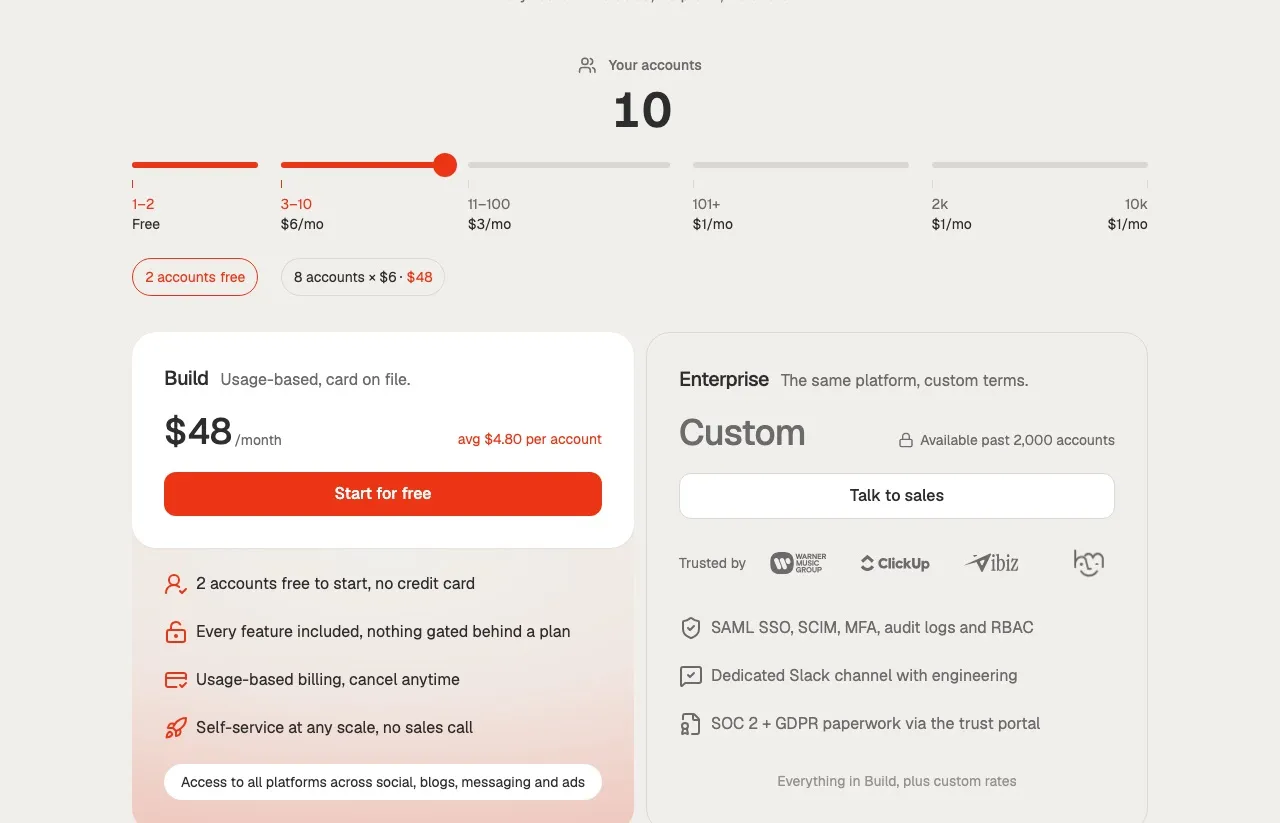
What you get for that is unusually flat. Zernio’s pricing page states that every connected account includes scheduling, analytics, inbox, full API access and unlimited posts, with no add-ons and no feature tiers. Two things meter on top: managed ads, and messages you send from the inbox, where the first 10,000 a month are free.
Its reach is 16 publishing destinations plus an ads surface its own pages count two ways, 7 on the agents page and 8 on the rate card, because one merges Facebook and Instagram into Meta Ads. The inbox is real but narrower than the homepage implies, and the rate card is the honest source: messaging covers 8 platforms, comments and reviews cover 9. TikTok is on neither list, which is worth knowing before you buy it for engagement.
Upload-Post Sells Platform Sets in Fixed Tiers
Upload-Post prices in fixed tiers with profiles included: Free at $0 for 2 profiles, Basic $24 for 5, Professional $50 for 25, Advanced $147 for 75, and Business $438 for 225.
Read that page carefully, because it opens on the annual toggle and prints the annual rate with a “/mo” suffix. The figures shown first ($16, $33, $118, $350) are what each month costs if you prepay a year. I clicked through to monthly to get the numbers above.
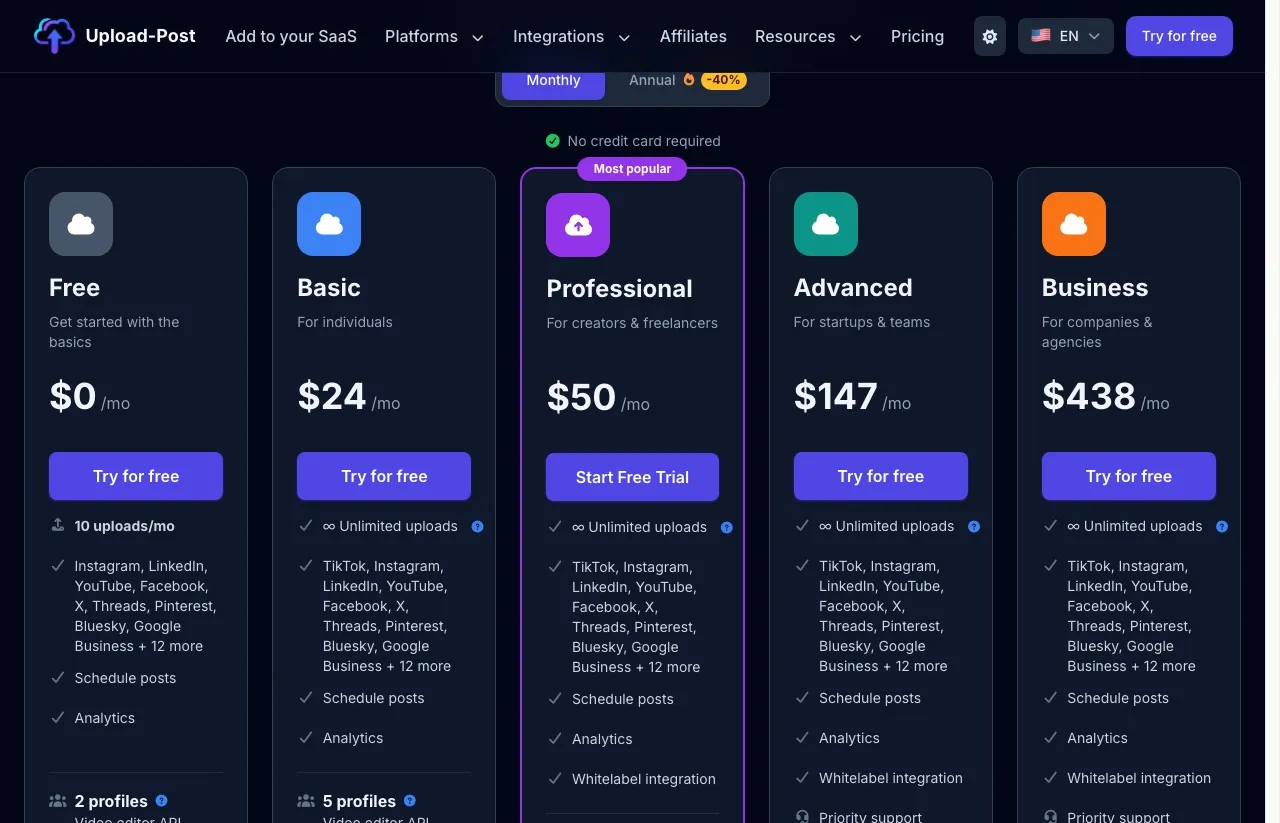
The free tier is genuine, with no credit card, but read its shape before you plan around it. It is 10 uploads a month across 9 networks and excludes TikTok, which is the platform most people are prototyping against.
Its reach is the widest thing in this category. I counted the list by hand and got 22 destinations, with the interesting ones sitting past the usual set. Mastodon, Nostr and Lemmy reach the fediverse, while Dev.to, Hashnode and WordPress reach written publishing. Google Business Profile, Discord, Telegram, Slack, Whop and Listmonk fill out the rest.
Same Workload, Two Bills
Here is the comparison done in the unit that matters, which is the job rather than the vendor’s word for it.
| Your workload | Zernio accounts | Zernio | Upload-Post tier | Upload-Post |
|---|---|---|---|---|
| 1 brand, 3 platforms | 3 | $6 | Free* | $0 |
| 1 brand, 9 platforms | 9 | $42 | Free* | $0 |
| 3 brands, 5 platforms | 15 | $63 | Basic | $24 |
| 5 brands, 9 platforms | 45 | $153 | Basic | $24 |
| 10 brands, 5 platforms | 50 | $168 | Professional | $50 |
| 25 brands, 9 platforms | 225 | $443 | Professional | $50 |
| 50 brands, 5 platforms | 250 | $468 | Advanced | $147 |
*The Free tier caps at 10 uploads a month and excludes TikTok, so treat those two rows as a prototype price rather than a production one. Basic at $24 is the first row that publishes without a ceiling.
Upload-Post wins every one of those rows, and the gap widens as platforms multiply. That is not a knock on Zernio’s pricing. It is what happens when you multiply a per-unit meter by a platform count that the other vendor gives away.
Now take the opposite workload, where the accounts pile onto one platform rather than spreading across many. Stacking 30 Instagram accounts is 30 Zernio accounts and 30 Upload-Post profiles, so the units finally line up and the comparison becomes a real one.
Read that way, both are free at one and two accounts, then Zernio leads through ten. After that the lead changes hands five times: Upload-Post from 11, Zernio again from 26, Upload-Post from 44, Zernio again from 76, and Upload-Post from 221. They tie exactly at 43 and again at 220.
Both readings are arithmetically correct. They answer different questions, and which one is yours depends on how your accounts spread across platforms. If each brand publishes to several platforms, the first table is yours and Upload-Post is cheaper. If your accounts concentrate on one or two platforms, the crossovers are yours and Zernio wins several of those bands outright. Count both numbers before you read either table.
Where the Rate Cards Disagree With Themselves
Both vendors contradict themselves on their own surfaces, and both conflicts are live as I write this. Neither is a gotcha. They are just places where you should trust one surface over another.
Zernio’s pricing page states the bands as “3-10 accounts at $6” in its table and its calculator, then its own FAQ further down the same page says “$6/account for 1-10.” Those cannot both be true, since the first two accounts are free. The calculator is authoritative: it renders “2 accounts free” and “8 accounts x $6” for a $48 total at ten accounts.
Upload-Post disagrees with itself on its agent tool count, in four places. Its machine-readable guide at llms-full.txt says the MCP server exposes 40 tools, its rendered MCP page says 50, its GitHub README says 58, and the published package listed 57 when I ran it. The vendor has not picked one, so count on a range of 40 to 58 and verify against your own client when you connect.
What Each One Gives an Agent
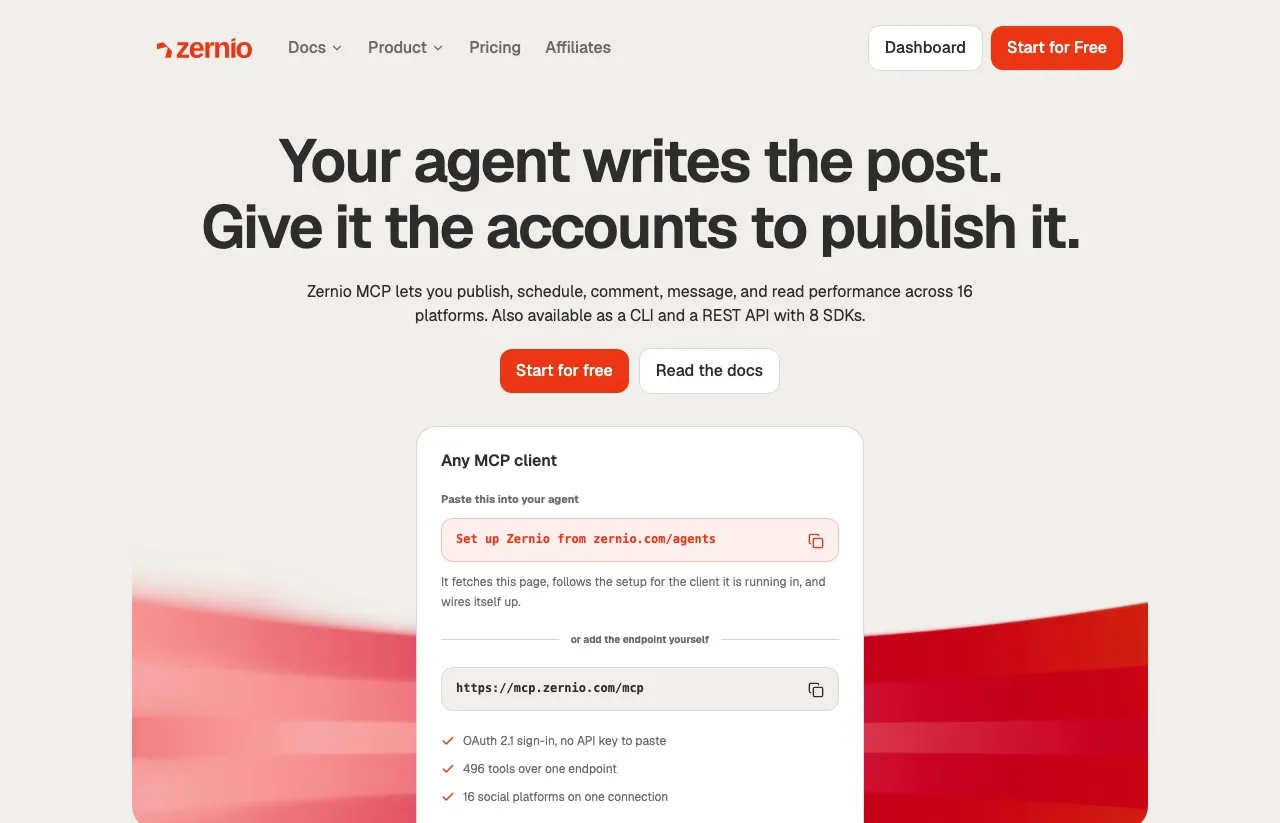
Both ship hosted MCP servers, and I probed both endpoints directly. mcp.zernio.com/mcp and mcp.upload-post.com/mcp each returned a 401, so both endpoints are live and demanding credentials rather than missing.
Zernio exposes 496 tools over that one endpoint, with roughly 50 visible by default and the rest discovered on demand through a search tool. That design exists because 496 tool definitions would swamp most agent clients if loaded at once, a constraint its API documentation spells out.
Upload-Post’s server is MIT licensed and open source, and it also offers a local stdio option via npx @upload-post/mcp alongside the hosted endpoint. If you want to read the server’s source before you point an agent at it, that option only exists on one side of this comparison.

The tool-count gap looks decisive and mostly is not. More tools means more of the API is reachable from an agent, not that any single job is easier. Zernio’s number is large because it generates roughly one tool per API endpoint across a much wider product that includes ads, messaging and blogs.
Reach Past the Usual Nine Networks
This is Upload-Post’s clearest win and it deserves stating plainly rather than hedging inside a table cell.
If your build needs Mastodon, Nostr or Lemmy, Upload-Post is the only one of the two that reaches them. If it needs Dev.to, Hashnode or WordPress, same answer. Zernio covers WordPress and Shopify through a separate Blogs API where each connected site counts as an account, but it does not reach the fediverse at all.
Zernio answers with depth rather than breadth: an ads surface across 7 or 8 networks depending which of its pages you read, WhatsApp and Telegram messaging, Google Business reviews, and an inbox that reads and replies. Those are product surfaces Upload-Post does not sell.
The X Link Charge Neither Page Leads With
X now bills per API call, and a post containing a URL costs $0.200 against $0.015 for a plain one under X’s published pricing. I broke the full rate card down in the X API pricing guide. Both vendors handle that charge, and they handle it differently.
Upload-Post strips URLs from X posts by default so they bill at the cheaper rate, and sells links back as a $19 a month add-on capped at 50 link-posts. Zernio passes X’s rates through at cost with zero markup, so links cost what X charges and nothing more.
If you drive traffic from X, that cap is a real ceiling written into a plan that never mentions it on the tier card. Fifty link-posts is under two a day. Past that you are either paying Zernio’s pass-through or not posting links.
Where Blotato Fits Against Both
Blotato bills on a third unit again, which is the honest reason to mention it here rather than a reason to pick it. It is $29 a month flat for 20 connected accounts, so neither your platform count nor your account count moves the bill until you cross 20.
Be careful reading us against that table, because the cap decides it before the price does. Four of those seven workloads need more than 20 accounts, so they are not Blotato jobs at Starter at all. Of the three that fit, we are the most expensive on every one: $29 against $6 and $0 at three accounts, $29 against $42 and $0 at nine, $29 against $63 and $24 at fifteen. Only the middle row has us beating anyone.
Our limits are narrower than both on reach, and you should weigh them before you take any of this as a pitch. Blotato publishes to 9 platforms against Zernio’s 16 and Upload-Post’s 22, so if the fediverse, Discord or a developer blog is on your list, we do not reach it at any price. Analytics covers 8 of those 9, with LinkedIn returning no metrics yet, and comments and DMs are Instagram and Facebook only.
Our 7-day trial also excludes the API, so if you are evaluating specifically to drive an agent, plan on starting the subscription rather than trialing it.
What we do have is 36 named MCP tools covering publish, schedule, analytics, comments, DMs and DM automations behind one key, and a bill that does not move when a post goes viral.
Pick Zernio When Accounts Stay Few
- You run under 10 connected accounts and want the first two free
- You need an engagement inbox that reads and replies across 8 messaging platforms
- Ads matter, and you want Meta, TikTok, X, LinkedIn, Pinterest and Google ads in the same API
- You want WhatsApp or Telegram alongside social publishing
- You post links to X often enough that a 50-post cap would bind
Pick Upload-Post When Platforms Multiply
- You publish one brand, or a few, to many platforms at once
- Your list includes Mastodon, Nostr, Lemmy, Dev.to or Hashnode
- You want to read the MCP server’s source, or run it locally
- You want to prototype free before paying anyone, and TikTok is not in the prototype
- Your account count grows by platform rather than by brand
Count Your Unit Before You Price It
If I were choosing between these two, I would not start on either pricing page. I would count how my own workload decomposes: brands times platforms.
If that multiplication is large, meaning few brands across many platforms, Upload-Post is cheaper and it is not close. If it stays small and flat, meaning many accounts on a few platforms, Zernio’s graduated meter and its wider product surface earn the money.
Both are honest products with real documentation and live agent endpoints. The comparison only goes wrong when someone puts their two headline prices side by side, which is exactly what the pages invite you to do.
Zernio vs Upload-Post FAQs
Is Zernio or Upload-Post cheaper?
It depends on whether your bill grows by account or by platform. Zernio charges per connected social account, graduated, with the first 2 free and accounts 3 to 10 at $6 each, while Upload-Post sells fixed tiers where one profile covers one account on every platform. One brand on 9 platforms is $42 at Zernio, or free at Upload-Post if 10 uploads a month without TikTok covers you, and $24 if it does not. Many accounts on few platforms reverses that in several bands.
How many platforms does each one support?
Upload-Post publishes to 22 destinations, including Mastodon, Nostr, Lemmy, Dev.to, Hashnode, WordPress and Google Business Profile. Zernio publishes to 16 and adds an ads surface alongside them. Upload-Post is the wider publishing reach. Zernio is the deeper product across ads, messaging and inbox.
Do Zernio and Upload-Post both have MCP servers?
Yes, and both are hosted. I probed mcp.zernio.com/mcp and mcp.upload-post.com/mcp, and both returned a 401, so both are live and demanding credentials rather than missing. Zernio exposes 496 tools with about 50 visible by default, while Upload-Post’s is open source under MIT and also runs locally via npx @upload-post/mcp. MCP is common enough across this category now that it is not a reason to pick either one.
Does Upload-Post really charge extra to post links on X?
Yes. X bills $0.200 for a post containing a URL against $0.015 for a plain post, so Upload-Post strips URLs from X posts by default and sells links back as a $19 a month add-on capped at 50 link-posts. Zernio passes X’s charges through at cost with no markup instead. If X link posts are central to your build, price that cap before you commit.
Does either one have a free plan?
Both do, with different shapes. Zernio makes your first 2 connected accounts free with no credit card, and every feature is included on them. Upload-Post’s free tier is 10 uploads a month across 9 networks and excludes TikTok. Blotato has no permanent free tier, just a 7-day trial that excludes API access.
Which one is better for an agency managing client accounts?
Count the clients and their platforms first. An agency running 25 clients on 9 platforms each is 225 accounts at Zernio, which is $443 a month, against Upload-Post Professional at $50 covering 25 profiles. That gap is large enough that the decision is usually made before any feature comparison starts, unless you need Zernio’s inbox or ads.