6 Best Loomly Alternatives That Cost Less Than $65 a Month (2026)
The best Loomly alternatives in 2026, compared on the jump from $65 to $332, account limits, and automation access. Tested by Sabrina Ramonov.

Add one social account to Loomly and your bill can go from $65 a month to $332. That is the entire story behind the surge in searches for Loomly alternatives, because Starter covers 12 accounts, the next self-serve tier covers 60, and Loomly sells nothing in between. A two-person shop that signs a third client pays roughly five times more for software that does exactly what it did yesterday. I’m the founder of Blotato, my top pick below, so weigh that entry accordingly and judge it on the math.
Quick Comparison: 6 Best Loomly Alternatives
| Tool | Best For | Starting Price | Key Strength |
|---|---|---|---|
| Blotato | Solo creators and small teams who want AI creation bundled with publishing | $29/mo flat | 20 accounts at one flat price, plus a hosted MCP server agents can drive |
| Publer | People who want to pay only for the accounts they actually connect | $5/mo first account, $4 each after | Modular per-account pricing with a genuinely usable free plan |
| Metricool | Creators who care more about analytics than approval chains | $25/mo | Deep reporting and competitor tracking, with MCP on every plan including Free |
| SocialBee | Small businesses that run evergreen content categories | $29/mo | Category-based recycling that keeps a queue full without daily input |
| Planable | Teams that stayed with Loomly purely for the approval workflow | $33/mo per workspace | The closest match to Loomly’s collaboration and client-approval model |
| Sendible | Agencies managing many client brands in separate workspaces | $35/mo | Workspace-per-client structure with unlimited users on every tier |
Planable sits fifth on price but first on one specific job. If approvals are the only reason you are still paying Loomly, skip to that entry. Everyone else should start at the top, where the account math is the most forgiving.
Automation access at a glance
For anyone automating part of their content process, this is the table that decides the shortlist. Loomly is a closed product: it has no public API and no MCP server, so an agent can only reach it through a Zapier trigger, never drive it directly.
| Tool | Public API | MCP server | AI content generation | Free plan |
|---|---|---|---|---|
| Loomly | No | No | Writing and post ideas | No, free trial only |
| Blotato | Yes | Hosted (mcp.blotato.com/mcp), 36 tools | Writing, image, video | No, 7-day trial |
| Publer | Yes, on Business | No official server | Writing | Yes, 3 accounts |
| Metricool | Yes | Yes (ai.metricool.com/mcp) | Writing | Yes, 1 brand |
| SocialBee | Yes | No official server | Writing | No, 14-day trial |
| Planable | Yes, from Pro | Yes (mcp.planable.io/mcp) | Writing | No, 50 free posts |
| Sendible | Yes | No official server | Writing | No, 14-day trial |
An MCP server is no longer a rare feature. Metricool and Planable both ship one, and so do Buffer, Hootsuite, and Agorapulse, though Buffer’s and Agorapulse’s are still in beta. What still varies is whether it costs extra and whether the bill moves when your volume does. If you want to see how the plans compare before reading further, you can check the pricing in a couple of minutes.
Why People Are Looking for Loomly Alternatives
Loomly has a genuinely good reputation as a product. It holds 4.6 out of 5 on G2 across roughly 1,800 reviews and 4.7 on Capterra across more than 500. Users like the calendar, the custom posting slots, and the approval workflows. People are not abandoning it over the software.
What changed was the commercial relationship. In January 2025, Loomly was acquired by Bending Spoons, the company behind Evernote, Meetup, and WeTransfer, a deal confirmed by the law firm that advised on it. What followed was a restructure. Loomly now sells exactly two self-serve plans plus an Enterprise tier you have to call about, and the graduated middle of the pricing table, where most small agencies used to live, is gone.
The result is a cliff rather than a curve. At 12 accounts you pay $65 a month. At 13 you pay $332, because the only way to buy a thirteenth account is to buy capacity for sixty. That gap explains the split in Loomly’s own review scores: 4.6 on G2 for the product, but 1.7 out of 5 on Trustpilot, where reviews focus on billing and support rather than features.
The third reason is quieter and matters most if you automate anything. Loomly has no public API and no MCP server. Its automation story is a Zapier connection, which is fine for simple triggers and useless if you want an agent to draft, review, and publish. If you are building any part of your content process with Claude or n8n, Loomly is a dead end regardless of what it costs.
Best Loomly Alternatives for 2026
I kept this list to six tools that a Loomly user would genuinely consider, ranked by how much of the pricing cliff they remove without giving up the parts of Loomly that people actually like.
1. Blotato: Best for solo creators and small teams who want AI creation bundled with publishing

Blotato’s homepage: one flat plan that writes, designs, and publishes across 9 platforms.
I built Blotato because I was tired of paying per seat and per account for tools that only handled the last step of the job. Where Loomly charges $65 for 12 accounts and then jumps to $332, Blotato’s Starter plan is $29 a month for 20 accounts, and the caption, image, or faceless video gets created in the same place it gets published. Plenty of tools ship an MCP server now, as the table above shows, so the part that matters is what sits behind it. Blotato’s is hosted at mcp.blotato.com/mcp on a flat plan, which means an agent can run the drafting and the publishing in one automated pipeline and the bill does not move when your volume does. I use it every day for my own content.
Honest limitation: Blotato has no client-approval chain. If your team routes every post through a named reviewer before it publishes, Planable below is built for that and Blotato is not.
Pricing: Loomly’s problem is the step, not the seat. Starter covers 12 social accounts at $65 a month, and the next tier up is $332, so outgrowing 12 accounts means a jump of more than five times. The ladder here is shorter: 20 accounts at $29, 40 at $97, 100 at $499. Card required for the 7-day trial, cancel anytime, and note the trial locks out the API, so an API or MCP build should start on a paid plan instead.
Ideal for: Solo creators and small teams who want 10 to 20 accounts covered at a predictable price, with the content itself generated rather than just scheduled.
Bottom line: There is one question that decides this. Were you paying Loomly for the calendar or for the sign-off? If it was the sign-off, nothing here fixes that, because Blotato has no required-approval step and is not trying to have one. If it was the calendar and the cliff from $65 to $332 is what broke it, 20 accounts at $29 with the content generated in the same place is the math that fixes it. Start a free trial if the account math is your problem.
2. Publer: Best for people who want to pay only for the accounts they actually connect
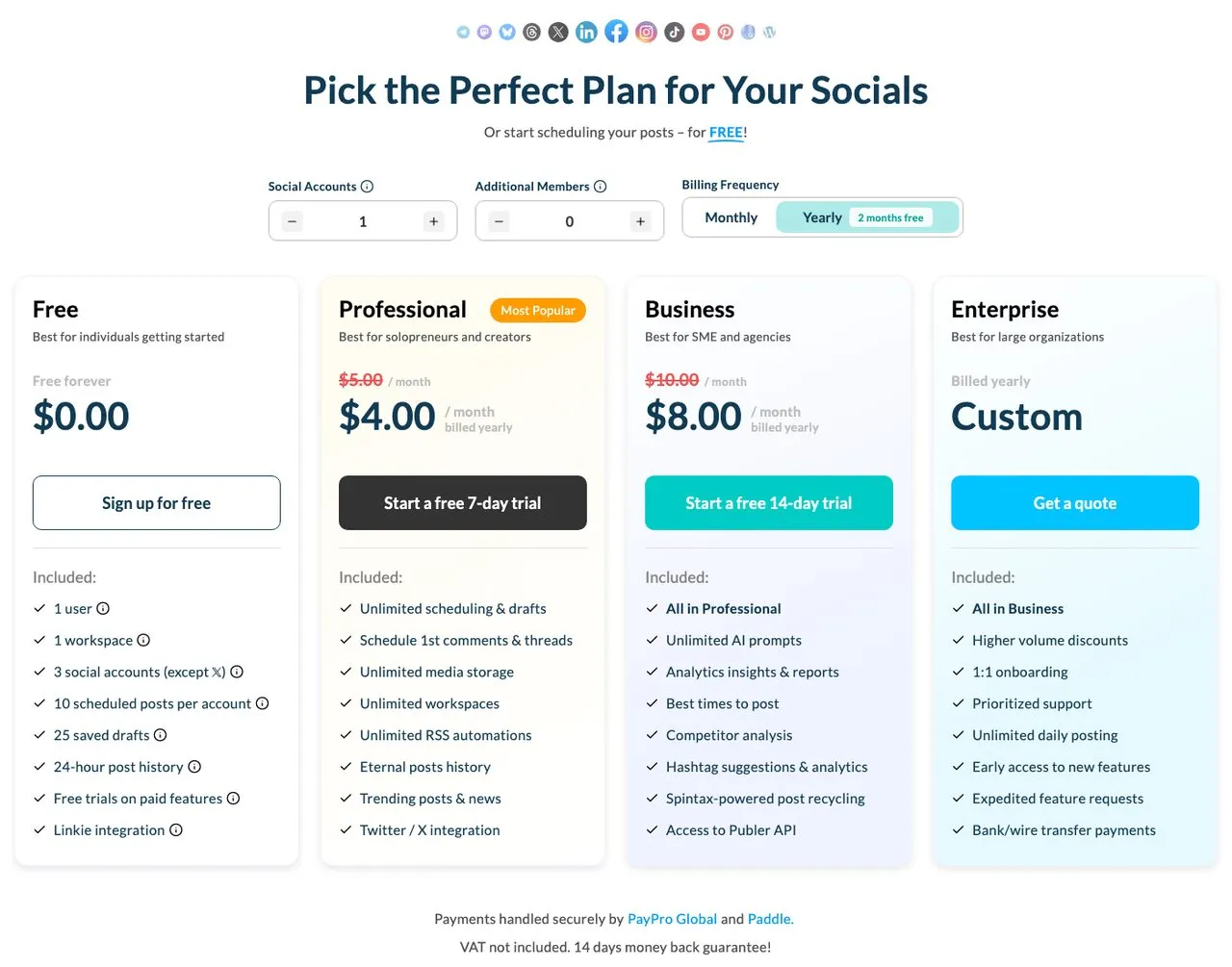
Publer prices per social account, so the bill scales one connection at a time.
Publer solves the Loomly cliff in the most literal way available: it removes tiers almost entirely. Professional is $5 for one account and $9 for two, and from the third the whole plan bills at $4 an account, so thirteen accounts on Professional runs $48 a month rather than triggering a $332 plan. Publer also makes every tenth account free. The free plan is unusually functional too, covering 3 accounts with 10 scheduled posts each. The trade-off is that per-account pricing stops being a bargain at scale, team members cost extra on top ($2 each on Professional, $3 on Business), and API access sits on the Business tier rather than the entry plan.
Pros:
- Pricing scales one account at a time with no cliff
- Free plan covers 3 accounts without a card
- Strong bulk scheduling and post recycling
Cons:
- Costs more than flat-rate plans once you pass roughly 8 accounts
- API access requires the Business tier
- MCP server limited to a beta group rather than generally available
Pricing: Free plan available (3 accounts). Professional $5/mo for one account, $9 for two, then $4 per account from the third (+$2 per team member). Business $10, then $17, then $7 per account (+$3 per member). Every tenth account is free. Enterprise by quote.
Ideal for: Anyone whose account count sits awkwardly just past a competitor’s tier limit.
Bottom line: The cleanest escape from tier cliffs, as long as your account count stays modest. I broke down where the per-account math stops working in Blotato vs Publer.
3. Metricool: Best for creators who care more about analytics than approval chains
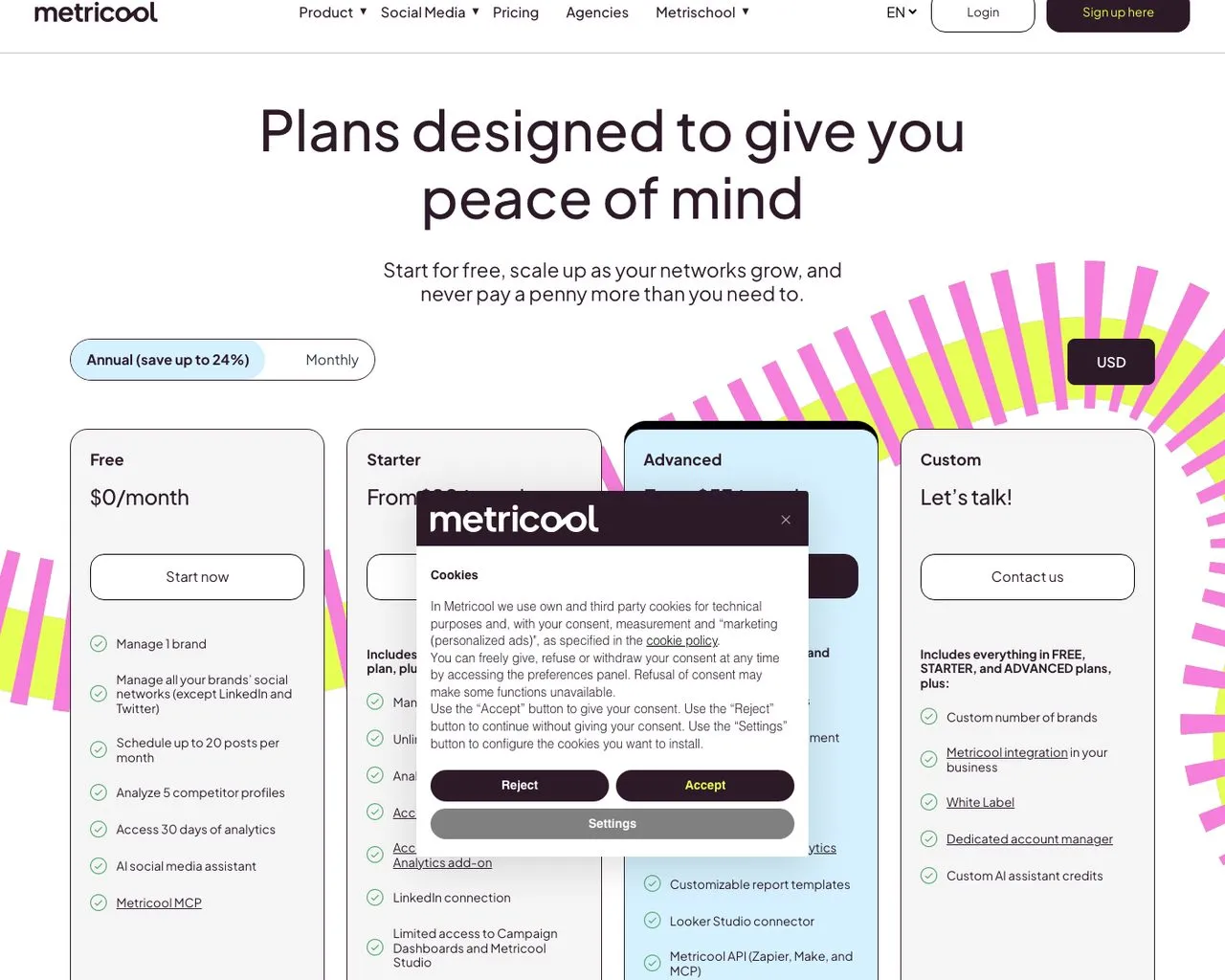
Metricool prices by brand rather than by seat, and includes competitor tracking.
Metricool is the pick if the reporting side of Loomly was what you valued. It goes deeper on analytics than anything else at this price, including competitor tracking and best-time-to-post modeling, and its free plan covers one brand with 20 scheduled posts a month. It also ships an MCP server that works on every plan including Free, which almost no competitor does, though its HTTP API is a separate product gated to Advanced. That split, and what it costs, is broken down in our comparison of Metricool alternatives. Scheduling is competent rather than remarkable, and the interface leans dense because it is showing you more data.
Pros:
- Best-in-class analytics and competitor tracking for the price
- MCP server available on every plan, including the free one
- Genuine free tier with no time limit
Cons:
- Publishing tools are thinner than dedicated schedulers
- Interface is dense and takes longer to learn
- Approval workflows only arrive on the Advanced plan
Pricing: Free plan (1 brand). In USD, Starter starts at $25/mo billed monthly or $20/mo billed yearly, and Advanced starts at $67/mo monthly or $53/mo yearly. Both scale with brand count (Starter covers up to 10 brands, Advanced up to 50), so price the tier against the number of brands you actually run. Custom by quote.
Ideal for: Creators and small teams who want to know what worked, not just what shipped.
Bottom line: Take it for the reporting, and accept that the calendar is a supporting feature. The full feature-by-feature comparison goes deeper if analytics is your deciding factor.
4. SocialBee: Best for small businesses that run evergreen content categories
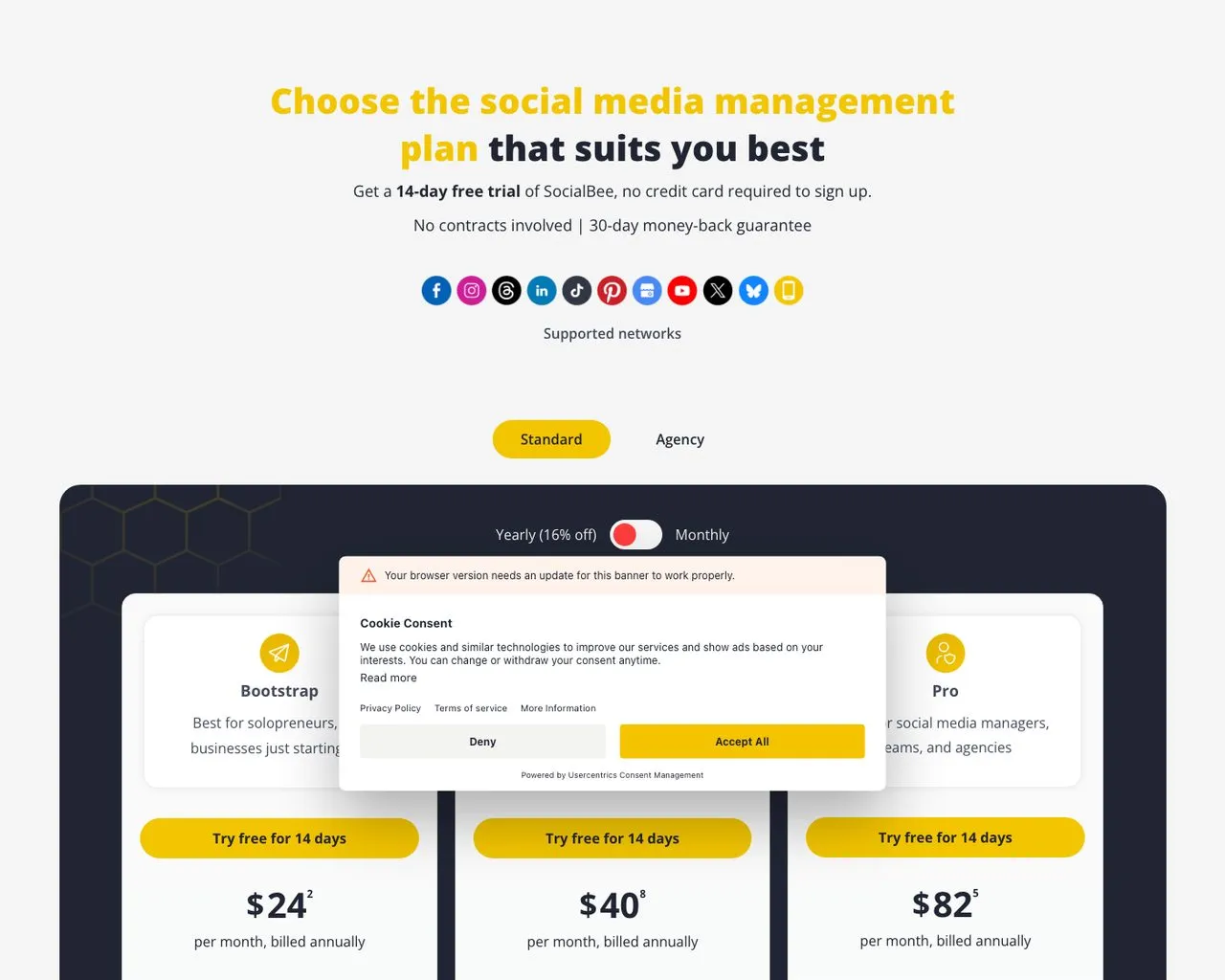
SocialBee organizes posts into categories that recycle on a schedule.
SocialBee is built around a different idea than Loomly. Instead of filling a calendar post by post, you sort content into categories and let each category recycle on its own cadence, which keeps a queue alive with far less weekly input. That suits a small business posting evergreen tips, offers, and testimonials on rotation. Its entry plan is $29 a month for 5 profiles, so it is cheaper than Loomly but not generous on account count.
Pros:
- Category-based recycling keeps queues full with minimal upkeep
- Solid AI post generation built in
- 14-day trial with no card required
Cons:
- Only 5 profiles on the entry plan
- One user per workspace until the Pro tier
- MCP server limited to a beta group rather than generally available
Pricing: Bootstrap $29/mo (5 profiles, 1 user), Accelerate $49/mo (10 profiles), Pro $99/mo (25 profiles, 3 users). Roughly 17% off billed annually. 14-day free trial, no card required.
Ideal for: Small businesses with a library of evergreen posts and no time to schedule weekly.
Bottom line: The best answer to “I need the calendar to stay full without me touching it.” I put its recycling model head to head with ours in Blotato vs SocialBee.
5. Planable: Best for teams that stayed with Loomly purely for the approval workflow
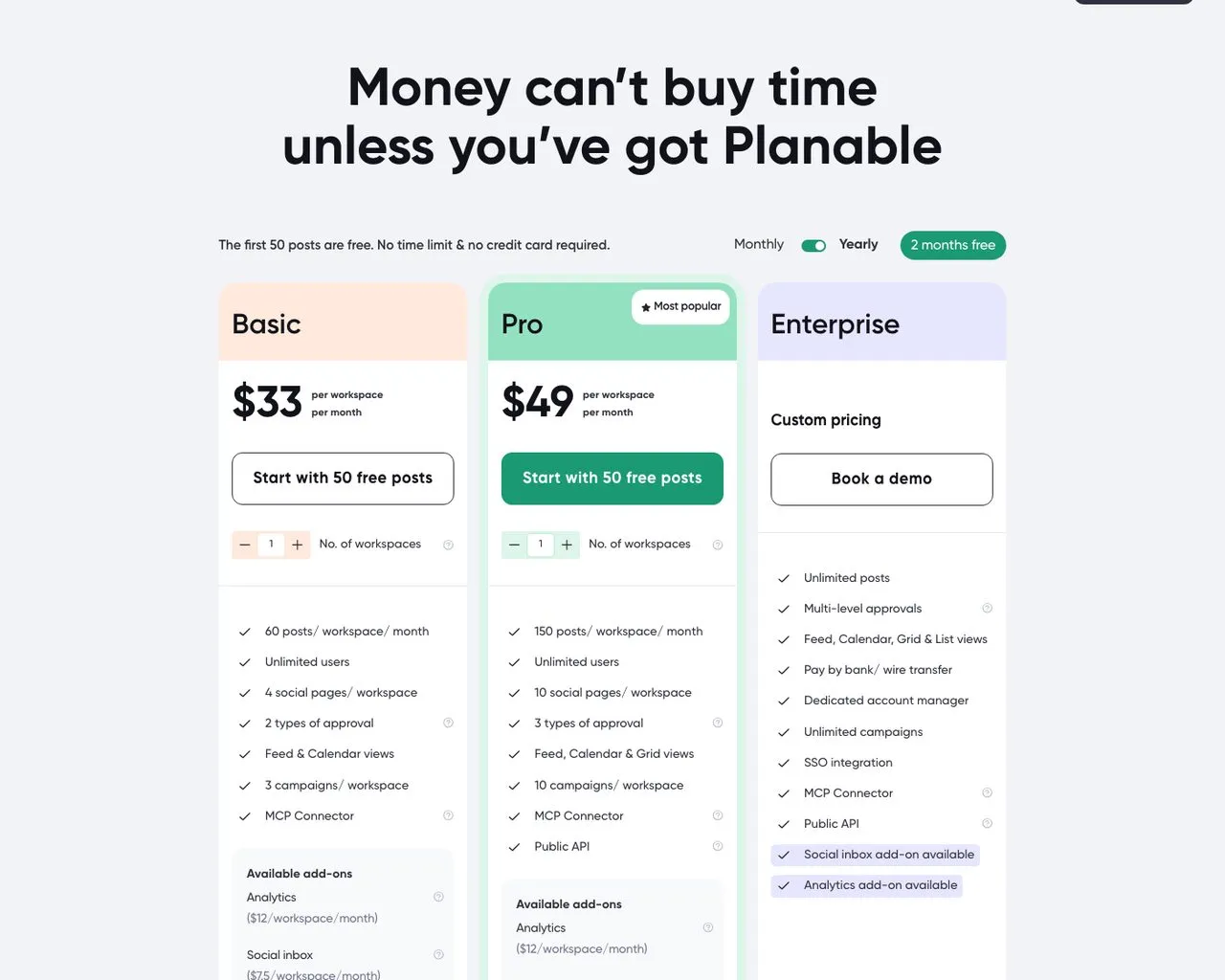
Planable prices per workspace with unlimited users, and lists an MCP connector on every tier.
If the only thing keeping you on Loomly is that clients sign off inside it, Planable is the closest replacement. It is built around approvals: posts render exactly as they will appear, feedback threads sit against each one, and users are unlimited on every plan, so adding a reviewing client costs nothing. Read the tier detail carefully though. Basic is $33 per workspace for 4 social pages and only offers optional approvals. Required approval, the kind most agencies actually need, starts on Pro at $49.
Pros:
- Unlimited users on every plan, so reviewers are free
- Pixel-accurate previews with threaded feedback
- MCP connector listed on all tiers, public API from Pro
Cons:
- Required approval workflows need the Pro tier
- Only 4 social pages on Basic
- Analytics and social inbox are paid add-ons
Pricing: Basic $33/mo per workspace (4 social pages), Pro $49/mo per workspace (10 social pages), Enterprise custom. Analytics add-on $12/workspace/mo, social inbox $7.50/workspace/mo. First 50 posts free with no card and no time limit. The MCP connector is included on every paid plan; it is the public API that starts on Pro.
Ideal for: Agencies and in-house teams where a human has to approve every post before it goes out.
Bottom line: The only tool here that beats Loomly at its own best feature, provided you budget for Pro. There is a fuller breakdown of how its approval chain works in Blotato vs Planable.
6. Sendible: Best for agencies managing many client brands in separate workspaces
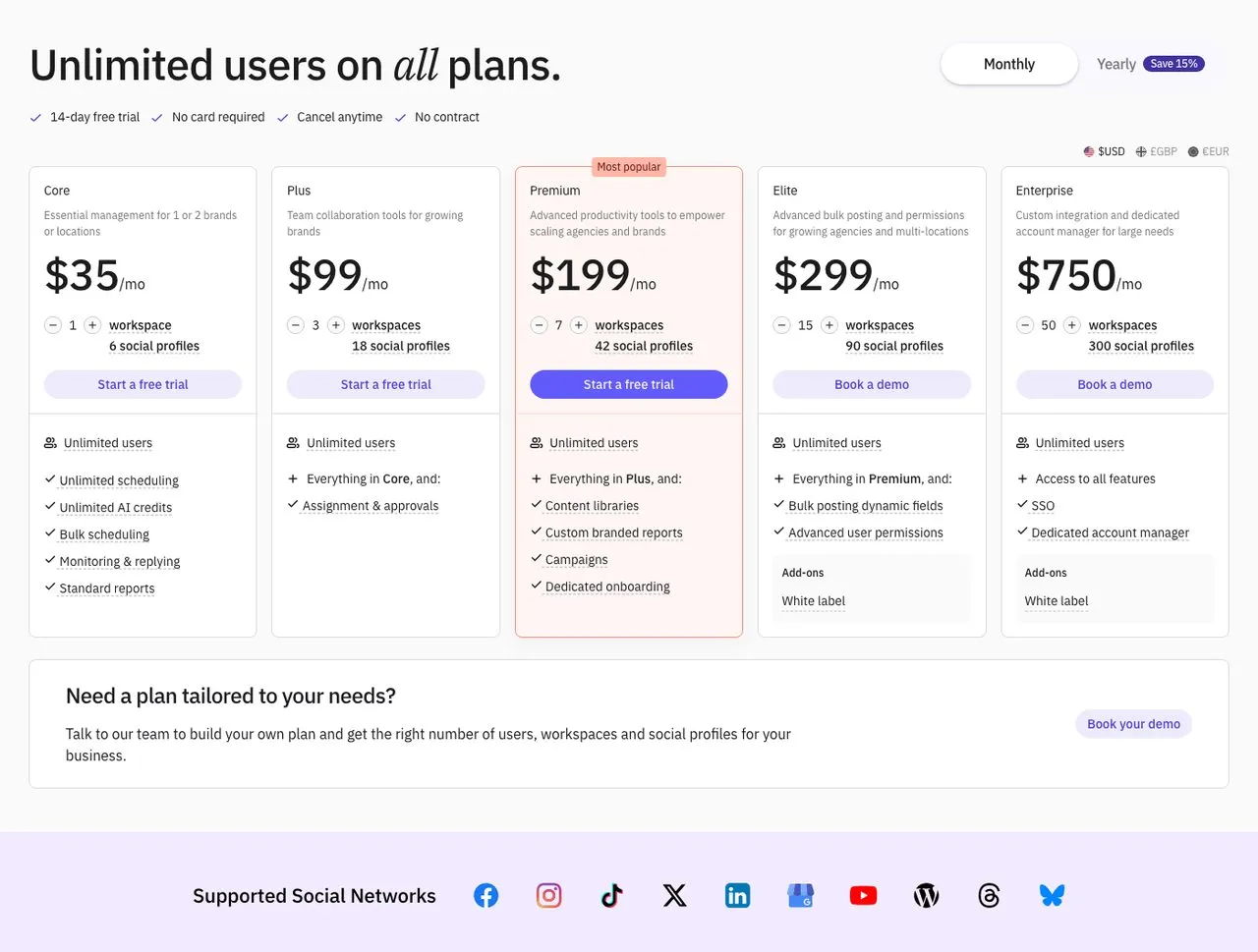
Sendible structures pricing around workspaces, with unlimited users on every plan.
Sendible is aimed squarely at the agency that outgrew Loomly Starter but refuses to pay $332. Core is $35 a month for 1 workspace and 6 social profiles, and every tier includes unlimited users, which matters when a client wants a login. The workspace model keeps each brand cleanly separated with its own approvals and reports. It is more expensive per profile than Publer, and how much more depends on where you sit in a block of six, but the workspace separation is worth that premium when clients are involved.
Pros:
- Unlimited users on every tier
- Clean separation of client brands into workspaces
- Strong white-label reporting options
Cons:
- Profile counts are modest relative to price
- White labeling is a paid add-on rather than included
- MCP server limited to a beta group rather than generally available
Pricing: Core $35/mo (1 workspace, 6 profiles), Plus $99/mo (3 workspaces, 18 profiles), Premium $199/mo (7 workspaces, 42 profiles), Elite $299/mo, Enterprise $750/mo. About 15% off billed yearly. 14-day trial, no card required.
Ideal for: Agencies running several client brands that need to stay separate.
Bottom line: A structural fit for client work, priced well under Loomly Beyond. If it makes your shortlist, other tools in its class are worth a look before you commit.
How I Chose These Loomly Alternatives
I evaluated each tool on five things a departing Loomly user actually cares about:
- Where the price cliff sits, meaning what happens to your bill when you add one more account
- Accounts included at the entry tier, since that is where most people land
- Whether approvals survive the move, because that is Loomly’s strongest feature
- Automation access, meaning a real API or MCP server rather than a Zapier trigger
- Whether AI creation is included or bolted on as another subscription
Pricing was verified on each tool’s own pricing page on the day this was published, and the strengths and gaps draw on G2, Capterra, and Trustpilot review patterns alongside my own testing. Where a feature sits on a higher tier than the entry price implies, I said so in the entry rather than in a footnote.
How to Choose the Right Loomly Alternative
If your account count just crossed 12 and the $332 tier is the whole problem, look at Blotato at $29 for 20 accounts or Publer at $5 for the first account and $4 for each one after. Both remove the cliff, in opposite ways.
If clients approve every post before it publishes, go to Planable and budget for the $49 Pro tier, because Basic does not include required approvals.
If you manage several distinct client brands, Sendible’s workspace model maps to how you already work, and the wider field is covered in my roundup of social media tools for agencies.
If reporting is the reason you log in, Metricool gives you more analysis per dollar than anything else on this list.
If you want an agent or automation to do the posting, your options narrow fast. Loomly has no API at all, so anything is an upgrade, but Blotato, Metricool, and Planable are the three here with a hosted MCP server an agent can actually call.
Sabrina’s Final Thoughts
Almost nobody leaves Loomly because the calendar stopped working. They leave because a two-tier pricing table turned a $65 tool into a $332 tool overnight, and because a closed product with no API cannot be automated no matter how good its interface is. Pick the replacement that matches which of those hurt more. If it was the bill, start with the flat-rate options and count your accounts honestly. If it was the approval chain, rule Blotato out first, because I never built a required sign-off step into it. And if you want the content created and published in the same place, Blotato’s trial will tell you in a week whether that changes your workflow.
Loomly Alternatives FAQs
What is the best Loomly alternative?
It depends on why you are leaving. For most solo creators and small teams the answer is Blotato, at $29 a month for 20 social accounts with AI writing and video generation included. If you left specifically because of client approvals, Planable is the closer match. If you only need a handful of accounts, Publer is the cheapest route, at $5 for the first social account and $4 for each additional one.
Why did Loomly get so expensive?
Loomly was acquired by Bending Spoons in January 2025 and its pricing was later restructured down to two self-serve plans. Starter is $65 a month for 12 social accounts and the next tier, Beyond, is $332 a month for 60. Because nothing sits between them, adding a thirteenth account multiplies the bill roughly fivefold.
Is there a free Loomly alternative?
Yes. Publer’s free plan covers 3 social accounts with 10 scheduled posts each, though it excludes X and drops published-post history after 24 hours. Metricool’s free plan covers 1 brand with 20 posts a month and includes MCP access. Planable does not have a recurring free tier but gives you the first 50 posts free with no credit card and no time limit.
Does Loomly have an API?
No. Loomly does not publish a public API and does not offer an MCP server, so it cannot be driven by an external script or an AI agent. Its automation is limited to a Zapier integration. If programmatic publishing matters to you, Blotato, Metricool, and Planable all expose an API and a hosted MCP endpoint.
Which Loomly alternative is best for agencies?
Sendible and Planable are the two built for client work. Sendible separates each client into its own workspace with unlimited users from $35 a month. Planable gives reviewers free seats from $33 per workspace, though required approvals start on its $49 Pro tier. Both cost far less than Loomly’s $332 Beyond plan for comparable multi-client work.