7 Best Mixpost Alternatives When You Stop Self-Hosting (2026)
The best Mixpost alternatives for social media publishing in 2026, compared on hosting upkeep, API access, and real cost. Tested by Sabrina Ramonov.

Most people searching for Mixpost alternatives in 2026 are not unhappy with the software. They are tired of being the person who gets paged when Instagram changes an endpoint and the queue silently stops. Blotato is my pick and I built it, so discount that as you see fit. Mixpost is a legitimately good product, and the thing you are actually evaluating is not features but who carries the pager.
The second thing worth checking before you renew: which edition your API access lives in.
Quick Comparison: 7 Best Mixpost Alternatives
| Tool | Best For | Starting Price | Key Strength |
|---|---|---|---|
| Blotato | Teams who want the API without running a server | $29/mo | Hosted MCP and API with no infrastructure to maintain |
| Postiz | Anyone who wants self-hosting to stay optional | Free self-hosted, or $29/mo | Identical product hosted or on your own server |
| Upload-Post | Replacing a license with the smallest possible bill | Free, then $24/mo | Unlimited uploads and an API on the free tier |
| Zernio | Operators who liked Mixpost's unlimited accounts | Free, then $6 per account/mo | No account ceiling and no feature gates |
| Buffer | Small operators who want zero operational work | Free, then $6 per channel/mo ($5 annual) | Free plan with an API key at 3,000 requests a month |
| Vista Social | Agencies who self-hosted for multi-client control | $79/mo | 15 client profiles and a deep MCP server on Advanced |
| Ayrshare | Products publishing for their own customers | $149/mo | Multi-tenant billing by profile instead of by seat |
Why People Are Looking for Mixpost Alternatives
The honest reason is operational, not financial. Mixpost is self-hosted only, so you provision the VPS, run the Docker container or the Laravel package, handle upgrades, and fix the queue when a platform deprecates something. The cost of that work is not steady. It is nothing for three months and then an urgent evening, usually at the worst possible time, and it lands on whoever is technical enough to understand the stack.
That is a fair trade if you have server ops capacity. It is a bad trade if you are one person with a content pipeline and no interest in becoming your own platform team.
The failure mode is worth naming precisely, because it is not the one people expect. Self-hosted publishing rarely breaks loudly. The container keeps running, the dashboard still loads, and the queue quietly stops draining because a token expired or a platform tightened a scope. You find out days later when a client asks why nothing posted. That is the real cost of owning the stack: not the hours, but the silence.
The second reason catches people mid-evaluation: the API and MCP are not in the free edition. Mixpost Lite is genuinely free and genuinely open source, but the API, MCP, webhooks, and the AI assistant all sit in the $299 Pro license. If your plan was to self-host Lite and drive it from an agent, that plan does not work without paying.
The third is scope. Mixpost publishes, schedules, and reports. It does not give your agent one key that also reaches comments, direct messages, and analytics, so a full agent workflow still means additional vendors.
It is worth being concrete about the three-year math, because it is the calculation most people do badly. Mixpost Pro is $299 once, with one year of updates and a perpetual fallback license after that. A $29/mo hosted plan is $1,044 over the same three years. So Mixpost saves roughly $745, which is real money.
Now price the other side. A small VPS capable of running the queue reliably is $10 to $20 a month, so call it $500 over three years, and the gap narrows to around $245. Then add the upgrade evenings and the incident where a platform changes an endpoint. If that costs you four hours a year at any professional rate, self-hosting is the more expensive option. If you were going to be running a server anyway and enjoy the work, it is not.
None of this makes Mixpost a poor product. If you want to own your data outright and you have the skills to run it, the one-time license is the cheapest option in this entire comparison. The question is only whether you want the job. If the answer is no and you just want the smallest hosted bill instead, the best Postoria alternatives covers the budget end without a server to maintain.
Best Mixpost Alternatives for 2026
I ordered these for someone leaving because of maintenance burden or the API gate, not for someone who wants a nicer calendar view.
1. Blotato: Best for the API without running a server

Blotato is hosted, so there is no server to patch when a platform changes.
The trade Blotato makes against Mixpost is simple: you give up owning the server and you stop owning the maintenance. The MCP server runs at mcp.blotato.com/mcp and the API is on the $29 Starter plan, with no license tier to buy first. When a platform changes an endpoint, that is my problem rather than yours, and you find out because your posts kept working.
One key reaches publishing and scheduling across 9 platforms, comments and direct messages on Instagram and Facebook, and analytics on eight networks. That breadth is the part Mixpost does not attempt.
The honest gaps: this is a subscription, so at high account counts over several years Mixpost’s one-time license is cheaper in raw dollars. Analytics does not cover LinkedIn. Comments and DMs are Meta-only. And there is no self-hosted option at all, which for some readers is a dealbreaker rather than a tradeoff.
Pricing: Starter $29/mo (20 accounts), Creator $97/mo (40 accounts), Agency $499/mo. The 7-day trial excludes the API, so plan on starting the Starter subscription if you are here for API or MCP access.
Ideal for: Builders who want agent publishing running today without provisioning anything.
Bottom line: You are paying to not be on call. If that trade appeals, the $29 plan is where to look.
2. Postiz: Best if you want self-hosting to stay optional

Postiz can be self-hosted for free or run as a hosted plan on the same codebase.
Postiz is the closest philosophical match to Mixpost and the most sensible first stop. It is open source, self-hostable for free, and unlike Mixpost it also sells a hosted version of the same product. You can start hosted and move in-house later, or the reverse, without changing tools.
Every paid tier includes the API and unlimited monthly posts, and the MCP endpoint answers at api.postiz.com/mcp on cloud plans. Tiers are channel-based, from 5 channels at $29 to 100 at $99. One caveat if you are switching to escape maintenance rather than cost: self-hosted Postiz is the same pager duty in a different colour, and the people who leave Postiz for that exact reason mostly end up choosing between the hosted options further down this page.
Pros:
- Self-host free or pay for hosting, same product
- API included on every paid tier
- Unlimited posts per month across all plans
Cons:
- Entry tier covers just 5 channels
- Self-hosting carries the same upkeep as Mixpost
Pricing: Standard $29/mo (5 channels), Team $39/mo (10), Pro $49/mo (30), Ultimate $99/mo (100). Self-hosting free.
Ideal for: Teams who want the self-hosting door to stay open without walking through it today.
Bottom line: The natural migration if you like Mixpost’s philosophy but want an exit. We put them head to head in Mixpost vs Postiz.
3. Upload-Post: Best for replacing a license with a small bill
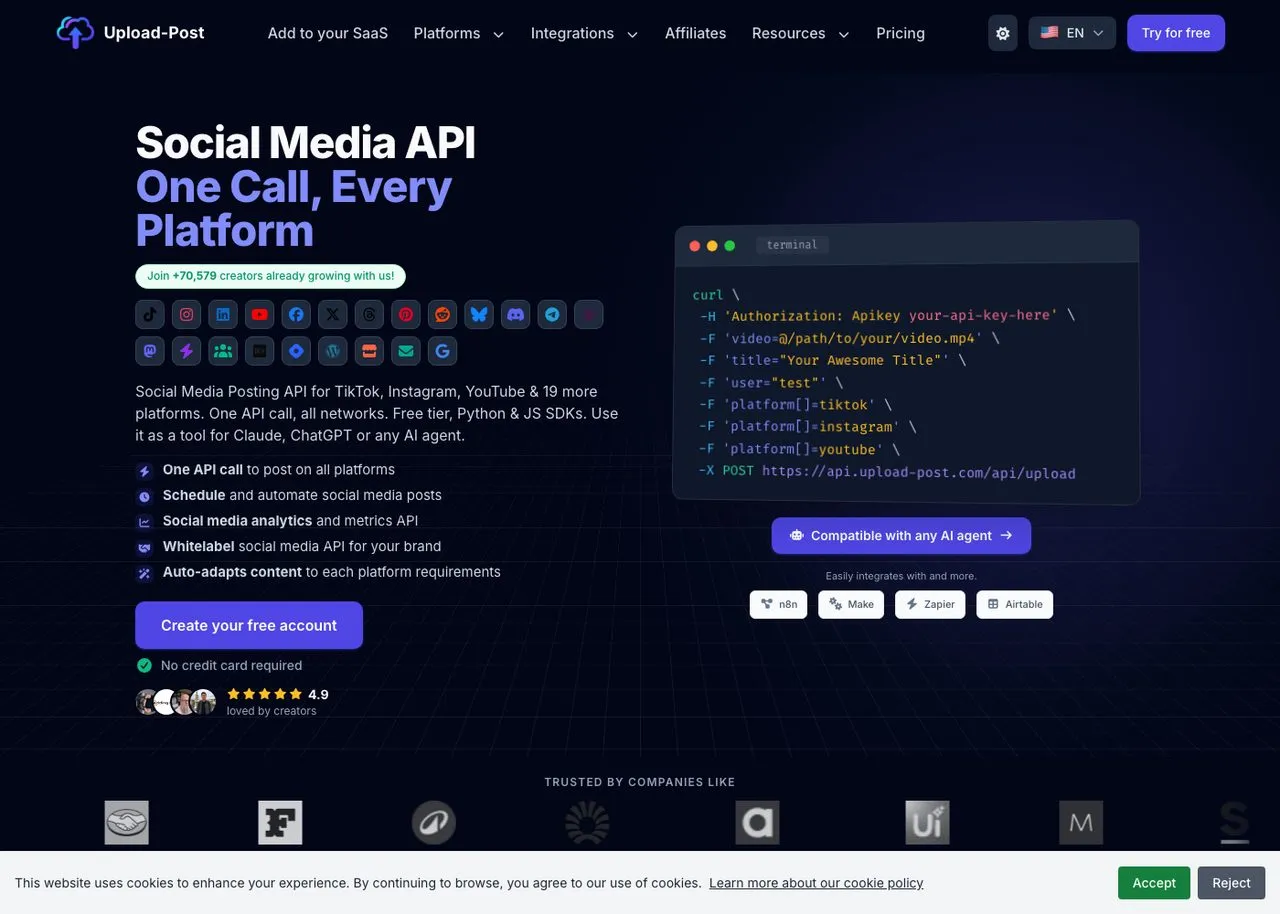
Upload-Post includes API access on its free plan and unlimited uploads on paid tiers.
Upload-Post is the cheapest hosted way to replicate what most people actually used Mixpost for: high-volume publishing without a per-post meter. Every paid plan includes unlimited uploads, and tiers are separated by profile count rather than volume.
The free plan carries 2 profiles and 10 uploads a month with no card, and the API works on it. TikTok is the one platform held back at that level. Its MCP server is MIT-licensed and open source, usable on any plan.
Pros:
- Unlimited uploads on every paid plan
- Free tier includes real API access
- MCP runs hosted or locally
Cons:
- Free plan excludes TikTok
- Profile count, not volume, becomes the constraint
Pricing: Free (2 profiles, 10 uploads/mo), Basic $24/mo (5 profiles), Professional $50/mo (25 profiles), Advanced $147/mo (75 profiles), Business $438/mo (225 profiles).
Ideal for: Former self-hosters who want the bill to stay under $50 a month.
Bottom line: Cheapest hosted escape from the maintenance job. See our Upload-Post alternatives comparison.
4. Zernio: Best if you liked unlimited accounts
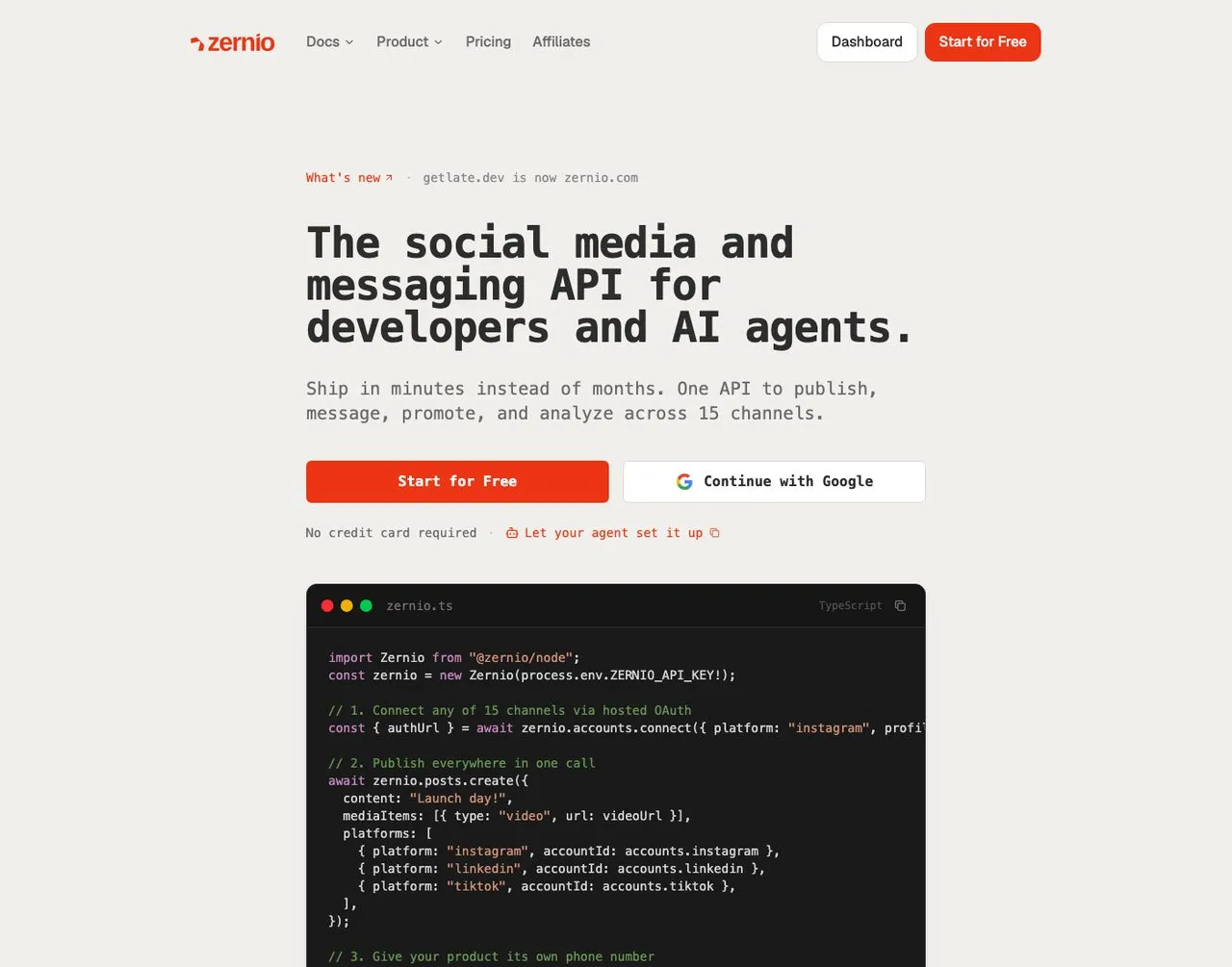
Zernio removes the account ceiling without asking you to host anything.
Zernio is the hosted option that scales most like Mixpost’s unlimited-accounts model. You pay per connected account on a graduated curve: the first two are free, 3 to 10 cost $6 each, 11 to 100 cost $3 each, and past 100 the rate drops to $1. Scheduling, analytics, inbox, and full API access come with every account.
At 100 accounts that is roughly $300/mo, so Mixpost’s $299 one-time license is dramatically cheaper on paper. The comparison only holds if you value your maintenance hours at zero.
Pros:
- No plan ceiling to hit as you grow
- API and inbox on every account
- Per-account rate falls sharply at volume
Cons:
- Expensive relative to a one-time license at high counts
- Costs scale directly with account growth
Pricing: Free for 1-2 accounts, $6/account (3-10), $3/account (11-100), $1/account (101+).
Ideal for: Agencies who want unlimited-style growth without running infrastructure.
Bottom line: Hosted elasticity at a price. More detail in our Zernio alternatives guide.
5. Buffer: Best for zero operational work
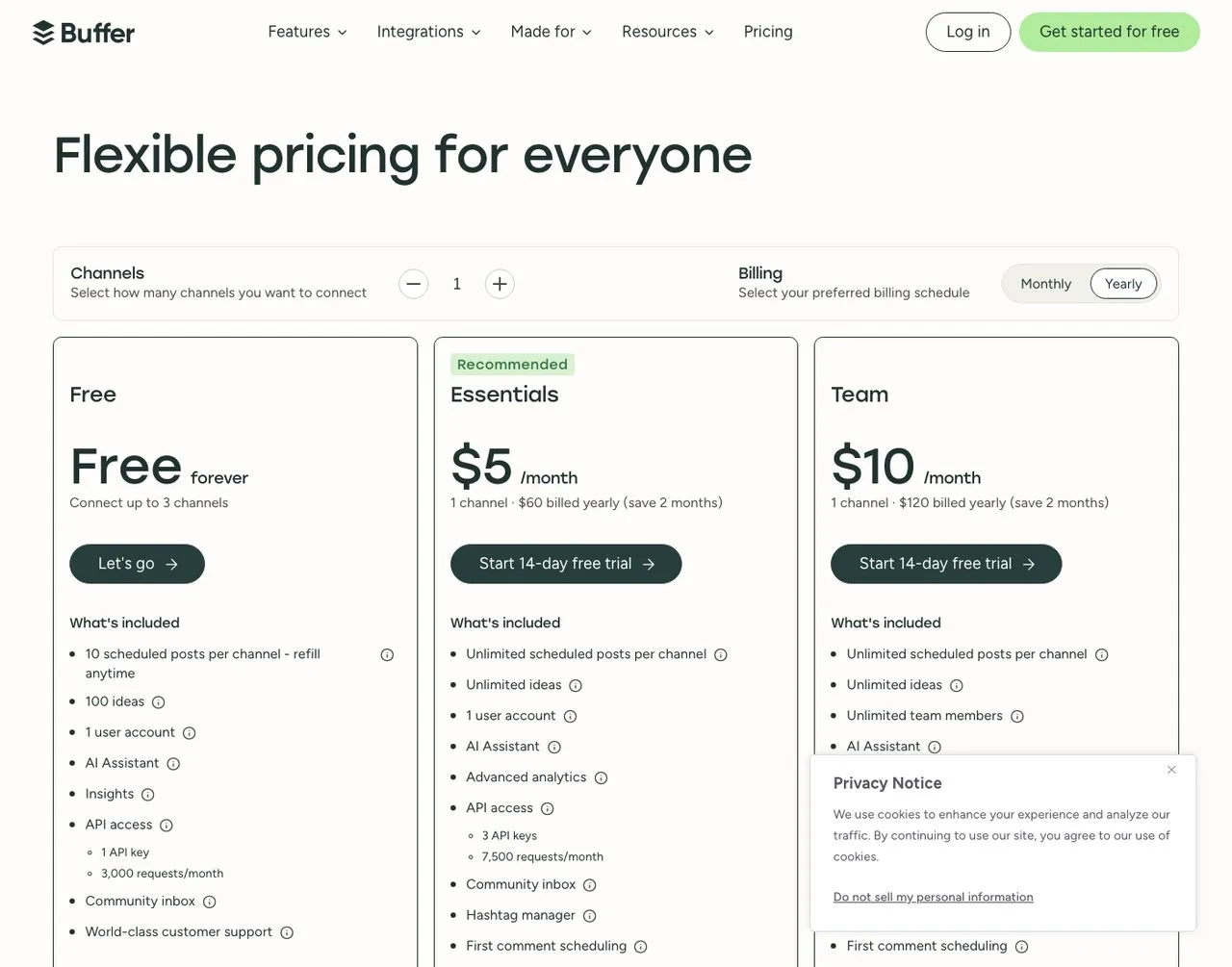
Buffer requires no server, no upgrades and no maintenance window.
Buffer is the furthest from Mixpost in philosophy and the easiest landing spot. Nothing to host, nothing to upgrade, no Docker container to babysit. Its free plan even carries an API key good for 3,000 requests a month, which is more programmatic access than Mixpost Lite gives you at any price.
Per-channel pricing means costs climb with each network, and it is a scheduling tool rather than agent infrastructure, though it does run an MCP server.
Pros:
- Free plan includes real API access
- No infrastructure or maintenance at all
- Reliable, mature publishing
Cons:
- Per-channel pricing compounds quickly
- Scheduling-first rather than agent-first
Pricing: Free plan available, Essentials $6 per channel/mo ($5 annual), Team $12 per channel/mo ($10 annual). Per-channel rates drop with volume, to $4 from channel 11 and $3 from channel 26.
Ideal for: Solo operators with a few channels who want the simplest possible setup.
Bottom line: The lowest-effort exit from self-hosting. More in our Buffer alternatives roundup.
6. Vista Social: Best for agencies who self-hosted for control
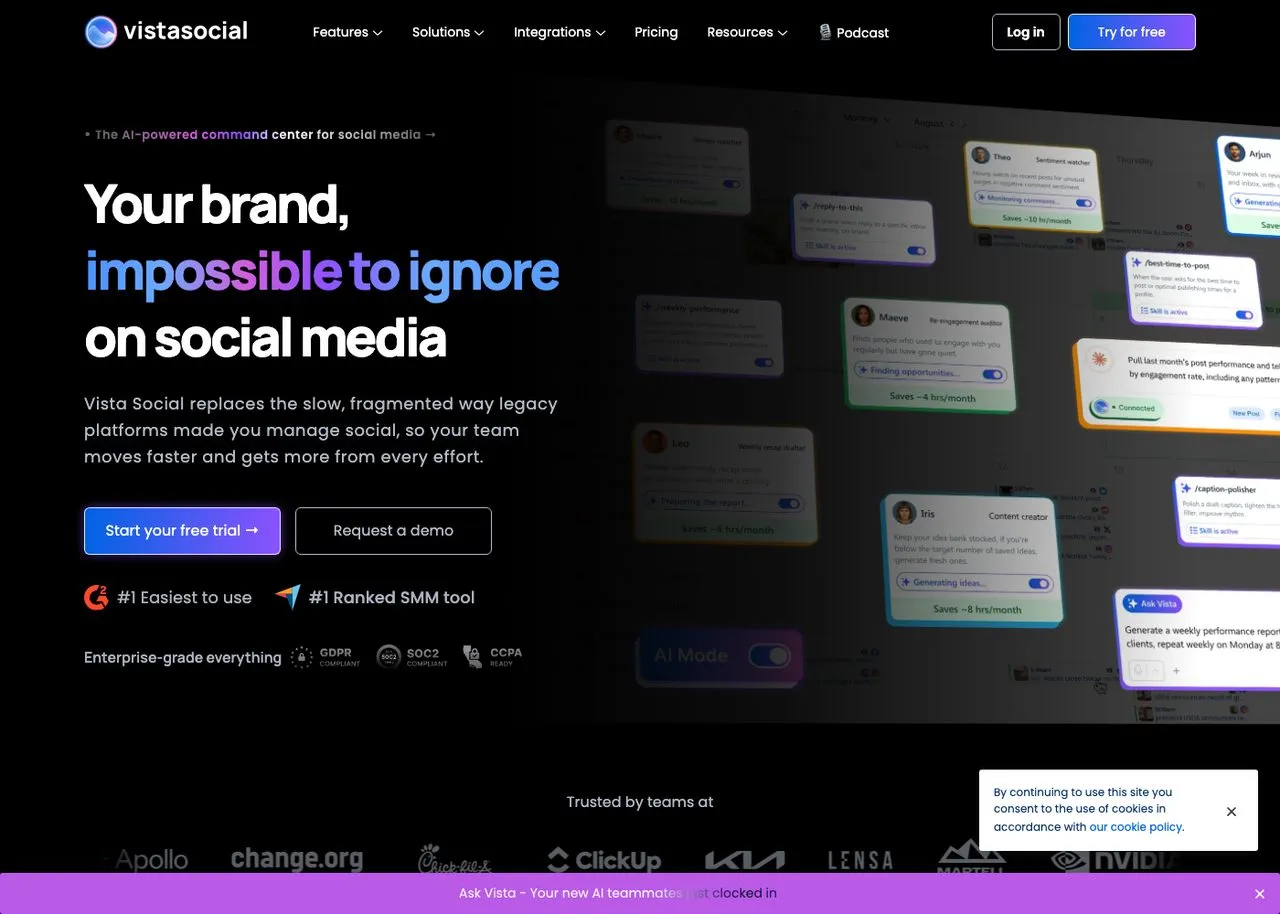
Vista Social bundles 15 client profiles into its entry agency plan.
A common reason to self-host Mixpost is client work: Pro includes multi-tenant support and Enterprise adds customer dashboards and billing. Vista Social covers that ground as a managed service, with 15 client profiles on its $79 entry plan and 30 on Advanced.
Its MCP server is unusually broad, reaching scheduling, analytics, inbox, tasks and listening, and it is included from the Advanced plan at $149. Connection is a per-user link from account settings rather than a public endpoint you paste.
Pros:
- 15 client profiles at the entry tier
- MCP spans far more than publishing
- Purpose-built for multi-client agency workflows
Cons:
- MCP requires the $149 Advanced plan
- No self-hosted option at all
Pricing: Professional $79/mo (15 profiles, 2 users), Advanced $149/mo (30 profiles, 4 users), Scale $349/mo (70 profiles, 8 users), Enterprise custom.
Ideal for: Agencies who ran Mixpost Pro for client separation and want that managed.
Bottom line: The managed answer to Mixpost’s multi-tenant use case.
7. Ayrshare: Best for products publishing for customers
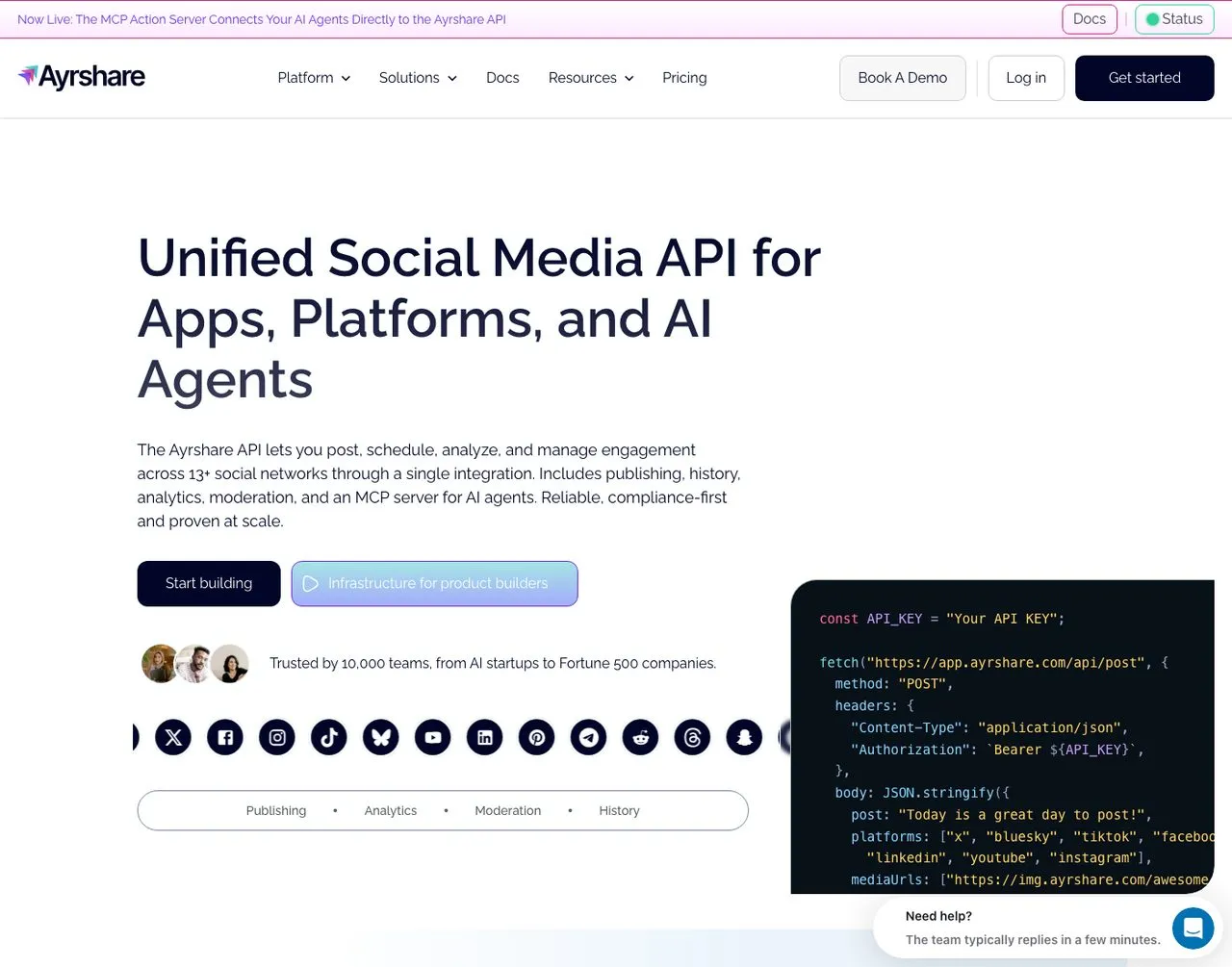
Ayrshare bills per active social profile, aimed at multi-tenant products.
If you self-hosted Mixpost Enterprise specifically to publish on behalf of your own users, Ayrshare is the managed equivalent. Billing counts active profiles rather than networks or seats, so a customer with six platforms connected still counts once.
It starts at $149/mo for a single profile and $299 for ten, with a 28-day no-card trial on the Launch tier, so it only makes sense when social publishing is a feature you resell.
Pros:
- Designed for multi-tenant products from the start
- One profile covers all of a customer’s networks
- Volume rates fall to $2.49 per profile past 500 on monthly billing, or $1.99 annually
Cons:
- Highest starting price in this comparison
- Poor fit for managing your own brands
Pricing: Premium $149/mo (1 profile), Launch $299/mo (10 profiles), Business from $599/mo (30 profiles), Enterprise custom.
Ideal for: SaaS teams who ran Mixpost Enterprise for its SaaS features.
Bottom line: The managed answer to Mixpost Enterprise. See our Ayrshare alternatives guide.
How I Chose These Mixpost Alternatives
- Who carries the maintenance? The central question when leaving a self-hosted tool, and the one most comparisons skip.
- Which edition or tier holds the API? Mixpost puts it in the $299 Pro license, and several tools here gate it too.
- What does the cost look like over three years? A one-time license beats a subscription on paper, before you price your own hours.
- Does it cover more than publishing? Comments, DMs, and analytics behind the same key save you adding vendors later.
- Does it support multi-tenancy? Some readers self-host specifically to publish on behalf of customers.
License and subscription costs come from each vendor’s own pricing page, and the self-hosting figures use published VPS rates rather than an estimate. MCP availability was checked at the endpoint or in the documentation, and review sentiment draws on G2, Capterra, Trustpilot, AppSumo, and Reddit.
How to Choose the Right Mixpost Alternative
If maintenance is what you are escaping: Blotato, Upload-Post, Vista Social and Buffer are fully hosted with nothing to patch.
If you still want the option to self-host: Postiz is the only tool here that offers both from one codebase.
If you were on Lite and hit the API gate: Upload-Post’s free tier and Zernio’s free two accounts both include API access at no cost.
If you run 100+ accounts: Mixpost stays cheapest in raw dollars. Zernio at $1 per account past 100 is the closest hosted equivalent.
If you self-hosted for multi-tenancy: Ayrshare and Vista Social both handle client separation as a managed service.
If your agent needs comments and DMs too: Blotato and Zernio both include inbox access, where most others publish only.
The Honest Verdict
Almost everyone leaving Mixpost is answering one question: is running this server a good use of my time? If you enjoy that work and want your data on your own hardware, stay. The one-time license genuinely is the cheapest option here and I am not going to pretend otherwise.
If the answer is no, then the useful move is picking a hosted tool where the API is on the first paid plan, so you are not trading a maintenance bill for a licensing gate. Blotato is built for that, and Postiz is the fairest alternative if you want to keep self-hosting within reach.
Mixpost Alternatives FAQs
What is the best Mixpost alternative for AI agents?
Blotato, if you want the maintenance to stop: the API and hosted MCP server are on the $29 entry plan, and one key also reaches comments, DMs, and analytics rather than publishing alone. Postiz is the better fit if you want to keep self-hosting available, since it offers the same product hosted or on your own server.
Does Mixpost’s free version include the API?
No. Mixpost Lite is free and open source under the MIT license, but the API, MCP, webhooks, and AI assistant are all part of the $299 Pro license. Lite also supports only Facebook Pages, X, and Mastodon, so Instagram, LinkedIn, TikTok, and YouTube require the paid edition.
Is self-hosting Mixpost actually cheaper?
In raw license cost, clearly yes: $299 once against $1,044 over three years for a $29 monthly plan. The comparison changes once you add server hosting at roughly $500 over the same period, plus upgrade time and the hours spent fixing publishing when a platform changes an API. If you already run infrastructure, the savings are real. If you do not, you are buying a job.
Can Mixpost be used as a hosted service?
Not officially. Mixpost is self-hosted only, deployed with Docker, as a Laravel package, or manually on your own VPS. There is no vendor-managed cloud version, which is the single biggest difference between it and every hosted tool on this list.
Which Mixpost alternatives run an MCP server?
All seven offer one, in different shapes. Blotato, Upload-Post, Zernio, Ayrshare, Vista Social and Buffer expose hosted endpoints, and Postiz runs one on its cloud plans. Note that Vista Social’s requires the $149 Advanced plan and connects through a per-user link rather than a public URL, so check the tier before you assume access.