8 Best Postoria Alternatives With No Add-On Surprises (2026)
The best Postoria alternatives in 2026, compared on X add-on costs, which tier unlocks the API, post caps, and each vendor's track record.

If you are searching for Postoria alternatives, there is a decent chance you got as far as the pricing table and found the row that says X (Twitter) is an add-on rather than an included network. The add-on price is not published anywhere, which means the advertised $10 a month is not a number you can actually plan against if X is part of your mix. I’m the founder of Blotato, my pick below, so weigh that entry accordingly and judge it against the published plans rather than my enthusiasm.
Quick Comparison: 8 Best Postoria Alternatives
| Tool | Best For | Starting Price | Key Strength |
|---|---|---|---|
| Blotato | Solo operators who want AI content generation and publishing on one flat bill | $29/mo flat | Writing, image, and video generation behind the same key that publishes |
| Publer | Budget schedulers who want per-account pricing that drops as they add accounts | Free, then $5 first account | Tiered per-account billing with every 10th account free |
| Buffer | Creators who want a permanent free plan and the most polished calendar | Free, then $6/channel/mo ($5 annual) | The most mature scheduling interface, with a real free tier |
| Metricool | Small teams whose reporting needs outgrew a scheduler | Free, then $20/mo | Analytics with competitor benchmarking and a six-network inbox |
| Postiz | Builders who want 28 channels and the option to self-host | $29/mo (free self-host) | Open source with an official API and MCP on every paid plan |
| SocialBee | Planners who want unlimited AI writing at a fixed monthly price | $29/mo | Evergreen content categories with unmetered AI on every tier |
| Mixpost | Owners who want no monthly fee and full data control | $299 one-time | Perpetual self-hosted license with unlimited accounts |
| Hootsuite | Larger teams with procurement, compliance, and approval requirements | Contact sales | Enterprise governance and the deepest listening tooling here |
Hootsuite sits last on purpose. Almost nobody leaving a $10 scheduler is heading to enterprise, but if approval workflows and compliance review are why you are shopping, it is the honest answer and everything above it will disappoint you.
Why People Are Looking for Postoria Alternatives

Postoria’s homepage: budget-priced scheduling across 12 supported networks.
Postoria is doing something genuinely useful at the low end. Ten social accounts and two workspaces on a free forever plan with no card is more generous than most, Pro at $10/mo covers 50 accounts, and Agency at $25/mo covers 500 accounts across 100 workspaces. For a multi-brand manager counting pennies, those numbers are hard to beat.
The catch is what the numbers do not include. The pricing comparison table marks X (Twitter) as an add-on rather than an included network, and Postoria’s own blog confirms it runs on posting credits. The price of that add-on is not published on any public page. So the real monthly cost of an X-inclusive setup is unknowable until after you sign up, which is an awkward place to start a vendor relationship.
The second gap is the API. Public API access, the MCP server, and the n8n integration all show a red cross in the Free column of Postoria’s own comparison table and a green check on Pro and Agency. That is a defensible business decision, but it means a developer cannot evaluate the integration surface before paying, and that surface is exactly what an agent builder came to test. The capability itself is real: Postoria runs a hosted MCP endpoint at mcp.postoria.io/mcp supporting OAuth sign-in or an API key, alongside a local npm option. It is just gated.
Third, and this is the honest one: there is almost nothing to go on. Postoria is a UK LLP registered in London, its own site carries a 2025 to 2026 copyright, and no founder or team is named anywhere on it. There is no about page and no public changelog, and the independent review directories that list it carry no user reviews at all. None of that is disqualifying for a personal account. For client work or anything load-bearing, it is worth knowing before you migrate 500 accounts onto it. The alternatives below fix the pricing opacity, the API gate, or the track-record question.
Best Postoria Alternatives for 2026
Ordered roughly by how close each one stays to Postoria’s budget-first promise, with the specialists at the end.
1. Blotato: Best for solo operators who want AI content generation and publishing on one flat bill

Blotato’s homepage: content generation, publishing, engagement, and analytics on one key.
Blotato costs more than Postoria and it should only win here for a specific reason: it creates the content rather than just scheduling it. Writing, images, and faceless video are generated in-product, then published to 9 platforms, with analytics on 8 of them and comments and DMs on Instagram and Facebook. X is included in the $29 plan rather than sold as an unpriced add-on. Both tools put API and MCP access behind a paid plan, so that is not a difference between them, but Blotato’s is on the entry tier. If your Postoria bill was only ever going to be $10, this is not a cost saving. If it was going to be $10 plus an X add-on plus a writing tool, run the comparison.
The tradeoffs are real. There is no permanent free tier, only a 7-day trial that excludes the API, so an API key ends the trial and starts paid Starter. Postoria’s 500-account Agency tier at $25/mo also undercuts Blotato badly on raw account count, and if account count is your only axis, Blotato is the wrong pick.
Pricing: The honest comparison is $29 against Postoria’s $10, plus whatever the unpriced X add-on turns out to cost, plus the writing tool you would still be paying for. Scheduling and publishing never draw down credits, so what you are buying at the higher number is the generation. Creator moves to $97, Agency to $499. Cancel anytime.
Ideal for: Solo operators and small teams who are paying for a scheduler and a writing tool separately.
Bottom line: The pick when creating the content is the actual bottleneck, at one predictable price.
2. Publer: Best for budget schedulers who want per-account pricing that drops as they add accounts

Publer’s homepage: a scheduling calendar with per-account pricing across 13 platforms.
Publer is the closest match to what Postoria is trying to be, with pricing you can actually calculate in advance. Professional runs $5 for the first social account and $4 for each additional one, Business runs $10 first and $7 additional, and every tenth account is free. Watch the shape when you compare quotes: the first account and each additional one are priced differently, so a single per-account figure will not match your bill. The free plan covers 3 accounts and 10 scheduled posts each.
One direct parallel to Postoria’s problem: X cannot be connected on Publer’s free plan at all, which Publer attributes to X’s enterprise API cost. It is more transparent than an unpriced add-on, but X remains a paid-tier concern here too. I compared the account math in Blotato vs Publer, and there is a full Publer alternatives list.
Pros:
- Transparent tiered per-account pricing with every 10th account free
- 13 platforms including Mastodon, Telegram, and WordPress
- Free plan with 3 accounts and no card
Cons:
- X cannot be connected on the free plan
- API access requires the Business plan or higher
Pricing: Free (3 accounts), Professional from $5/mo (first account, $4 each additional), Business from $10/mo (first account, $7 each additional), Enterprise on request.
Ideal for: Multi-brand managers who want the bill to be arithmetic rather than a surprise.
Bottom line: The most honest budget alternative as long as a scheduler is all you need; the API only arrives on the Business plan, and the free plan cannot connect X.
3. Buffer: Best for creators who want a permanent free plan and the most polished calendar

Buffer’s homepage: the most established scheduling dashboard on this list.
Buffer trades account count for maturity and finish. Three channels free forever with 10 scheduled posts each, then $6 per channel per month ($5 on annual billing), and X is a normal channel rather than an add-on. Where Postoria has no meaningful review corpus to check, Buffer has a decade of operating history and a large public one, which is the entire reason it is on this list. It also runs a hosted MCP server at mcp.buffer.com/mcp.
Per-channel pricing is the obvious ceiling. Ten channels is $50/mo on Essentials, where Postoria’s Pro covers 50 accounts for $10. If raw account count drives your decision, Buffer loses badly. I ran that math in Blotato vs Buffer.
Pros:
- Permanent free plan with 3 channels, no card
- The most refined interface of anything here
- X included as a standard channel with no add-on
Cons:
- Per-channel billing is expensive past a handful of accounts
- 11 platforms, fewer than Postoria’s 12
Pricing: Free (3 channels), Essentials $6/channel/mo ($5 annual, $60/yr per channel), Team $12/channel/mo ($10 annual). 14-day trial on paid plans.
Ideal for: Creators with a few channels who value polish and stability over account volume.
Bottom line: The low-risk choice, priced for a handful of channels rather than fifty.
4. Metricool: Best for small teams whose reporting needs outgrew a scheduler
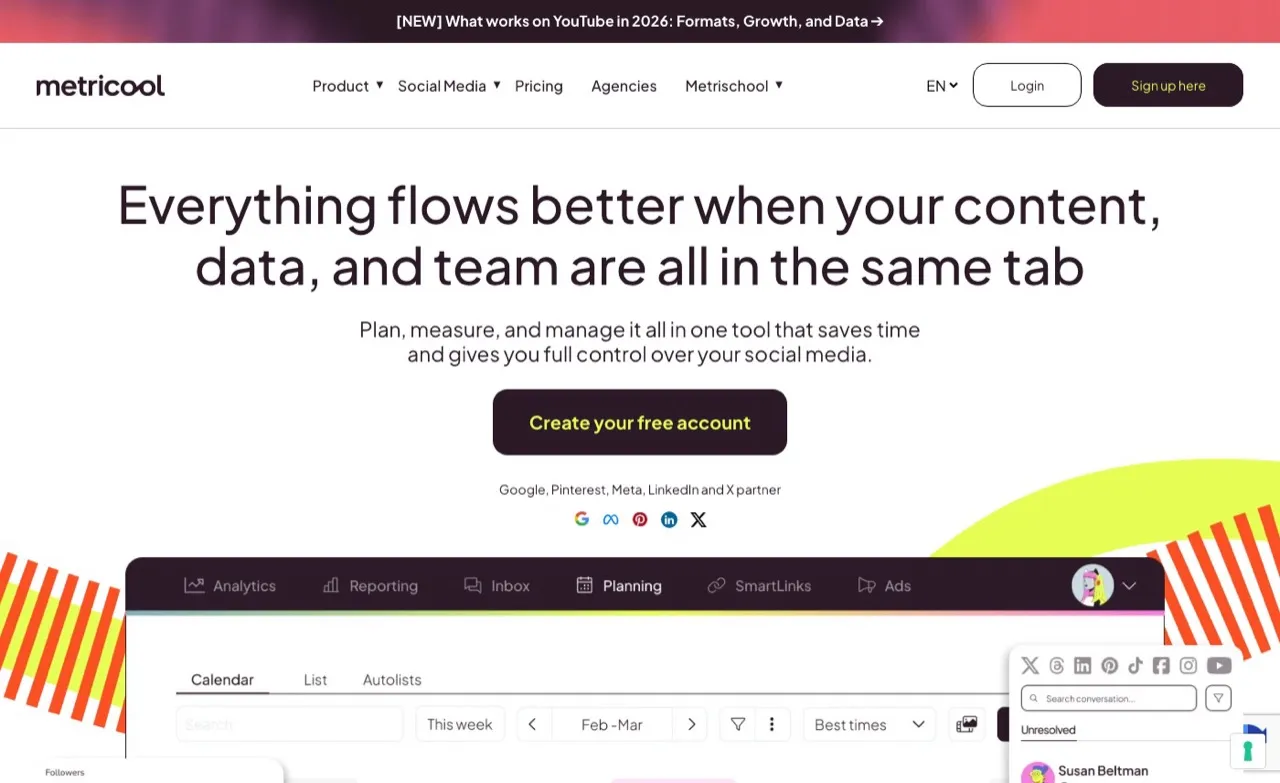
Metricool’s homepage: analytics, reporting, inbox, and planning in one dashboard.
Metricool is where you go when scheduling stopped being the hard part. Postoria lists analytics as a feature, but scoped to posts published through Postoria. Metricool’s reporting is the product: competitor benchmarking, unlimited history on paid plans, and an inbox spanning Instagram, Facebook, TikTok, YouTube, LinkedIn, and Google Business from Starter.
Worth getting the API detail right, because it is easy to misread as a contradiction. Metricool’s MCP server works on every plan including Free, while the HTTP API used by Zapier and Make requires Advanced at $53/mo. Two products, two gates. See Blotato vs Metricool for the fuller comparison.
Pros:
- Genuine analytics depth with competitor benchmarking
- Inbox across six networks from the Starter tier
- MCP available on every plan, including Free
Cons:
- The HTTP API for Zapier and Make requires the $53/mo Advanced tier
- Priced per brand, which climbs quickly for multi-client work
Pricing: Free (1 brand), Starter from $20/mo (5 brands) to $36/mo (10 brands), Advanced from $53/mo (15 brands) to $159/mo (50 brands).
Ideal for: Teams who need to prove what worked, not just publish it.
Bottom line: The upgrade when reporting became the reason you log in.
5. Postiz: Best for builders who want 28 channels and the option to self-host

Postiz’s homepage: agent-driven scheduling across 28 channels, self-hostable and open source.
Postiz answers the vendor-risk question in the most direct way available: the software is open source, so if the company disappears you can run it yourself. For anyone hesitating over Postoria’s single-partner LLP and absent public team, that is a meaningful hedge. It covers 28 channels, ships an official API and an MCP server at api.postiz.com/mcp on cloud plans, and includes analytics and AI generation on every paid tier.
Channel counts run tight at the bottom: Standard is $29/mo for 5 channels, where Postoria’s $10 Pro covers 50 accounts. Self-hosting is free but means owning Postgres, Redis, and Temporal. The tradeoff is covered in Blotato vs Postiz, and we ranked the hosted options that skip the Temporal stack entirely.
Pros:
- 28 channels, the widest coverage here
- Open source, so self-hosting is a genuine exit
- API and MCP on every paid plan, not gated to a higher tier
Cons:
- Only 5 channels at $29/mo, far behind Postoria on account count
- Self-hosting means running your own infrastructure
Pricing: Standard $29/mo (5 channels), Team $39/mo (10), Pro $49/mo (30), Ultimate $99/mo (100). Free self-hosted, 7-day trial on cloud.
Ideal for: Builders who want reach plus an escape hatch from vendor risk.
Bottom line: The strongest hedge here against vendor risk, since you can run the code yourself.
6. SocialBee: Best for planners who want unlimited AI writing at a fixed monthly price

SocialBee’s homepage: category-based evergreen scheduling with AI writing on every tier.
SocialBee is built around content categories rather than individual posts. You fill buckets, it recycles them on a schedule, and the queue keeps running without daily attention. Unlimited AI content generation is on every tier, which is a different model from credit metering, and comments, mentions, and DMs are handled in-product. Postoria’s AI is scoped to caption generation only.
It is a dashboard tool through and through. No API tier is documented and no MCP server was found, so agent access is not the play here. There is also no permanent free plan, only a 14-day trial. Compared in Blotato vs SocialBee.
Pros:
- Unlimited AI content generation on every tier
- Evergreen category queues that keep publishing on their own
- Comments, mentions, and DMs managed in-product
Cons:
- No documented API tier and no MCP server found
- No free plan, and $29/mo covers only 5 profiles
Pricing: Bootstrap $29/mo (5 profiles, $24.50/mo billed annually), Accelerate $49/mo (10), Pro $99/mo (25), then $179, $329, and $449/mo for 50, 100, and 150 profiles.
Ideal for: Planners who think in content pillars and want the AI allowance uncapped.
Bottom line: Strong content engine, wrong tool if code needs to call it.
7. Mixpost: Best for owners who want no monthly fee and full data control
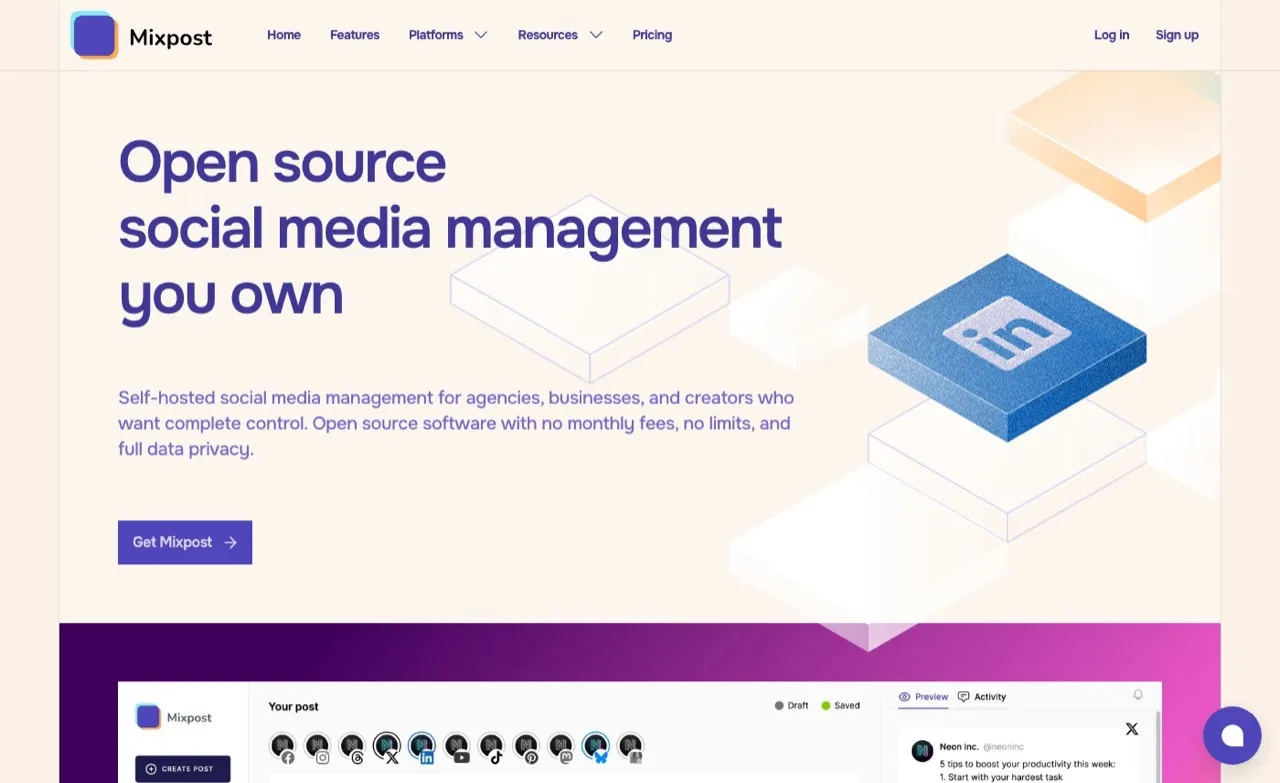
Mixpost’s homepage: a self-hosted, one-time-license social media manager you run yourself.
Mixpost removes the subscription question entirely. The Pro license is $299 once, perpetual, with unlimited accounts and unlimited workspaces on your own server. For someone running 500 accounts who was drawn to Postoria’s Agency tier, the payback math against $25/mo is roughly a year. After that there is no subscription, though you are still paying for hosting and your own time.
Two things to be clear about. It is self-hosted only, with no cloud option, so uptime, backups, and OAuth token refreshes are yours. And its MCP support ships inside the self-hosted Pro license rather than as a hosted endpoint, so mcp.mixpost.app does not resolve and there is nothing to point an agent at without running the server yourself. The free Lite license covers only 3 platforms. There is a full Mixpost alternatives roundup if self-hosting turns out not to suit you.
Pros:
- One-time $299 license, no recurring fee, unlimited accounts
- Complete data ownership and control
- API, MCP, and webhooks included in the Pro license
Cons:
- Self-hosted only, so uptime and backups are your responsibility
- Free Lite tier covers just 3 platforms
Pricing: Lite free (3 platforms), Pro $299 one-time (11 platforms), Enterprise $1,199 one-time.
Ideal for: Technical owners running many accounts who would rather buy once than rent forever.
Bottom line: The cheapest option at scale, if you are willing to be the sysadmin.
8. Hootsuite: Best for larger teams with procurement, compliance, and approval requirements

Hootsuite’s homepage: enterprise-grade social management with listening and governance.
Hootsuite is on this list for completeness and for one specific reader: the person whose organization requires approval workflows, role permissions, audit trails, and a vendor with the compliance documentation a security review asks for. Postoria cannot answer any of that today, and neither can most tools above. Hootsuite also has the deepest social listening of anything here.
It is the wrong answer for nearly everyone leaving a $10 scheduler. Pricing is no longer published per seat on the plans page, so budget through sales, and the interface carries two decades of accumulated enterprise weight. I compared the two ends of the market in Blotato vs Hootsuite, and there is a Hootsuite alternatives roundup for the other direction.
Pros:
- Approval workflows, permissions, and governance built in
- The most developed social listening on this list
- An established vendor most enterprise procurement teams already recognize
Cons:
- Pricing requires contacting sales, so you cannot compare it here
- Heavier and far more expensive than anything else on this list
Pricing: Not published per seat on the plans page. Contact Hootsuite directly for current pricing.
Ideal for: Teams where compliance review, not cost, is the binding constraint.
Bottom line: The right call only if governance is why you are shopping.
How I Chose These Postoria Alternatives
I evaluated each tool on six things: whether every advertised platform is actually included at the advertised price or sold as an add-on, which tier unlocks API and MCP access, whether post caps exist and where they bite, how AI is metered, how deep analytics really goes, and how much verifiable operating history sits behind the vendor. Pricing is current as of August 2026 and was read off each vendor’s own live pricing page, including rendering Postoria’s full feature-comparison table to confirm which rows carry a check and which carry a cross. Capability and MCP claims come from vendor documentation and direct endpoint probes rather than from directory listings.
How to Choose the Right Postoria Alternative
- If the X add-on is what sent you here: Buffer and Postiz treat X as a normal channel. Blotato includes it in the flat price. Publer is transparent that X needs a paid plan.
- If you need the API before you pay: Postiz and Metricool both expose more of their integration surface at lower tiers than Postoria does.
- If account count is your only axis: Publer’s tiered per-account pricing or Mixpost’s one-time license, in that order.
- If reporting is the real gap: Metricool.
- If the content itself is the bottleneck: Blotato generates it, and SocialBee writes it if you never need API access.
- If vendor risk is the worry: Postiz is open source and Mixpost ships you the self-hosted code under a one-time license, so either way you can keep running it yourself.
- If compliance has to sign off: Hootsuite.
Sabrina’s Final Thoughts
Postoria is priced to win on one number, and it does win on that number. The problem is that the number is not the whole bill: X sits behind an unpriced add-on, and the API and MCP that agent builders came for start on Pro. Before you switch, work out what you would actually pay for your real platform mix, then compare that against the tools above rather than against the $10 headline. If the honest answer is that you are also paying for something to write the posts, that is the specific overlap Blotato collapses, and the plan comparison takes about ten minutes.
Postoria Alternatives FAQs
Is Postoria really free?
The free plan is genuine and permanent: 10 social accounts, 2 workspaces, and 50 posts a month with no card and no trial period, which is more generous than most free tiers here. Two caveats decide whether it works for you. X (Twitter) is an add-on rather than an included network, at a price not published publicly, and the API, MCP server, n8n integration, bulk upload, and team members are all excluded from Free. Blotato has no permanent free tier at all, only a 7-day trial that excludes the API, so on free access alone Postoria wins.
Does Postoria have an API and an MCP server?
Yes to both, on paid plans only. The public API runs at api.postoria.io/v1 with bearer-token auth and a documented limit of 300 requests per 5 minutes per account, and the hosted MCP endpoint at mcp.postoria.io/mcp accepts OAuth sign-in or an API key, with a local npm server as the alternative. Postoria’s own help center states both require an active Pro or Agency plan. Note one wrinkle for agencies: each account gets one active API key, and keys are account-level rather than workspace-level, so per-client key isolation is not available. MCP is standard across this category now, so compare on what the tools reach rather than on whether a server exists.
How much does Postoria’s X (Twitter) add-on cost?
Postoria has not published the price. The pricing comparison table marks X as an add-on rather than an included network, and Postoria’s own blog states it runs on posting credits, but no public page lists a rate. That means you cannot calculate your true monthly cost before signing up. If X is central to your posting, this is the single strongest reason to look at an alternative that includes it in the base price, such as Blotato, Buffer, or Postiz.
What do users say about Postoria?
Very little, and that is the finding rather than a criticism. The independent directories that list Postoria carry no user reviews at all, and the one score that exists is explicitly editorial rather than user-generated. No substantive Reddit discussion surfaced either. The company is a UK LLP registered in London with a 2025 to 2026 copyright on its own site, no named founder, no about page, and no public changelog. Treat any roundup that quotes specific user complaints about Postoria with suspicion, because there is no public corpus to quote from. For a personal account the risk is low. For client work, weigh it deliberately.
Which Postoria alternative is cheapest for managing many accounts?
Over a full year, Mixpost’s $299 one-time Pro license with unlimited accounts beats every subscription here if you can self-host. Among hosted tools, Publer’s tiered per-account pricing (Professional at $5 for the first account and $4 for each additional, with every 10th free) scales the most gently. Postoria’s own $25/mo Agency tier for 500 accounts is genuinely cheaper than all of them on raw account count, so if account volume is your only criterion and X is not in your mix, staying put may be the right answer.