Postiz vs Buffer: Per-Channel Bill or Flat Social Media Tier?
Postiz vs Buffer on price: free at 3 social media channels, a tie at 5, Postiz cheaper from 10 up. Buffer's API and MCP are free too.
Postiz vs Buffer comes down to channel count, and the answer changes hands as you add channels. Buffer is free at 3 channels, the two are within a dollar of each other at 5, and from about 10 channels up Postiz cloud is cheaper and never gives the lead back. Self-hosted Postiz costs nothing in license at any count, though it costs you a server.
The other half most write-ups miss: Buffer’s API and its MCP server both work on that free plan, documented on Buffer’s own MCP guide and its help center article on API access. Nearly every comparison of this pair still quotes Buffer at $5 a channel and calls it the closed option for non-technical people. Both halves of that are wrong, and the $5 error alone understates the monthly bill by about 17 percent.
So the real comparison is not open against closed. It is a per-channel meter against a flat tier, and one tool that generates images and video against one whose AI stops at text. Blotato competes with both and is an app I built, which you should weigh against everything below.
Postiz vs Buffer: At a Glance
Go with Postiz when you want the source, you need reach past the mainstream networks into Discord, Telegram, Reddit, Farcaster or blog targets, or you want AI image and video generation in the same tool that publishes.
Go with Buffer when you want something that has run reliably since 2010, you are on a handful of channels, or you want to test an API integration without paying anything at all. Its free tier is genuinely free, not a trial.
Both assume you are the one wiring it up. If you would rather one key covered publishing, comments and analytics together, see what a managed plan includes, with the honest caveats later on.
Managed Convenience Against Self-Hosted Control
Partly. They overlap on scheduling and diverge on almost everything around it.
Buffer is a publishing product with fifteen years of polish on it. Scheduling, a calendar, a link-in-bio page, a comment inbox, analytics. It is opinionated, it is easy, and its AI helps you write rather than trying to produce the visuals for you. Buffer’s own transparency dashboard puts it at $26.5M ARR against about 257,000 monthly active users, a level of durability none of the newer tools here can claim.
Postiz is a younger open-source project with an agentic bent. AGPL-3.0, past 35,000 GitHub stars, self-hostable via Docker or available as a hosted plan. It schedules, but it also writes, generates images and video, and ships a CLI. The pitch is breadth and ownership rather than polish.
The real split is what happens when the tool is not enough. With Buffer you wait for Buffer. With Postiz you can read the code, patch it, and run your fork, as long as you honor the AGPL.

Buffer’s Audience: Simplicity Over Control
Buffer is built for creators, solo operators and small teams who want scheduling to be a solved problem. Started in 2010, it has outlasted most of its competitors, and the product reflects that: a narrow feature set, few settings to misconfigure.
Pricing is per channel, and this is where nearly every comparison of Buffer gets it wrong, including the ones ranking today. Buffer’s pricing page defaults to the yearly toggle and shows $5 and $10, which are annual rates. Paying monthly, Essentials is $6 per channel and Team is $12 per channel.
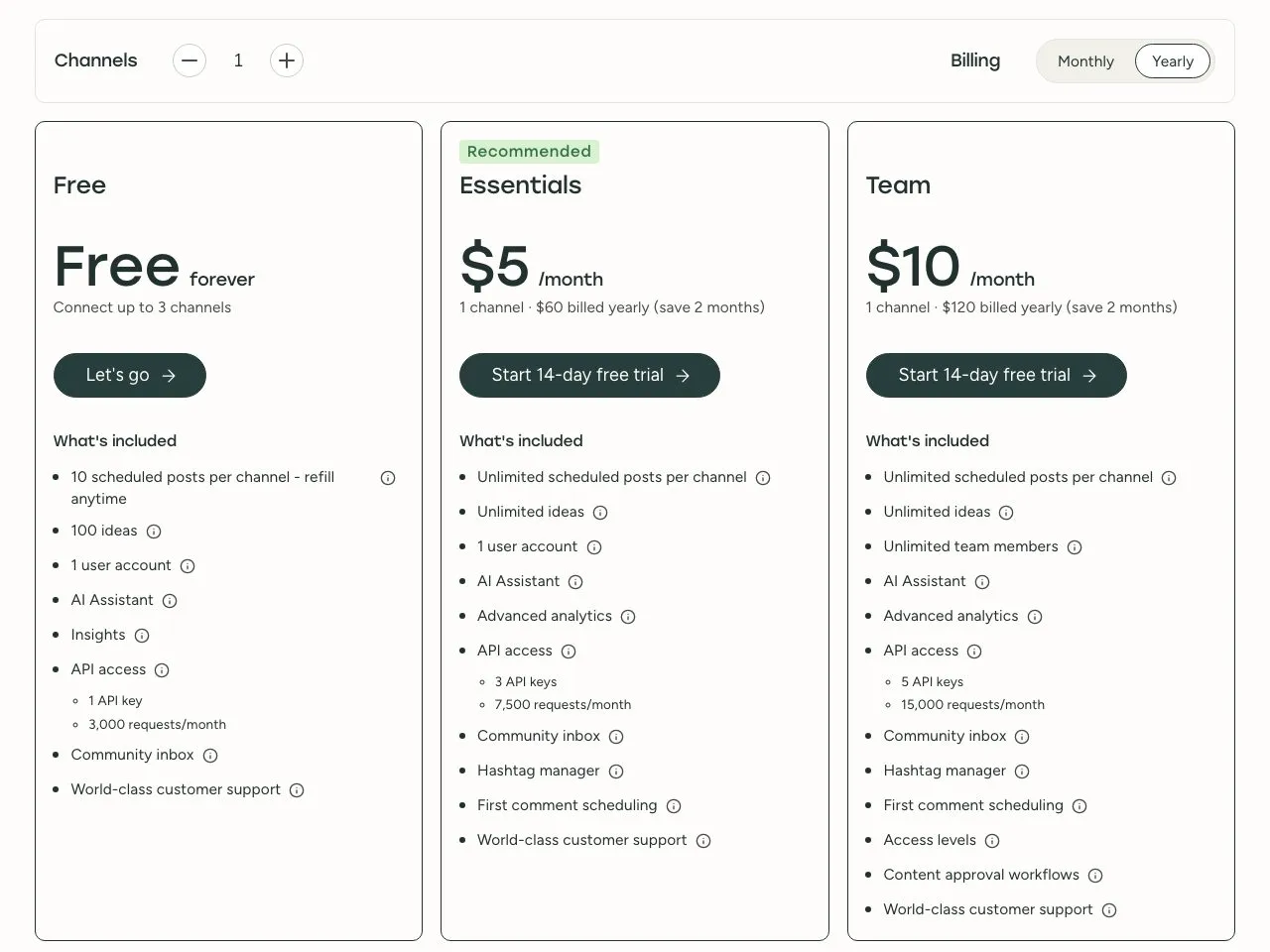
The rate does bend at volume, which is worth knowing before you assume per-channel always loses. Buffer’s machine-readable rate card, a plain-markdown file it publishes for AI agents, lists Essentials at $6 per channel for 1 to 10, $4 for 11 to 25, $3 for 26 to 50, and $1 for 51 and up. Those bands are marginal, so the cheaper rate applies only to the channels inside it.
Note the oddity in their own table: past 10 channels the marginal rate is identical on both plans. Team still runs $60 more at every count, since its first ten bill at $12, but each channel you add beyond ten costs the same either way. We worked the same ladder out at 5, 10 and 20 channels separately.
Buffer supports 11 networks: Bluesky, Facebook, Google Business Profile, Instagram, LinkedIn, Mastodon, Pinterest, Threads, TikTok, X and YouTube. Mastodon being on that list matters, because open-source comparisons often treat it as self-hosted-only.
Where Buffer is thin is creation. The AI Assistant writes and repurposes text, and that is the whole of it. No image generation, no video. Seats are also the sharp edge: Free and Essentials are one user, so a second person means jumping to Team and doubling the per-channel rate under 10 channels.
Postiz’s Audience: Control Over Convenience
Postiz is built for people who would rather own the thing than rent it. Self-host under AGPL-3.0 and nothing is edition-gated: all platforms, API, webhooks, MCP, AI copilot, analytics. The licence is what costs nothing, so budget separately for the model provider the AI features call.
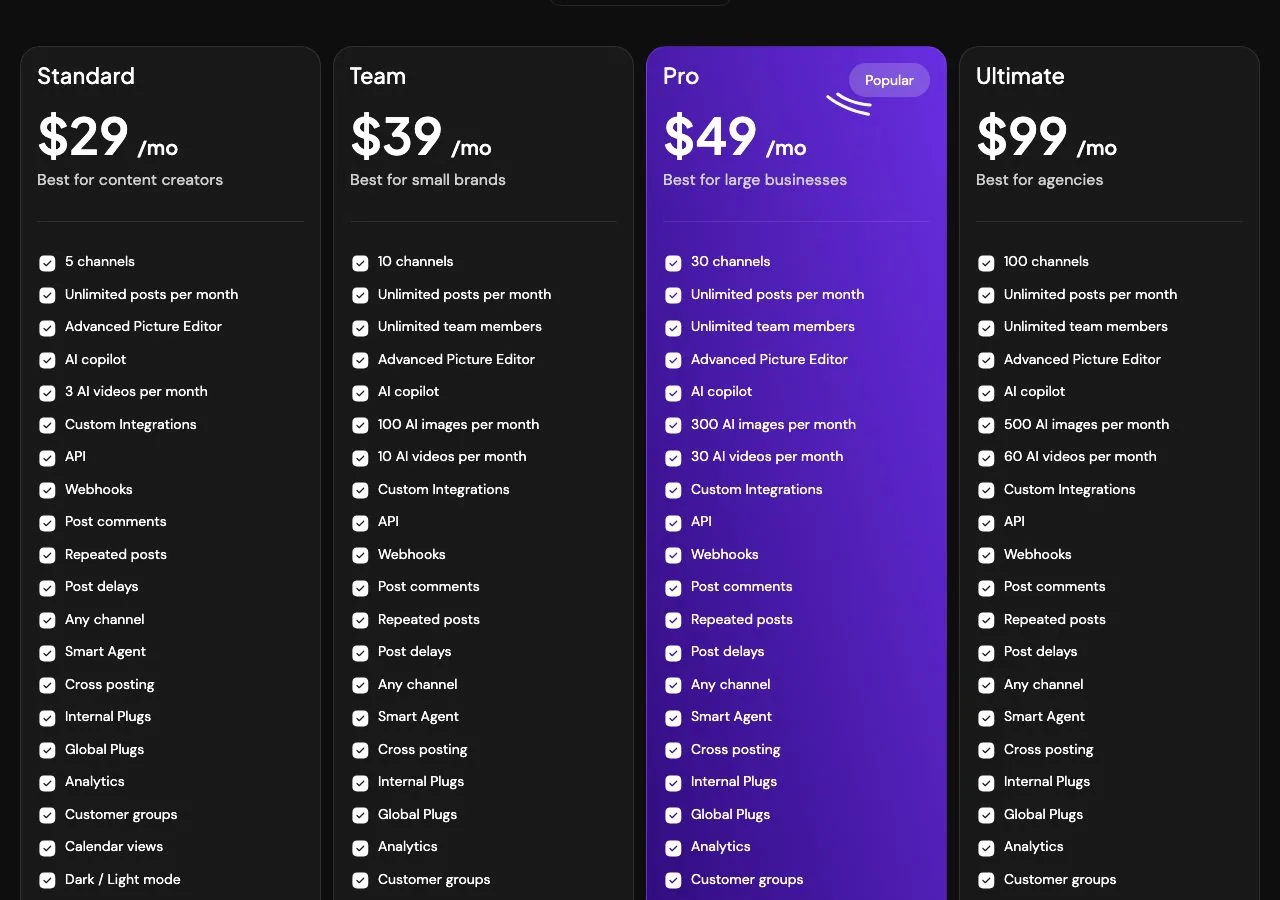
If you would rather not run it, the hosted ladder climbs $29, $39, $49 and $99 for 5, 10, 30 and 100 channels, behind a 7-day trial with no permanent free tier. Annually those come to $278, $374, $470 and $950 per the plans doc, and we put the tier ladder under a microscope elsewhere.
Reach is the headline, though Postiz cannot decide on its own number: its public API reference heads a list of 32 platforms while the general docs claim 34. Read what is inside either total before you weigh it. WordPress, Medium and Hashnode are blogs, Listmonk is a newsletter tool, and Skool and Whop are communities, so as conventional social networks the count sits much closer to Buffer’s 11 than the raw totals suggest. What Postiz genuinely reaches that Buffer does not is Discord, Telegram, Slack, Reddit, Farcaster and Nostr.
Postiz also generates. Text via the AI copilot, video metered at 3, 10, 30 and 60 a month by tier, and images at an allowance nobody at Postiz seems to agree on.
Its plans doc gives Standard 20 image credits, then two rows down marks the image generator itself “No” for that same tier. The pricing page’s markup says 20 while its rendered Standard card omits the line Team, Pro and Ultimate all carry. Assume 20 and check your account.
That is not the only place its own pages argue. Every tier card promises “Unlimited posts per month” and the limits doc agrees that posts are “unlimited on every paid plan,” while the FAQ payload inside that same pricing page caps Standard at 400 posts a month. All three were live today.
Self-hosting is the cost, and it is three services: Postgres, Redis, and Temporal since v2.12.0. Postiz’s system requirements start at 2 vCPU and 2 GB of RAM and climb to a recommended 4 vCPU and 8 GB once real users arrive. The out-of-memory warning that circulates about Postiz is worth dismissing properly: it applies to building from source, not to the official image, and it has a documented one-line fix.
Postiz vs Buffer: Side by Side
| Category | Postiz | Buffer |
|---|---|---|
| Model | AGPL-3.0 open source, self-host or cloud | Hosted SaaS, closed |
| Pricing | Flat per tier | Per channel, volume ladder |
| Entry cost | $0 self-hosted, or $29/mo cloud | Free for 3 channels |
| Free tier | Self-hosting only (7-day cloud trial) | Yes, permanent, 3 channels |
| Monthly paid rate | $29 for 5 channels | $6/channel (Essentials), $12 (Team) |
| Platforms | 32 to 34, by its own docs | 11 |
| AI text | Yes | Yes (all tiers, including free) |
| AI images | Yes, metered (20 on the $29 tier per its docs) | No |
| AI video | Yes, metered | No |
| Public API | All hosted tiers, plus free when self-hosted | All tiers, including free |
| API shape | REST | GraphQL |
| MCP server | Yes, 11 tools, self-hostable | Yes, 20 documented tools, hosted |
| MCP on the free tier | Yes, when self-hosted | Yes, on the free plan |
| Comment replies via MCP | No, “not today” per its docs | No comment tools documented |
| Comment inbox | No inbox, only scheduled comments on your own posts | Yes, all tiers |
| Link-in-bio | No | Yes (Start Page), all tiers |
| Seats | Unlimited on Team and up | 1 user until the Team plan |
| Founded | Repo created 2023 | 2010 |
Two rows do most of the work. Buffer gives you an API and MCP on a free plan. Postiz gives you generation and reach, which Buffer does not sell at any price.
Buffer’s Case: Polish, Support, and a Free Tier
A free tier that includes the API. Three channels, one API key, 3,000 requests a month and MCP access, for nothing. For prototyping an agent integration this is the cheapest honest starting point in the category.
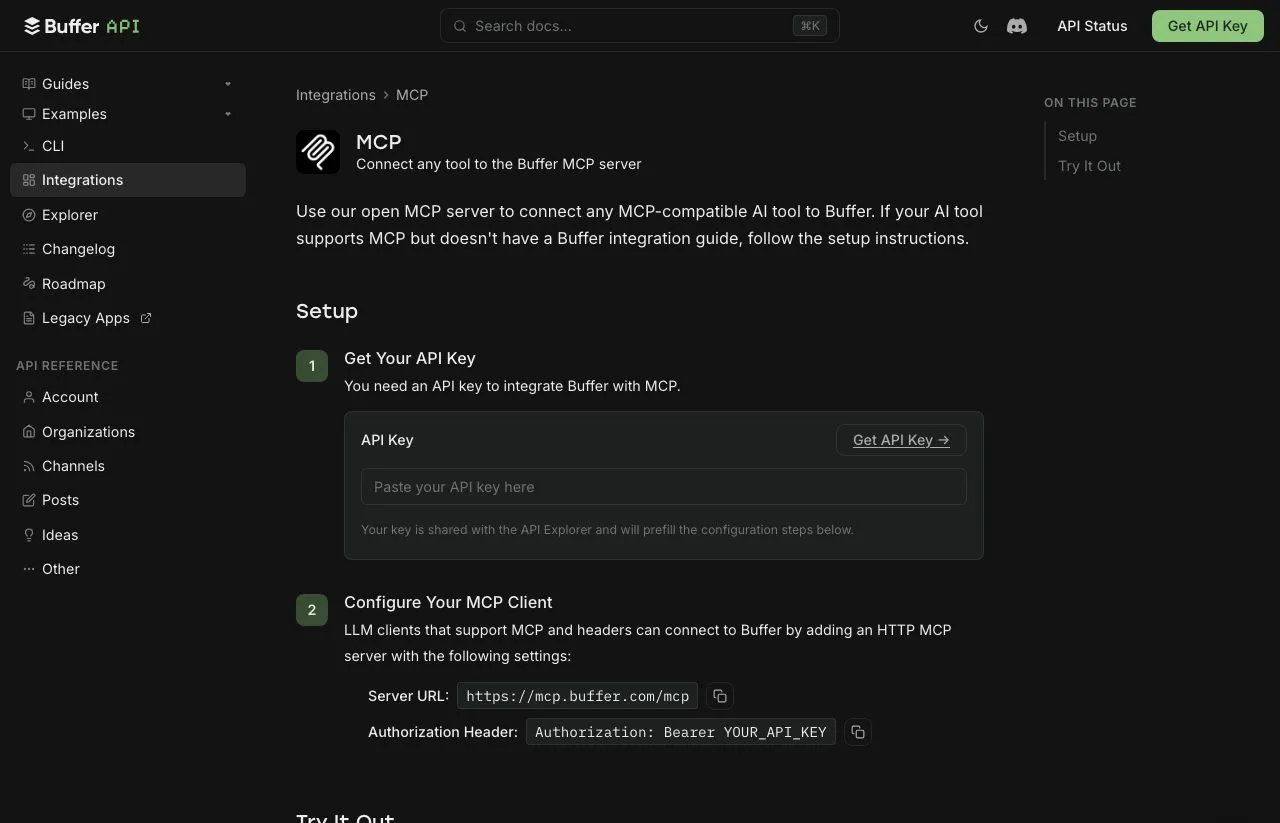
It ships MCP. mcp.buffer.com/mcp with Bearer auth. Its integrations index lists eleven named setup guides today, Claude, ChatGPT, Cursor, Raycast, Perplexity, Antigravity, Manus, Notion, Grok, plus Zapier and n8n, which are automation platforms rather than MCP clients. Grok is new since I last checked. Anyone telling you Buffer is the non-technical option has not read their developer docs lately.
Fifteen years of not falling over. Buffer has been publishing since 2010 and reports $26.5M ARR on its public dashboard. For anything you intend to run unattended, that track record is a real feature.
Cheapest at the low end, and free at three channels. At 3 channels Buffer costs nothing against Postiz cloud’s $29, and even paid Essentials at 3 channels is $18.
Comment inbox and link-in-bio on every tier. Postiz has no link-in-bio page, and what it calls comments is scheduling follow-ups on your own posts rather than reading what anyone said back.
Postiz’s Case: Source Access and No Per-Channel Bill
You can own it. AGPL-3.0, about 35,600 stars on GitHub, active maintenance. If vendor risk is something you actually model rather than something you say, this is the only option here where a vendor decision cannot strand you.
It makes content. Text, images and video, metered but present. Buffer’s AI is text only, so anything visual is a second tool and a second bill.
Reach past the mainstream. Discord, Telegram, Slack, Reddit and Farcaster all have a connect flow, and Nostr, WordPress, Medium and Dev.to are reachable through the API. Buffer covers the 11 networks most people use and stops there.
Flat pricing once channels add up. At 10 channels Postiz cloud is $39 against Buffer Essentials at $60 a month, and the gap widens from there. Below that, per-channel billing is the cheaper shape, which is the honest half of this bullet.
Unlimited seats below the top tier. Postiz includes unlimited team members from its $39 plan. Buffer keeps you at one user until Team.
Per-Channel Billing Against a Self-Hosted Zero
At monthly rates, using Buffer’s own published ladder.
| Channels | Buffer Essentials | Buffer Team | Postiz cloud |
|---|---|---|---|
| 3 | Free (or $18) | $36 | $29 (Standard) |
| 5 | $30 | $60 | $29 (Standard) |
| 10 | $60 | $120 | $39 (Team) |
| 25 | $120 | $180 | $49 (Pro) |
| 50 | $195 | $255 | $99 (Ultimate) |
| 100 | $245 | $355 | $99 (Ultimate) |
One detail most write-ups get wrong: Buffer’s rate card is marginal, not flat. The $1 rate above 50 channels applies only to the channels above 50, so 100 channels is $245 on Essentials, not $100. Every row above matches Buffer’s own worked examples up to 50, and the 100-channel figures come from the same published bands.
The gap compounds once it opens: Postiz is $21 cheaper at 10 channels, $71 at 25, and $146 at 100. Self-hosted Postiz is $0 in license at every row, plus your server and your hours.
Three places this table lies to you. If you run 3 channels and only need scheduling, Buffer’s free plan is the correct answer and nothing here beats it. If you need a link-in-bio page or a real comment inbox, Postiz will not replace Buffer. And if a second teammate is the reason you are shopping, Buffer’s Team plan at 1 to 10 channels is expensive enough that the flat tiers look better fast.
Where Blotato Fits in This Particular Choice
Disclosure: I built Blotato, so weigh this against the two sections above rather than in place of them. There is a longer head-to-head against Buffer alone if that is the pairing you want.
At 20 accounts Blotato is $29 flat against Buffer Essentials at $100 a month, which is ten channels at $6 plus ten at $4 from Buffer’s own bands, and Postiz cloud at $49, and that arithmetic is only worth anything to you if those 20 accounts sit on our nine platforms, you can live without a link-in-bio page, and you would rather never see a server.
All three run an MCP server. What separates them is what an agent can call.
| Capability over MCP | Postiz | Buffer | Blotato |
|---|---|---|---|
| Where it runs | Self-host or their cloud | mcp.buffer.com/mcp | mcp.blotato.com/mcp |
| Free to try | Yes, self-hosted | Yes, on the free plan | No, the trial excludes the API |
| Documented tools | 11 | 20, though Buffer publishes no count | 36 |
| Publish and schedule | Yes | Yes | Yes |
| Read your posts back | postsListTool | list_posts | Yes |
| Comments | None, “not today” per its docs | None, despite an inbox in the product | Instagram and Facebook |
| Direct messages | None | None | Instagram and Facebook |
| Analytics | No documented tool | get_aggregated_post_metrics | 8 platforms, not LinkedIn |
| Image or video generation | Both, metered | Neither | Both, credit-metered |
The comments row is the surprise: Buffer runs a real community inbox on every tier and exposes none of it to an agent.
Where we lose plainly: Postiz reaches 32 to 34 destinations and Buffer 11 against our 9, Buffer ships a link-in-bio page on every tier and we ship none, and generating an API key ends the 7-day trial and starts the Starter subscription, so an agent build here begins as a paid one.
Buffer Is the Answer for a Small, Simple Calendar
- You run 5 or fewer channels, where Buffer is free or within a dollar of Postiz.
- You want to prototype an agent integration without paying.
- You need a link-in-bio page or a comment inbox.
- You want a tool with a fifteen-year track record.
- Scheduling is the whole job and creation happens elsewhere.
Postiz Is the Answer If You’ll Actually Run It
- You want the source code and the option to self-host.
- You run 10 or more channels and per-channel billing is adding up.
- You need Discord, Telegram, Reddit, Farcaster or blog targets.
- You want AI image and video generation in the publishing tool.
- You need unlimited seats without the top tier.
Hosted Simplicity vs Open Source, Decided
Neither of these wins on MCP itself. Both ship a real server, both take a bearer token, and both work with Claude: Buffer’s is the faster one to try because it is hosted and free, Postiz’s is the one you can extend. Pick on what the server is attached to rather than on the server, because the open-versus-closed framing that dominates this comparison is mostly a distraction.
Where that leaves you: at 3 channels Buffer’s free plan costs nothing and wins, at 5 the dollar between them is noise so pick on features, and from 10 up Postiz is cheaper by a margin that keeps growing. If you want the source, self-host it and count the server as the price. If the server turns out to be the thing you did not want, a managed plan is worth pricing.
If MCP is the actual reason you are here, we ranked every social media MCP server worth connecting, including both of these. For adjacent comparisons, we put Postiz against Mixpost on licensing, Postiz against Zernio on agent workloads, and ran the full field in our roundups of what else replaces Buffer and Postiz alternatives.
Postiz vs Buffer FAQs
Is Postiz cheaper than Buffer?
Below 5 channels Buffer, above 10 Postiz, and at 5 it is close enough to decide on features. The part the raw ladder hides is what happens on annual billing, where Buffer takes roughly two months off and Postiz’s yearly totals run $278, $374, $470 and $950. That narrows the gap without closing it. And if you self-host, the licence is free at every count, so the real question becomes what your own hours are worth.
Does Buffer have an MCP server?
Yes, at mcp.buffer.com/mcp with Bearer-token auth, documented on Buffer’s own MCP setup guide, and its integrations index carries eleven named client guides including Claude, ChatGPT, Cursor, Perplexity and Grok. Buffer publishes no tool count of its own, calling it “a large list of tools,” and counting the documented ones gives 20, none of which touch comments. AI assistants still answer that Buffer has no MCP server, which is no longer true. Postiz ships one too, exposing 11 tools, served from your own domain when self-hosted.
Is Buffer free?
Yes, permanently, not as a trial. The free plan covers 3 channels, 10 scheduled posts per channel, one user, and the AI Assistant, and it includes 1 API key with 3,000 requests a month plus MCP access. Paid tiers raise that to 3 keys and 7,500 requests on Essentials and 5 keys and 15,000 on Team. The API is GraphQL rather than REST, and Buffer’s rate-limit doc adds a 15-minute ceiling of 100 requests on every plan, so budget for both if your client assumes otherwise.
Does Postiz have a free plan?
Not on the hosted side. Postiz cloud offers a 7-day trial and then starts at $29 a month for 5 channels. The free route is self-hosting the AGPL-3.0 version, which withholds nothing: every platform, the API, MCP and the AI copilot are included, in exchange for running Postgres, Redis and Temporal yourself.
Does Buffer generate images or video?
No. Buffer’s AI Assistant writes and repurposes text, adjusts tone and length, and tailors posts per platform, but it does not generate images or video. Postiz generates both, metered by tier, with the $29 Standard plan documented at 20 images and 3 videos a month.
Which supports more social platforms?
Postiz, though by less than it appears. Its own docs say 32 in one place and 34 in another, while Buffer supports 11. Several Postiz targets are blogs, newsletters or communities rather than social networks. The genuine additions over Buffer are Discord, Telegram, Slack, Reddit, Farcaster and Nostr.
Can Buffer be self-hosted?
No. Buffer is closed hosted software with no self-hosting option. Postiz is the self-hostable one here under AGPL-3.0, which also means that if you modify it and offer it as a service over a network, you owe your users the modified source. For internal use that obligation does not apply.