Zernio vs Postiz: Which Social Media API for AI Agents?
Zernio vs Postiz compared on rate limits, MCP tools, and self-hosting cost, including the AI generation gap that only one of the two actually fills.
Zernio vs Postiz is a comparison between two tools that both want to be the social media API your agent calls, and they picked opposite routes to get there. One is a closed hosted API with a rate card that starts at zero. The other is AGPL-licensed source you can clone tonight and run on your own server.
The spec sheets make them look closer than they are. Both ship an MCP server, a REST API on the entry tier and an n8n node, so both will technically do the job.
The differences that matter are not on the feature grid. They are in the rate limits, in what happens at account number eleven, and in whether the tool can write the post it is publishing. One of these two cannot, which surprises people given how it markets itself.
One conflict to state plainly before anything else: Blotato is a product I built, so it is a competitor to both tools on this page. I have put my own numbers in the same tables as theirs and marked the places where each of them beats us. The first two thirds of this post are about the choice between Zernio and Postiz, and you can skip my section entirely without losing the answer. If Postiz against Blotato is your actual shortlist, that comparison has its own post.
Zernio vs Postiz: At a Glance
Zernio is the better pick if: you connect a handful of accounts and want to start free, you need inbox and comment endpoints as part of the same API, or you want analytics across every destination you publish to. Two accounts cost nothing and no card is required.
Postiz is the better pick if: you want to own the stack, you need reach into places like Mastodon, Discord, Telegram, Nostr or Farcaster, or you would rather pay a flat $29 than watch a per-account meter climb. Self-hosted, the software itself is free. You can see how a flat hosted plan compares further down.
Both Publish. Only One Hands You the Server.
They overlap in the middle and diverge hard at both ends.
Postiz is an open-source social media scheduler with an agentic layer bolted on top. It is a product you use, with a calendar, a picture editor and an AI copilot, that also exposes an API. You can run it on your own hardware under AGPL-3.0, or pay for the cloud and skip the servers.
Zernio is infrastructure with almost no product surface. There is no calendar you are meant to live in. It is a single API and an MCP server that publishes, reads analytics, and works the inbox across a set of platforms, and the assumption is that your code or your agent is the interface. The API is closed and cloud-only. You cannot self-host it, no matter what the GitHub org suggests at a glance.
That last part is worth slowing down on, because Zernio’s GitHub presence is confusing. The MIT and Apache repos there are real, and every one of them is a client of the paid hosted API. You can self-host a Zernio dashboard. You cannot self-host Zernio.

Zernio’s Audience: Breadth Without the Ops
Zernio is built for developers and agencies who want one API key and no infrastructure. It was called Late until a rebrand moved it to zernio.com. Old SDKs keep working through a grace period and the endpoints did not change.
The pricing model is the most distinctive thing about it. There are no plans and no seats. You pay per connected social account, per month, on a graduated rate card: your first two accounts are free with no card, accounts three through ten run $6 each, accounts eleven through one hundred drop to $3 each, and past one hundred it is $1. Every feature is included at every level, including on the free two.
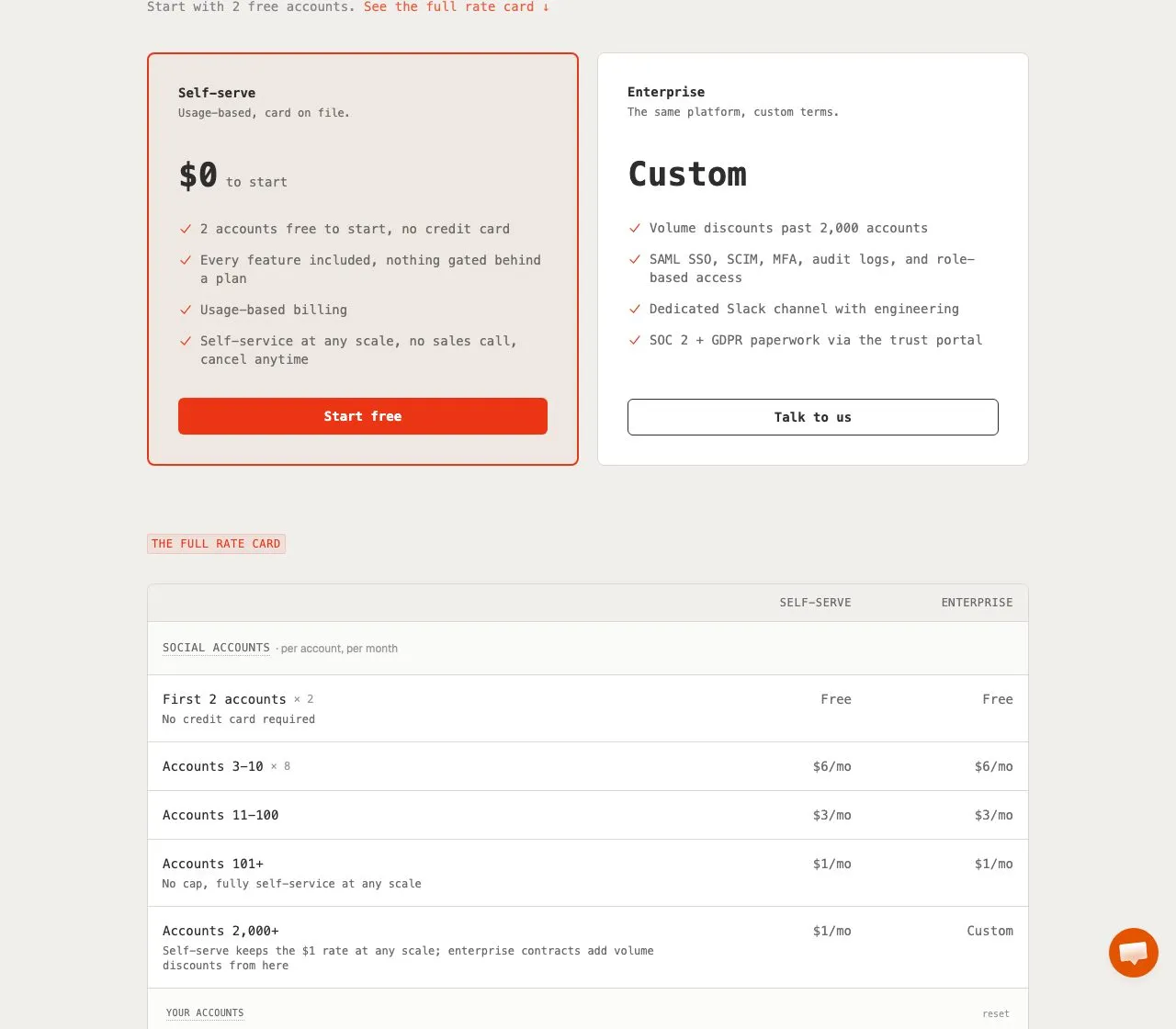
What you get for that is broad. Publishing across sixteen destinations, an inbox with DMs and comments, comment automations, reviews, mentions, and a deep analytics surface covering content decay, best time to post, follower history, demographics and YouTube video retention. That is a wider measurement surface than either other tool in this post documents.
One caveat on the count. Zernio’s docs are internally inconsistent right now: the platforms page says fifteen while the API reference title says sixteen, and Slack was added recently enough that the enumerated lists have not all caught up. Sixteen matches the current destination pages, but check it yourself before you build against a specific network.
The inbox needs one correction that Zernio’s own marketing invites. Its agents page advertises reading and replying on any platform that has an inbox, which reads as all sixteen. Its rate card is narrower and more specific: messaging covers eight platforms (Instagram, Facebook, X, WhatsApp, Bluesky, Reddit, Telegram, Slack) and comments and reviews cover nine (Instagram, Facebook, Threads, X, YouTube, Bluesky, Reddit, LinkedIn, Google Business). TikTok is on neither list. If your agent’s job is answering TikTok comments, none of the three tools in this post does it.
The gap is in generation. Zernio brands itself for AI agents and ships AI-ready JSON, and it is easy to read that as “the AI writes things.” It does not. Its published API reference and its MCP tool list contain no tool that generates a caption, an image, or a video. The one Instagram field with “AI” in the name is isAiGenerated, a disclosure flag that labels media as AI-made. Zernio moves and measures content. Something else has to make it.
Postiz’s Audience: Ownership of the Whole Stack
Postiz is built for people who want the source. It is AGPL-3.0 licensed, has passed 35,000 GitHub stars, and is maintained under the Gitroom org with a repo dating to mid-2023. If you self-host, the software costs nothing forever.
Cloud pricing runs $29 a month for 5 channels, $39 for 10, $49 for 30, and $99 for 100. Every tier includes the API, webhooks, the AI copilot, analytics and cross-posting. Postiz says annual billing “saves about 20%”, and its own plan docs put the yearly totals at $278, $374, $470 and $950, which works out to roughly $23, $31, $39 and $79 a month. There is a 7-day trial and no permanent free tier on the hosted side, though the FAQ points out you can deploy it yourself for free instead.
One thing to check before you budget against a post volume. Postiz’s pricing page currently disagrees with itself about how many posts Standard includes. Every tier card lists “Unlimited posts per month”, including the $29 Standard card. The FAQ further down that same page, under “How much does Postiz cost, and what’s included in each plan?”, reads “Standard - $29/mo. 5 channels, 400 posts/month, AI text, 20 AI images, 3 AI videos, public API, 2 webhooks.” The same line appears on the Postiz homepage.
Both are live as I write this. The FAQ is also the only surface that mentions 20 AI images on Standard, where the card lists none. If your agent’s volume sits anywhere near 400 posts a month, get that number in writing before you commit, because the card is the generous reading and the FAQ is the one written as a specification.
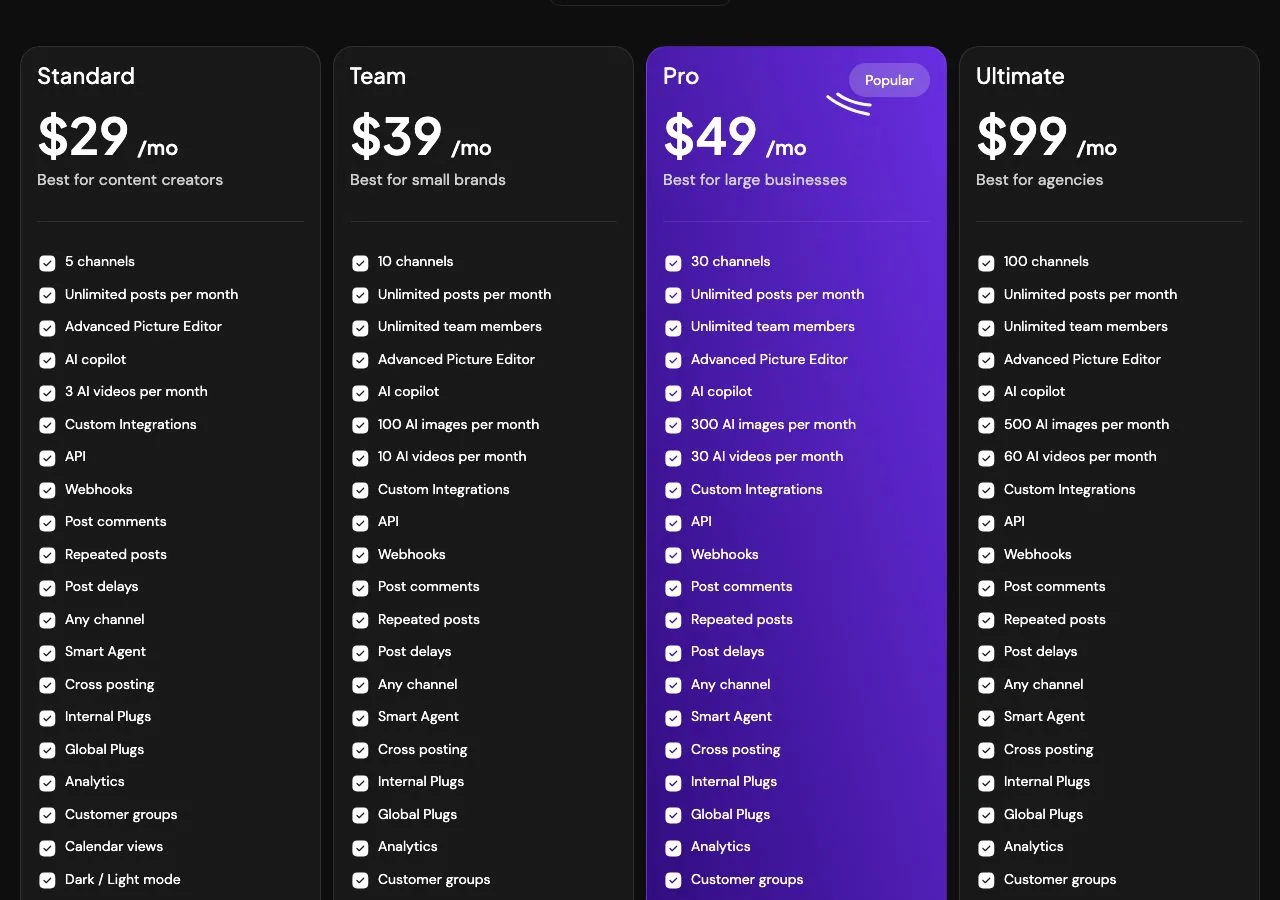
Postiz does generate content, which is the mirror image of Zernio’s gap. The AI copilot writes, image generation is metered at 0, 100, 300 and 500 a month by tier, and video at 3, 10, 30 and 60. The $29 tier is the odd one out on images: its card lists none at all, while the FAQ on the same page credits it with 20. Either way it is far below the 100 on Team, and easy to miss on a feature list that otherwise looks identical across tiers.
Platform reach is its other headline, though Postiz does not agree with itself on the number. Its analytics page says “Only 10 of the 34 platforms report analytics back to Postiz.” Its public API introduction heads a section “Supported Platforms (32 total).” So the honest range is low thirties, and “30+” holds up as a count while any exact figure does not. Worth knowing what is in that number: WordPress, Medium, Dev.to and Hashnode are blogs, Listmonk is a newsletter tool, and Skool and Whop are communities. The conventional social platform count is lower than any of the three figures suggests.
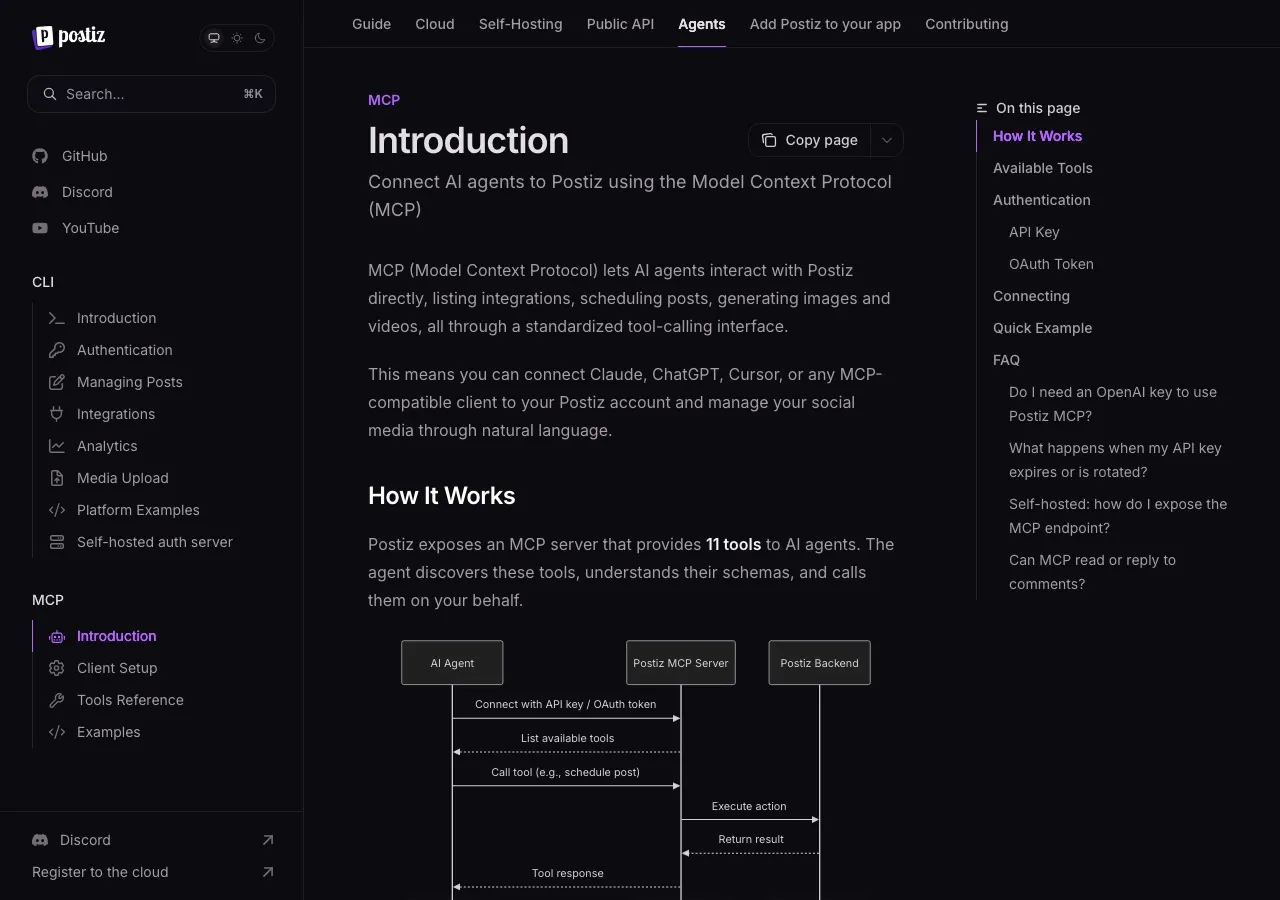
On self-hosting, Postiz’s official system requirements list 2 vCPU and 2 GB RAM as the floor for the all-in-one Docker install and 4 vCPU with 8 GB as the recommended spec. Since v2.12.0 you also need Temporal running alongside Postgres and Redis.
The real cost of self-hosting is not the server, though. It is that you become the developer app. Postiz’s own pricing FAQ says the quiet part out loud: some platform approvals need only a submission, but “Facebook, Instagram, Threads and YouTube are more complicated and can usually take more than a month with multiple changes in the submissions, privacy policy and terms of service.” That is per platform, filed by you, before a single post ships. Free software with a month of Meta review in front of it is a different product from free software you can use on Saturday.
Zernio vs Postiz: Side by Side
| Category | Zernio | Postiz |
|---|---|---|
| Model | Closed hosted API | AGPL-3.0 open source, self-host or cloud |
| Pricing | Per connected account | Flat per tier |
| Entry cost | Free for 2 accounts, no card | $0 self-hosted, or $29/mo cloud |
| Free tier | Yes, 2 accounts, permanent | Self-hosting only (7-day cloud trial) |
| Platforms | 16 destinations | Low 30s (32 in its API docs, 34 elsewhere) |
| AI text generation | No | Yes (AI copilot) |
| AI image generation | No | Yes, metered (0 on the $29 tier) |
| AI video generation | No | Yes, metered (3/mo on the $29 tier) |
| REST API | Yes, all tiers including free | Yes, all paid tiers |
| API rate limit | 60/min at 1-2 accounts, 600/min above | 100/hr cloud on create-post |
| MCP server | Hosted, mcp.zernio.com/mcp, 496 tools | Hosted or self-hosted, 11 tools |
| Inbox / DMs | Yes, 8 of 16 platforms | No |
| Comments | Yes, 9 of 16, plus automations | Scheduled follow-up comments only |
| Analytics | Deep (decay, demographics, retention) | 10 of 34 platforms, all tiers |
| n8n / Make / Zapier | All three official | n8n and Make official, Zapier via the API |
Two rows decide most of this. Zernio has the engagement and analytics surface Postiz does not, and Postiz generates content Zernio does not. Almost everything else follows from open versus closed.
The analytics row is worth a number rather than a word. Postiz reports analytics on 10 of its 34 platforms by its own documentation, and LinkedIn analytics there cover Pages only, not personal profiles. So “basic, all tiers” means the feature is on every plan, not that it reaches every network you publish to.
Zernio’s Case: Channel Count and Bundled Inbox
The free tier is real. Two accounts, permanently, no credit card. For a prototype or a personal automation that is the whole bill. No other hosted option here starts at zero without a trial clock, though self-hosted Postiz is $0 in license too.
Engagement endpoints. A full inbox and comment surface, plus keyword-triggered comment automations, reviews and mentions. Postiz is built around publishing rather than conversation, and its own docs confirm MCP cannot read or reply to comments, so if your agent needs to read a DM and answer it, this is Zernio’s lane.
Analytics depth. Content decay, follower history, demographics, posting frequency, YouTube retention, across all sixteen destinations. Postiz documents analytics on 10 of its 34 platforms and ours covers 8 of 9, so on documented breadth Zernio is ahead of both.
No infrastructure at all. No Postgres, no Redis, no Temporal, no upgrades. Point at the URL and go.
Rate limits that scale with you. 60 requests a minute on the free tier, 600 once you are past two accounts. Which brings up a claim worth correcting.
Zernio’s own comparison page advertises “up to 1200 req/min, roughly 720x more headroom” than Postiz. Both halves of that need an asterisk. Zernio’s own rate-limit docs show the 1,200 tier only unlocks past 2,001 connected accounts, so a normal buyer gets 60 or 600. And Postiz’s 100-per-hour limit applies only to the create-post endpoint, not the whole API, and Postiz’s API docs explicitly tell you to batch multiple posts into one request. The real gap is large. It is not 720x for anyone reading this.
Postiz’s Case: Free Forever If You Host It
You can own it. AGPL-3.0, 35,000 stars on GitHub, active maintenance. If a vendor shutting down or repricing is a risk you actually model, this is the only option here that takes it off the table, though platform API changes and app approvals stay your problem either way.
A fixed bill at each tier. At 30 channels Postiz cloud is $49 whether you post once or constantly. On Zernio, 30 accounts costs $108 a month. The crossover arrives earlier than most people expect, and it only widens.
It makes content. Text, images and video, metered but present, though the $29 tier includes zero images. Zernio is focused on moving and measuring posts rather than producing them, so pairing it with a generation tool is a two-vendor setup by default.
Reach into places the big APIs ignore. Mastodon, Discord, Farcaster and Nostr, plus blog targets like WordPress, Medium and Dev.to that Zernio does not publish to at all. If your audience lives somewhere unfashionable, Postiz is likelier to reach it.
A CLI and an official n8n node. n8n-nodes-postiz is real and current, and the CLI is genuinely useful for agent work.
Per-Account Curve Against a Server Bill
Per-account versus flat is the whole game, so here is where it actually crosses over.
| Connected accounts | Zernio | Postiz cloud |
|---|---|---|
| 2 | Free | $29/mo (Standard, 5 channels) |
| 5 | $18/mo | $29/mo (Standard) |
| 10 | $48/mo | $39/mo (Team) |
| 30 | $108/mo | $49/mo (Pro) |
| 100 | $318/mo | $99/mo (Ultimate) |
| Posting 100 link posts to X | Add $20/mo | Included |
One line item that table does not show, and it is the one that bites agent workloads. Zernio passes X API charges straight through at cost: $0.005 per read, $0.015 per post or DM send, and $0.200 per post that contains a URL. If your agent publishes link posts to X at any volume, that last figure moves the bill more than the account ladder does. A hundred link posts a month to X is $20 on top, which is more than the difference between the two tools at five accounts.
Zernio wins below roughly eight accounts and wins hardest at two, where it is free and Postiz is not. The two run close through the middle: at eight accounts Zernio is $36 against Postiz Team at $39, so call that a tie and pick on features. From about ten accounts upward Postiz pulls ahead and the gap compounds, until at 100 accounts Zernio costs more than three times as much. Self-hosted Postiz is $0 in license at every row, plus your server and your time.
Neither column prices the generation you may still need on top, and on Zernio’s side that means a second vendor entirely. This is where I have a conflict of interest, so treat the next section accordingly.
Where Blotato Sits Between These Two
Disclosure: Blotato is a product I built, so weigh this against the two sections above rather than instead of them.
Blotato is hosted infrastructure for agents, at $29 a month flat for 20 social accounts on Starter, publishing to 9 platforms. The MCP server lives at mcp.blotato.com/mcp and covers publishing, scheduling, comments, messaging and analytics behind one key. Writing and visuals come from the same subscription that publishes them, with AI image and video generation drawing on the plan’s monthly credits.
Against Zernio, the honest comparison is scope versus depth. Zernio reaches 16 destinations to our 9. Our analytics covers 8 platforms, LinkedIn being the exclusion, and our comments and DMs cover Instagram and Facebook only, so if your agent has to work an inbox on Reddit, Telegram or Slack, our engagement surface does not reach those and you should weigh that before you pick us. I would rather say it here than have you find out in week two.
Against Postiz, the trade is ownership versus operations. Postiz self-hosted is free software under a licence that cannot be revoked on the code you already have. We are $29 a month and there is no server for you to patch at 2am. Postiz also reaches far more destinations than we do. If owning the code is the requirement, we do not meet it and are not trying to.
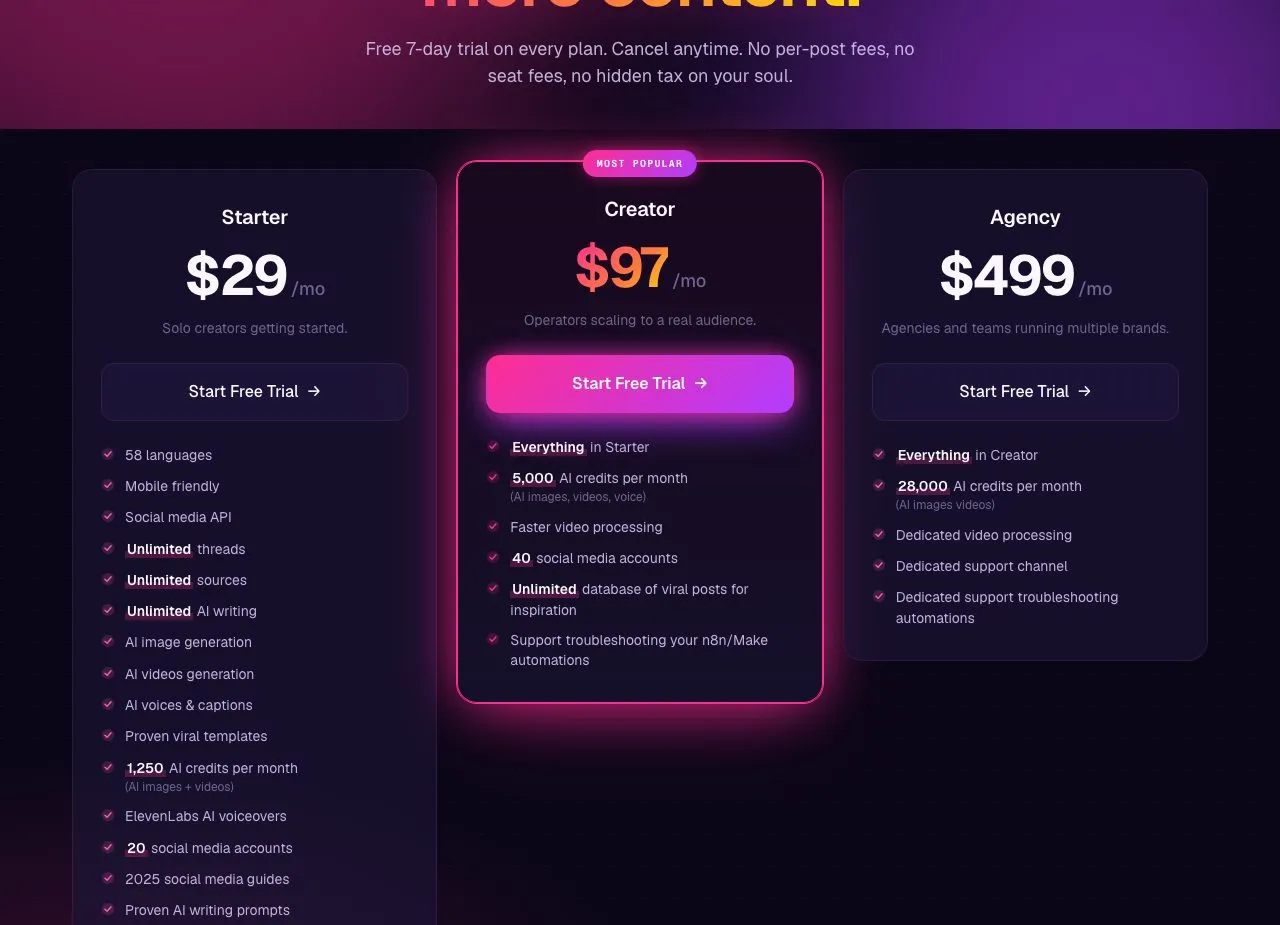
One caveat that matters for anyone here for the API: our 7-day trial excludes API access, and generating a key ends the trial and starts the Starter subscription. If you are evaluating us as agent infrastructure, plan on starting the subscription rather than trialing it. The plan details spell out what is included.
Zernio Suits a Wide Account Footprint
- You are under seven connected accounts, or want a permanently free two.
- Your agent needs to read and reply to DMs and comments.
- You want deep analytics without building a reporting layer.
- You need Snapchat or WhatsApp as destinations.
- You never want to run infrastructure.
Postiz Suits a Team With Ops Capacity
- You want the source code and the option to self-host.
- You run eight or more channels and want a flat bill.
- You need Mastodon, Discord, Farcaster, Nostr, or blog targets.
- You want scheduling and generation in one product.
- You are comfortable running Postgres, Redis and Temporal.
Managed Breadth or Self-Hosted Ownership
These two are not really competing for the same person. Zernio is a metered utility that moves and measures posts without making any. Postiz is software you can own that ships generation in the box but leaves engagement outside the API entirely. The tell is your account count and your appetite for servers.
My honest advice: if you are under seven accounts, publishing only, and want to test an idea this weekend, Zernio’s free two costs nothing and gets you running today without a server. If you are past ten accounts and have someone who can run Postgres, Redis and Temporal, self-hosted Postiz is the cheaper bill, provided you are willing to file your own Meta and YouTube app approvals first. If you land in the middle and your real bottleneck turns out to be producing the posts rather than moving them, that is the gap I built Blotato to sit in. If Postiz is the one you keep circling back to, it is also worth seeing how it compares to Mixpost, the other serious self-hosted option. For a wider field, our guide to replacing a self-hosted Postiz install and Zernio alternatives roundups run the full list.
Zernio vs Postiz FAQs
Is Zernio cheaper than Postiz?
Below about seven connected accounts, yes, and at two accounts Zernio is free while Postiz cloud is $29. Above roughly eight accounts Postiz is cheaper and the gap widens fast: at 30 accounts it is $49 against $108, and at 100 it is $99 against $318. Self-hosted Postiz is free software at every account count.
Does Zernio generate content with AI?
No. Despite branding aimed at AI agents, Zernio’s published API reference and MCP tool list contain no text, image, or video generation tool. Its “AI” refers to output your agent can consume, not content it creates. Postiz does generate text, images and video, though its $29 tier includes zero AI images and only three videos a month. The full tier-by-tier picture is in my Postiz pricing breakdown, and Zernio’s graduated ladder is in my Zernio pricing breakdown.
Can you self-host Zernio?
No. The Zernio API is closed and cloud-only, which their GitHub org, zernio-dev, states directly: the API is closed, everything built on top of it is open. The MIT and Apache repos under that org, including the dashboard and SDKs, are all clients of the paid hosted API. Postiz is the self-hostable one here, under AGPL-3.0.
Do Zernio and Postiz both have MCP servers?
Yes, and so do Blotato, Ayrshare and Mixpost, so MCP alone no longer separates these tools. Zernio hosts one at mcp.zernio.com/mcp exposing 496 tools, 20 hand-built plus one generated per endpoint, surfaced to your client through search rather than loaded at once. Postiz exposes 11 and can be self-hosted. We compared the field in the best social media MCP servers.
What are the real API rate limits?
Zernio allows 60 requests a minute on the free tier and 600 once you are past two accounts, reaching 1,200 only past 2,001 accounts. Postiz limits the create-post endpoint to 100 an hour on cloud and 90 self-hosted, and self-hosters can raise it. That limit covers one endpoint, and you can batch several posts per request.
How many posts does Postiz Standard actually include?
Postiz’s pricing page gives two different answers. Every tier card, including the $29 Standard card, says “Unlimited posts per month.” The FAQ on that same page, answering what each plan includes, says Standard covers 400 posts a month. If your agent’s volume approaches that, confirm the limit with Postiz in writing before you commit, because the two surfaces disagree and the lower number is the one written as a specification.
Does Zernio handle comments and DMs on every platform?
No, and its marketing reads as though it does. Zernio’s rate card lists messaging on eight platforms (Instagram, Facebook, X, WhatsApp, Bluesky, Reddit, Telegram, Slack) and comments and reviews on nine (Instagram, Facebook, Threads, X, YouTube, Bluesky, Reddit, LinkedIn, Google Business), out of sixteen publishing destinations. TikTok appears on neither list. Postiz has no inbox at all, and its docs confirm MCP cannot read or reply to comments.
What does Zernio actually cost for an agent posting links to X?
More than the account ladder suggests. Zernio passes X API charges through at cost on top of the per-account price: $0.005 per read, $0.015 per post or DM send, and $0.200 for a post that contains a URL. An agent publishing 100 link posts a month to X adds $20 to the bill, which is more than the entire difference between Zernio and Postiz at five accounts. Postiz cloud prices by channel count rather than by request, and publishes no per-request pass-through, so a link post is not billed differently there.
Which one is better for an AI agent?
It depends on the job. For publishing plus reading and answering messages, Zernio covers more surface. For owning the stack and reaching unusual networks, Postiz. If your agent needs to write the post as well as ship it, Postiz can do that natively and Zernio cannot, so a Zernio setup means pairing it with a generation tool.