Zernio Pricing 2026: The Real Cost of Your Next Account
Zernio pricing in 2026: how the graduated per-account rate card works, and what 5, 10, 20, and 50 accounts cost.
Zernio pricing has no plans, no tiers, and no seats. You pay per connected social account per month, the first two are free, and the rate drops as you add more. That makes the useful question not “which plan am I on” but “what does my next account cost.”
The answer changes three times. Your third account costs $6. Your eleventh costs $3. Your hundred and first costs $1. Nothing else about the product changes at those boundaries, which is the part worth understanding before you compare it to anything else.
That matters most if an agent is doing the posting. When you wire a social API into Claude, n8n, or your own service, the bill stops tracking your team and starts tracking how many accounts the agent touches, and that number tends to grow quietly.
This post breaks down the full rate card, what real account counts actually cost, where the graduated math surprises people, and when usage-based billing is the better structure. Two things about the model are worth naming up front: the full rate card is published rather than quoted, and every feature runs on every account with no plan gating.
Zernio Pricing at a Glance
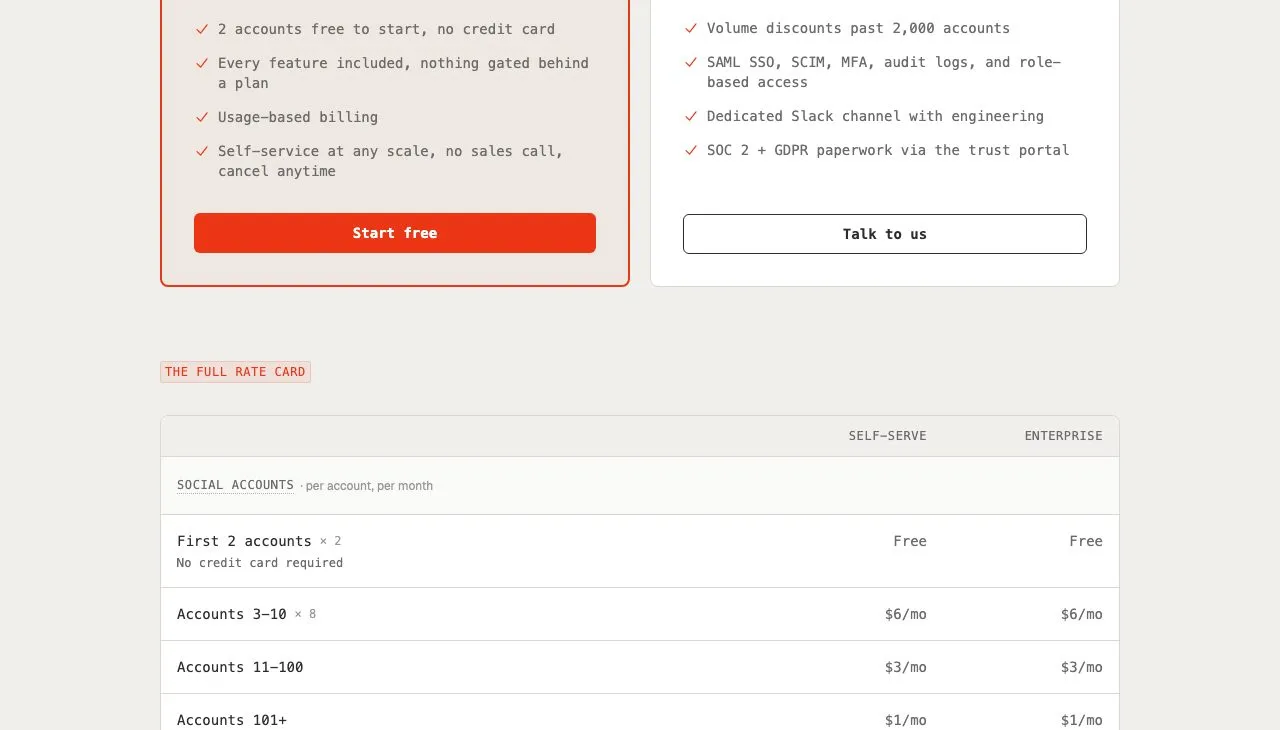
First 2 accounts: free, no credit card required.
Accounts 3 to 10: $6 per account per month.
Accounts 11 to 100: $3 per account per month.
Accounts 101 and up: $1 per account per month.
Accounts 2,000+: the $1 rate continues on self-serve, and Enterprise contracts add volume discounts beyond it.
Enterprise: custom, adds SAML SSO, SCIM, MFA, audit logs, role-based access, a dedicated Slack channel, and SOC 2 plus GDPR paperwork via a trust portal.
The quirk that matters: the rates are graduated, not retroactive. Hitting account 11 does not reprice accounts 3 through 10.
How Zernio’s Graduated Per-Account Pricing Actually Works
Graduated pricing is the detail people get wrong, and getting it wrong changes your estimate substantially.
Each band’s rate applies only to the accounts inside that band. Your first two accounts are always free. Accounts 3 through 10 always cost $6 each, even after you have 200 accounts. Accounts 11 through 100 cost $3 each. Everything past 100 costs $1.
So at 20 accounts you are not paying 20 times $3. You are paying nothing for two, $6 each for eight, and $3 each for ten.
| Band | Accounts in band | Rate | Band cost |
|---|---|---|---|
| First 2 | 2 | Free | $0 |
| Accounts 3 to 10 | 8 | $6/mo | $48 |
| Accounts 11 to 100 | 90 | $3/mo | $270 |
| Accounts 101+ | unlimited | $1/mo | $1 each |
The practical consequence: your average cost per account climbs until you hit 10 accounts, then falls continuously after that. Accounts 3 through 10 all cost the same $6 to add, so the tenth is not more expensive than the fourth. What makes 10 the peak is the average, which tops out there at $4.80 before the $3 band pulls it down. Zernio’s own rate card publishes the same figure in its example bills, listing 10 accounts at $48 a month and an effective $4.80 each.
The Real Cost at 5, 10, 20, and 50 Accounts
This is the table the rate card implies but does not show you.
| Accounts | Monthly cost | Annual cost | Average per account |
|---|---|---|---|
| 2 | $0 | $0 | free |
| 5 | $18 | $216 | $3.60 |
| 10 | $48 | $576 | $4.80 |
| 15 | $63 | $756 | $4.20 |
| 20 | $78 | $936 | $3.90 |
| 50 | $168 | $2,016 | $3.36 |
| 100 | $318 | $3,816 | $3.18 |
The shape is the story. Cost per account peaks at $4.80 exactly at 10 accounts, then declines. If you are running 8 to 12 accounts, you are sitting in the most expensive part of Zernio’s curve, and that is the range where flat-rate tools compete hardest.
Below 3 accounts Zernio costs nothing, which a $29 flat plan cannot beat. Above 50 accounts the average keeps dropping toward $1. The squeeze is in the middle.
What Every Account Includes
The unusual part of Zernio’s model is that nothing is gated. Every feature runs on every account at every count. That covers scheduling and publishing with unlimited posts, threads, first comment, queue, and calendar. It covers analytics for impressions, reach, engagement, and follower tracking. It also covers messaging to read and send DMs, comments and reviews, ads, and webhooks for real-time post, message, and comment events.
There is no plan that unlocks analytics and no upgrade that adds messaging. You are buying capacity only, which makes the pricing genuinely simple to reason about.
X and Twitter API usage is passed through at X’s exact rates with zero markup, billed per request: reads at $0.005, user reads and follows at $0.010, posts and DM sends at $0.015, and posts with a URL at $0.200. That last one is worth noting if your workflow posts links at volume, because it costs about 13 times a plain post, and it is X’s price rather than Zernio’s. If you are budgeting around that, my breakdown of X API pricing covers how those rates changed and what they cost at volume. The current tiers sit on X’s own developer docs.
Zernio also sells adjacent communication infrastructure that most social tools do not touch: dedicated phone numbers from $3 a month across 54 countries, PSTN calls from $0.01 a minute, call recording at $0.004 a minute, outbound SMS from $0.008 per message segment, inbound SMS at $0.010, 10DLC carrier registration at $9 one-time for US texting, and campaign fees from $4 a month.
What Zernio’s Platform Actually Does
Zernio prices infrastructure, not content. Every account gets the full operational surface, and none of it involves generating anything.
What it covers:
- Publishing and scheduling with unlimited posts, threads, first comment, queue, and calendar.
- Analytics for impressions, reach, engagement, and follower tracking.
- Messaging, comments, reviews, and ads, all without a plan upgrade.
- Webhooks for real-time post, message, and comment events, which is what an agent needs to react rather than poll.
Where it stops:
- No AI text generation. Your captions come from somewhere else.
- No AI image or video generation.
- No content workspace. This is an API and a rate card, not a place to make posts.
That split matters when you compare headline prices. A $6 account on Zernio and a flat plan that includes generation are not the same purchase, and the difference usually costs more than the per-account rate does. My AI content repurposing tools roundup covers the tools that fill the generation half.
What’s Not Included in Zernio’s Published Pricing
- Per-minute API rate limits. The pricing page itself does not state them, though Zernio’s
llms.txtdoes: 60 requests per minute on the free two accounts, 600 on any paid account, and 1,200 on high-volume or Enterprise. Posting volume stays unlimited per account, so the ceiling is request throughput rather than posts. - AI content generation. Zernio prices publishing, analytics, messaging, ads, and telephony. Generating the images, video, or copy is a separate problem and a separate tool.
- A formal uptime SLA at the self-serve level. The pricing page states 99.7%+ uptime as a figure rather than a contractual SLA, with SOC 2 and GDPR paperwork appearing on the Enterprise side.
None of these are hidden. They are simply outside what the rate card covers, and the rate card is unusually complete about what it does cover.
When Zernio Pricing Makes Sense (and When It Doesn’t)
When it makes sense:
- You run 1 or 2 accounts, where Zernio is free and nothing else is.
- You run 50 or more accounts, where the average drops toward $3 and keeps falling.
- Your account count changes month to month and you want the bill to follow it.
- You need messaging, comments, ads, or telephony alongside publishing, all without a plan upgrade.
- You want a fully published rate card rather than a sales call.
The one case where the per-account ladder works against you is a small number of brands each posting to a long list of networks. I worked out exactly where that tips against Ayrshare’s per-brand pricing.
When it starts to bite:
- You sit around 10 accounts, where the average peaks at $4.80 and flat-rate plans cover double the capacity for less.
- You post links on X at volume, where the $0.200 per-request pass-through adds up fast.
- You need AI generation included, which is not part of this product.
- You want a predictable fixed invoice, since usage-based billing moves with your account count by design.
The model rewards the very small and the very large. The middle is where you should run the math against a flat-rate alternative rather than assuming usage-based is cheaper.
Zernio Pricing vs Common Alternatives
| Tool | Cheapest paid tier | Billing unit | Bill at 20 accounts | What you get at entry tier |
|---|---|---|---|---|
| Zernio | $6/account/mo after 2 free | Connected account, graduated | $78/mo | Every feature on every account, no plan gating |
| Postiz Standard | $29/mo | Fixed channel block | $49/mo on Pro (30 channels) | 5 channels, unlimited posts, API access, no AI images |
| Ayrshare Premium | $149/mo | Social profile (a customer or brand) | $599/mo on Business (30 profiles) | 1 social profile, up to 14 accounts across 14 networks |
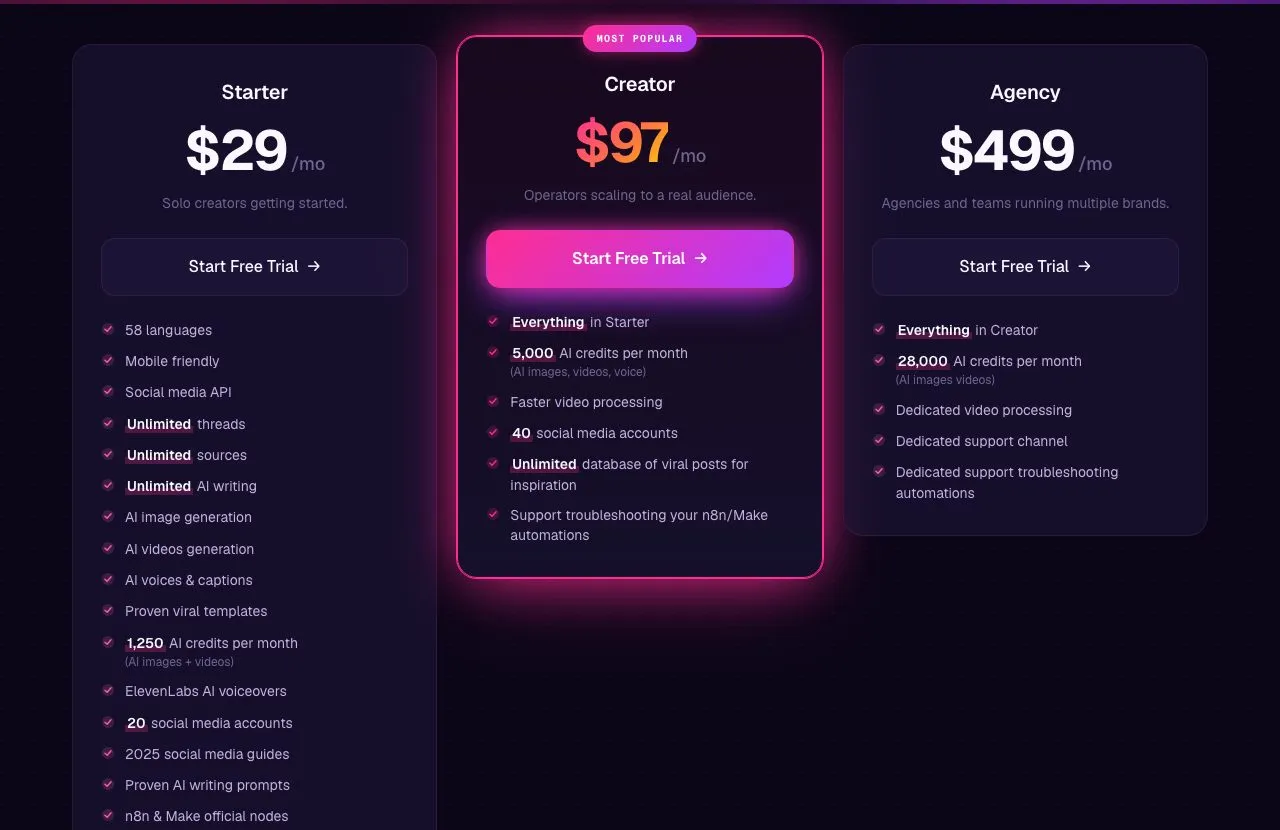
| Blotato Starter | $29/mo flat | Flat plan | $29/mo | 20 accounts, 1,250 AI credits, unlimited AI writing, AI image and video generation, n8n and Make official nodes |
The crossover points are concrete. At or below 6 accounts Zernio is cheaper than a $29 flat tier, and account 7 at $30 is where that flips, so start on Zernio and stay as long as your count holds. At 10 accounts Zernio is $48 against Blotato’s $29 for up to 20 accounts, which is where flat-rate wins on price alone. Past 50 accounts Zernio’s $168 beats stacking flat plans and the gap only widens, so if your count is heading that way Zernio is the honest answer regardless of what I sell.
Two category differences sit underneath those numbers. Zernio does not sell AI image or video generation at any account count, so if generation is part of the job you are comparing two different products rather than two prices. Running the other way, Zernio’s engagement surface is genuinely wider than Blotato’s: its rate card lists DMs on eight platforms and comments on nine, where Blotato’s comments and messaging cover Instagram and Facebook only. Worth reading their per-feature table rather than the headline, though, because the marketing line is “any platform that has one” while the rate card enumerates a specific and shorter list.
Worth saying plainly: Blotato is a tool I create and test for, so treat my placement of it in that table with the skepticism it deserves.
Sabrina’s Take on Zernio Pricing in 2026
Zernio’s rate card answers the questions most pricing pages leave open. Every band is published, X’s API costs are passed through with the markup stated as zero, and no feature sits behind a plan upgrade.
The consideration is the shape of the curve rather than any individual number. Usage-based billing reads as automatically cheaper, and here it genuinely is at the edges and genuinely is not in the middle. Ten accounts on Zernio costs $48 a month, which is more than several flat-rate tools charge for double that capacity. Knowing where you sit on the curve matters more than the headline “$6 per account.”
Find your row in the table above. That is the entire decision, and it splits three ways.
Under 3 accounts, start free and stay there as long as it serves you. Over 50 accounts, the per-account average keeps falling and the economics get hard to beat. Between 8 and 20 your average sits near its peak, so price Blotato and Postiz against your row before committing.
One thing that matters more than the per-account rate at any count: whether you need AI generation. Zernio does not sell it, so if that is part of the job, you are comparing two different products rather than two prices. My Zernio alternatives roundup breaks the field down by account band.
Zernio Pricing FAQs
Is Zernio free?
Your first two connected accounts are free with no credit card required, and that is a permanent free tier rather than a trial. Every feature runs on those two accounts. Billing starts at your third account, at $6 per account per month.
How much does Zernio cost per month?
It depends entirely on account count. Five accounts is $18, ten is $48, twenty is $78, fifty is $168, and a hundred is $318. The rates are graduated, so each band’s price applies only to the accounts inside it.
Does adding an account reprice my existing accounts?
No. The bands are graduated, not retroactive. Accounts 3 through 10 stay at $6 each no matter how many you add, and only accounts 11 and beyond get the $3 rate. Your average cost per account falls as you grow, but your existing accounts do not get cheaper.
Why is my cost per account highest at 10 accounts?
Because the $6 band covers accounts 3 through 10 and the discount does not start until account 11. At exactly 10 accounts you are paying $48, an average of $4.80, which is the peak of the curve. Every account after that pulls the average down.
Does Zernio include AI content generation?
No. The rate card covers publishing, scheduling, analytics, messaging, comments and reviews, ads, and webhooks, plus telephony as a separate line. Generating images, video, or copy needs a different tool, which is worth factoring in when comparing against tools that bundle it.
How does Zernio pricing compare to Blotato?
They bill on different units, so the answer moves with your account count. Zernio charges per connected account on a graduated ladder, which is $0 at two accounts, $48 at ten, and $78 at twenty. Blotato is $29 a month flat for up to 20 accounts. So Zernio is cheaper under about six accounts, Blotato is cheaper through the middle of the curve, and Zernio pulls ahead again past roughly 50 accounts where its average keeps falling toward $1. Feature-wise the split is real in both directions: Blotato bundles AI image and video generation that Zernio does not sell at any count, and Zernio’s rate card lists DMs on eight platforms and comments on nine against Blotato’s Instagram and Facebook. I build content for Blotato, so price your own row rather than taking my table on faith.
Is Zernio cheaper than a flat-rate tool?
At the edges, yes. Under 6 accounts it beats a $29 flat plan, and past 50 accounts the per-account average keeps falling toward $1. In the 8 to 20 range a flat plan covering 20 accounts is usually cheaper than Zernio’s $48 to $78, so the honest answer depends on your count.