6 Best WoopSocial Alternatives Beyond Publish-Only APIs (2026)
The best WoopSocial alternatives in 2026, compared on analytics, inbox and comment APIs, credit metering, and independent track record.
Here is the moment people start hunting for WoopSocial alternatives: the posts are going out fine, and then someone asks how they performed. WoopSocial publishes well and prices aggressively, but analytics, inbox, and comment management are not in the product or the API, so the answer requires a second tool. I’m the founder of Blotato, my pick below, so treat that entry with the appropriate skepticism and judge it on what each tool actually ships. If you want the plan math up front, it is on the pricing page.
Quick Comparison: 6 Best WoopSocial Alternatives
| Tool | Best For | Starting Price | Key Strength |
|---|---|---|---|
| Blotato | Agent builders who want publishing, engagement, and content generation on one key | $29/mo flat | Hosted MCP plus AI writing, image, and video behind a flat bill |
| Metricool | Solo marketers who need real reporting before they need an API | Free, then $20/mo | Deep analytics with competitor benchmarking, MCP on every plan |
| Postiz | Developers who want the widest channel list and an open-source escape hatch | $29/mo (free self-host) | 28 channels, official API and MCP, self-hostable |
| SocialBee | Content-category planners who want unlimited AI writing included | $29/mo | Category-based evergreen queues with AI generation on every tier |
| Buffer | Solo creators who want a permanent free plan and a polished calendar | Free, then $6/channel/mo ($5 annual) | The most mature scheduling UI here, with a genuine free tier |
| Ayrshare | Products that embed posting and engagement for isolated end users | $149/mo | Per-profile token isolation with comment and DM moderation built in |
Ayrshare lands last on price, not on quality. It solves multi-tenant isolation, which nothing above it does, and if that is your requirement the order flips entirely.
Why People Are Looking for WoopSocial Alternatives
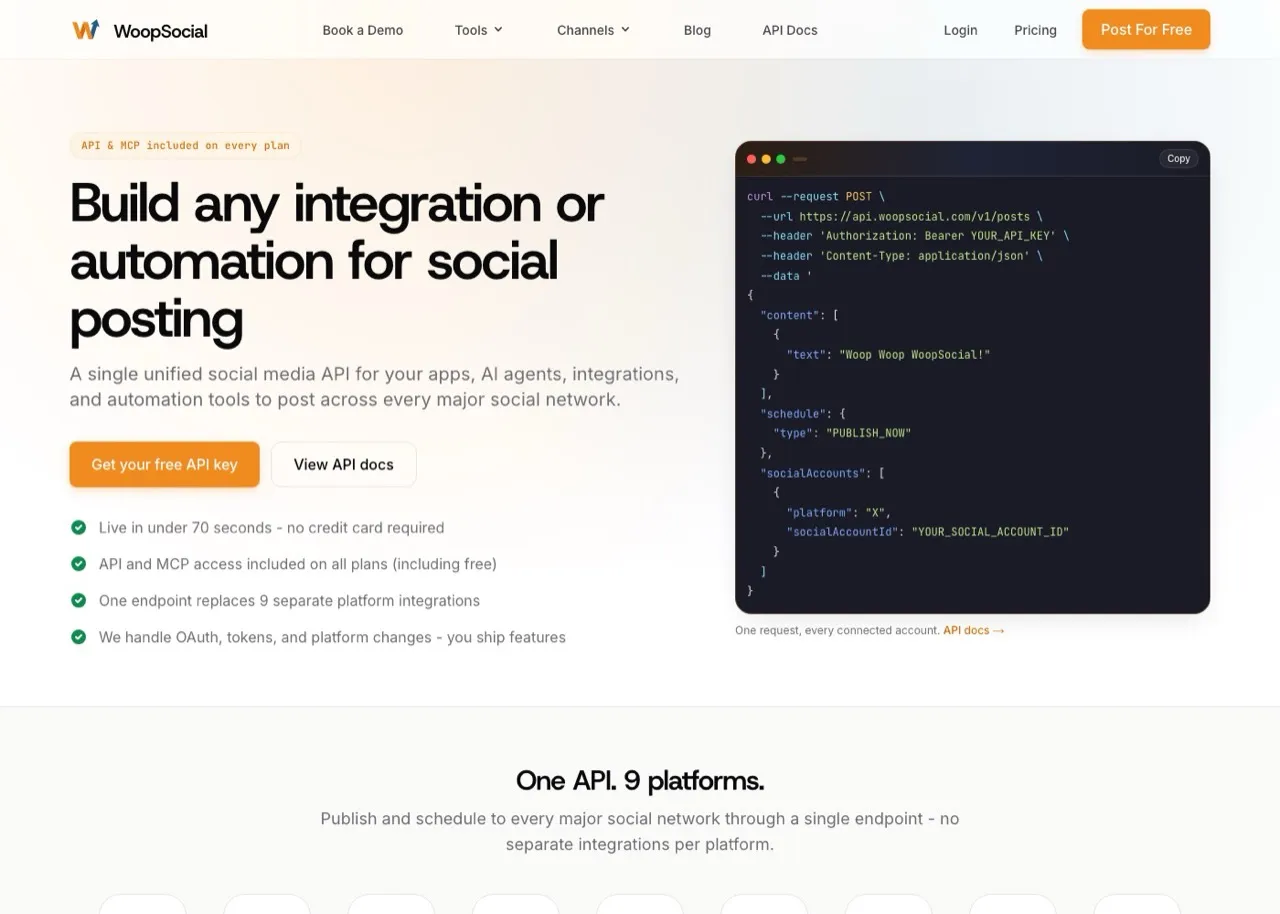
WoopSocial’s homepage: a unified publishing API with API and MCP access on every plan.
WoopSocial repositioned into API and MCP territory, and it did it well. Its homepage badge reads “API & MCP included on every plan,” its free tier genuinely includes both, and Pro covers 20 connected accounts at $19/mo. Compared against tools that paywall the API entirely, that is a real advantage and worth saying plainly.
The ceiling is scope. Checked across the homepage, pricing page and comparison table, the docs, and all 19 paths in the live OpenAPI spec, there is no analytics endpoint, no inbox, no DM handling, and no comment management. WoopSocial publishes. If your workflow ends at delivery, that focus is a feature. If someone needs to know what worked or reply to the person who commented, you are running a second subscription alongside it.
Two smaller frictions show up next. Every plan advertises unlimited posts, but a footnote qualifies X: first posts are free, then it moves to credits, so an X-heavy schedule meters out. And the AI features run on the same credit pool, with the free tier holding 30 credits a month. Then there is the account-count cliff: Business covers 100 accounts at $49/mo, and the next tier is Max at $799/mo for 2,500. An agency sitting at 120 accounts either stacks Business plans or faces a 16x jump.
One thing worth flagging, because it is easy to get wrong. Search results surface harsh one-star reviews on Trustpilot and Sitejabber for woopsocial.com dated 2019 and 2020, well before the current product existed. The Internet Archive’s earliest captures of that domain, from 2018 and 2019, carry the page title “Social media scheduler and advanced analytics - Woop,” which is a different product under a different name. So those reviews appear to describe whatever occupied the domain then, not the API company running it now. Worth checking yourself if it matters to your decision. Either way, the fair criticism of WoopSocial today is not that it has bad reviews. It is that it has almost no independent review history at all, in either direction.
Best WoopSocial Alternatives for 2026
Ordered by which gap they close: measurement first, then breadth, then the specialist cases.
1. Blotato: Best for agent builders who want publishing, engagement, and content generation on one key

Blotato’s homepage: publishing, comments, DMs, and analytics behind a single API and MCP surface.
The reason Blotato is my pick against WoopSocial specifically is scope rather than price, and the two are close on price anyway. Blotato publishes to 9 platforms, reads and posts comments and DMs on Instagram and Facebook, returns analytics on 8 platforms, and generates the content itself: writing, images, and faceless video. All of it sits behind one key, with a hosted MCP server at mcp.blotato.com/mcp for Claude, Cowork, or an n8n agent. Against a publish-only tool, that is the difference between an agent that ships posts and an agent that can also report on them and answer the replies.
Be clear on the limits. Analytics covers every platform except LinkedIn, engagement covers Instagram and Facebook rather than all 9, and the 7-day trial excludes the API, so an API key starts paid Starter immediately. Plan on subscribing rather than trialing if you are evaluating the integration.
Pricing: Price is close enough here that it should not decide this for you. Starter is $29, Creator $97, Agency $499, scaling by connected accounts and AI credits. The line worth checking before you commit is reach rather than cost: analytics reports on every publishing platform except LinkedIn, and comments and DMs work on Instagram and Facebook only, so a workflow that needs LinkedIn reporting or a non-Meta inbox is not served yet. Cancel anytime.
Ideal for: Builders whose agent needs to create, publish, and respond in one session.
Bottom line: WoopSocial ends at delivery, and Blotato covers what happens before and after it, on one flat plan.
2. Metricool: Best for solo marketers who need real reporting before they need an API
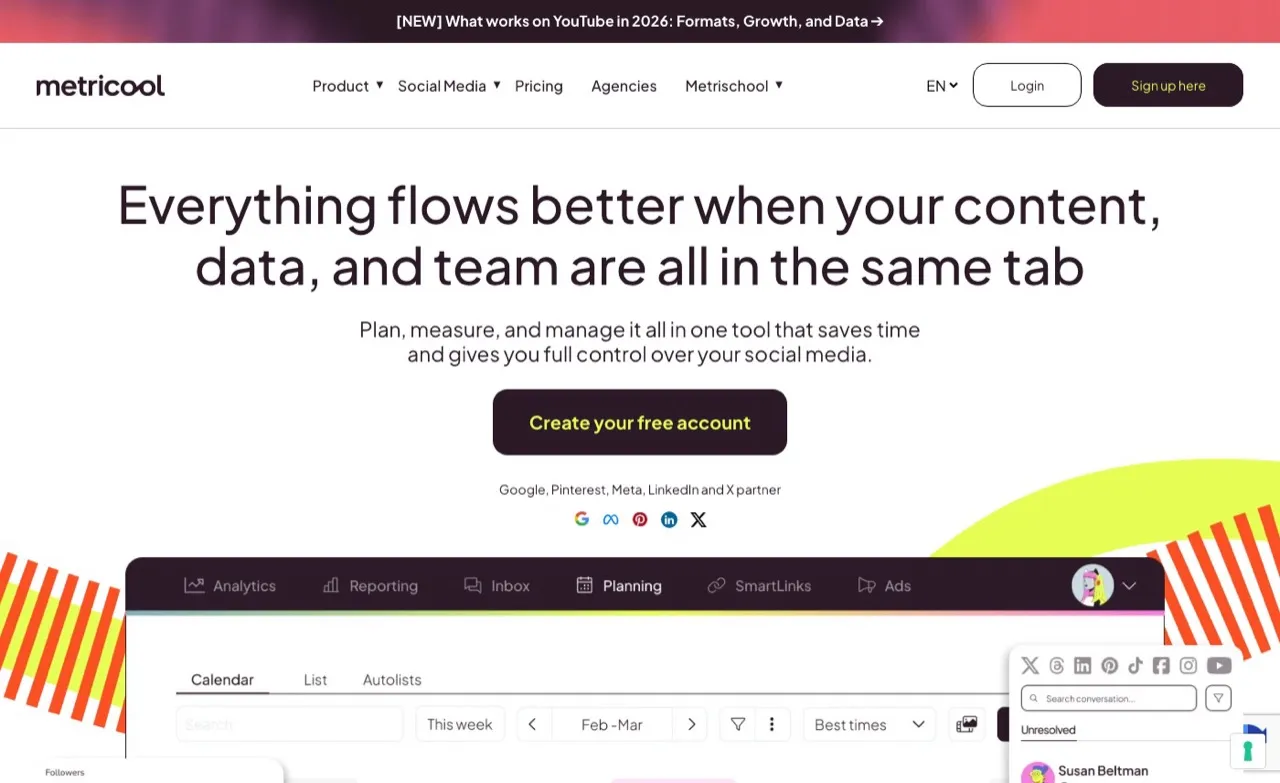
Metricool’s homepage: analytics, reporting, inbox, planning, and ads in a single dashboard.
Metricool is the most direct answer to WoopSocial’s biggest gap. Reporting is the core product rather than an afterthought, it includes competitor benchmarking, and the inbox covers Instagram, Facebook, TikTok, YouTube, LinkedIn, and Google Business from the Starter tier. Its free plan covers one brand with 20 posts a month and 30 days of analytics.
The API story is more nuanced than it first looks, and it is worth stating precisely because it is easy to get wrong. Metricool’s MCP server works across plans including Free, while the HTTP API used by Zapier and Make requires the Advanced tier at $53/mo. Those are two separately gated products, not a contradiction. I compared the reporting depth directly in Blotato vs Metricool.
Pros:
- Analytics depth and competitor benchmarking that publish-only tools cannot match
- Inbox across six networks from the Starter tier
- MCP available on every plan, including Free
Cons:
- The HTTP API for Zapier and Make requires Advanced at $53/mo
- Pricing scales by brand, which adds up for multi-client work
Pricing: Free (1 brand), Starter from $20/mo (5 brands) to $36/mo (10 brands), Advanced from $53/mo (15 brands) to $159/mo (50 brands), Custom on request.
Ideal for: Marketers whose next question after publishing is always “how did it do?”
Bottom line: The clearest fix if measurement, not delivery, is what is missing.
3. Postiz: Best for developers who want the widest channel list and an open-source escape hatch

Postiz’s homepage: agent-driven scheduling across a very wide channel list, self-hostable.
Postiz triples WoopSocial’s platform count at 28 channels and is fully open source, so if vendor continuity is your worry you can run it yourself and stop depending on anyone’s roadmap. It ships an official REST API and an MCP server at api.postiz.com/mcp on cloud plans, plus analytics and comment scheduling on every tier. AI generation is included and scales by tier, from 3 videos a month on Standard up to 500 images and 60 videos on Ultimate.
Self-hosting is real work: Postgres, Redis, and Temporal workers are yours to keep running, and provider-connection failures show up in their own GitHub issues. The $29/mo hosted tier avoids that. I worked through the tradeoff in Blotato vs Postiz, and ranked what to run instead of a self-hosted stack if the upkeep is the part you want gone.
Pros:
- 28 channels, far past WoopSocial’s 9
- Fully open source, so self-hosting is a real exit
- Analytics and AI generation included on every paid tier
Cons:
- Self-hosting means owning Postgres, Redis, and Temporal uptime
- Channel counts are tight at the low tiers: 5 on Standard
Pricing: Standard $29/mo (5 channels), Team $39/mo (10), Pro $49/mo (30), Ultimate $99/mo (100). Free if self-hosted, 7-day trial on cloud.
Ideal for: Developers who want maximum reach and an owned-infrastructure fallback.
Bottom line: The widest channel list here, and the only one you can take with you.
4. SocialBee: Best for content-category planners who want unlimited AI writing included
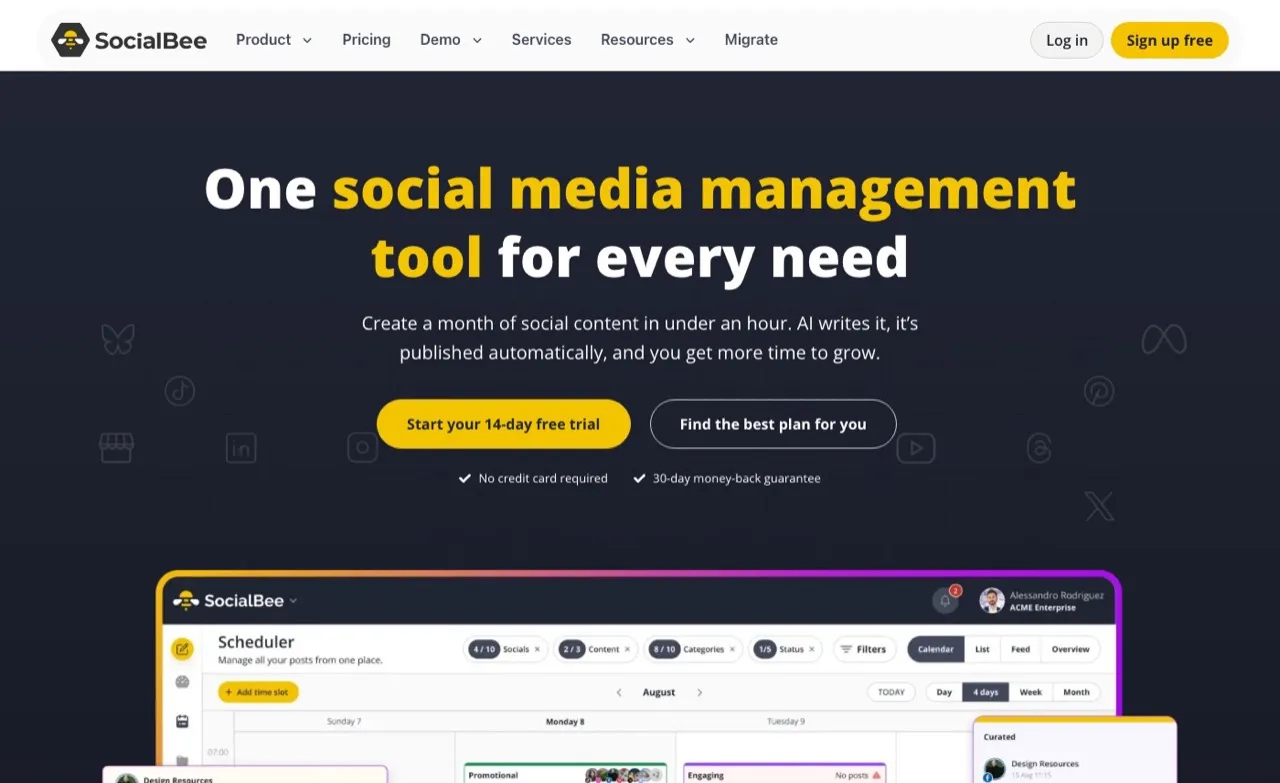
SocialBee’s homepage: category-based scheduling with AI writing included on every tier.
SocialBee approaches the same job from the content side. Its organizing idea is content categories feeding evergreen queues, so instead of scheduling individual posts you keep buckets full and it recycles them on a cadence. Unlimited AI content generation is included on every tier, which compares favorably against WoopSocial’s credit-metered AI, and comment, mention, and DM management is part of the product.
It is a dashboard product, not an API-first one. The pricing page does not document an API tier, and probes found no MCP server, so if agent access is a requirement this is the wrong shape of tool. Analytics runs 3 months of history on Bootstrap and 2 years above that. I compared the two approaches in Blotato vs SocialBee.
Pros:
- Unlimited AI content generation on every tier
- Category-based evergreen queues that keep publishing without daily input
- Comments, mentions, and DMs handled in-product
Cons:
- No documented API tier and no MCP server found
- No permanent free plan, only a 14-day trial
Pricing: Bootstrap $29/mo (5 profiles), Accelerate $49/mo (10), Pro $99/mo (25), then $179, $329, and $449/mo for 50, 100, and 150 profiles. 14-day trial, no card required.
Ideal for: Solo marketers who think in content pillars rather than individual posts.
Bottom line: The strongest AI allowance here, provided you never need to call it from code.
5. Buffer: Best for solo creators who want a permanent free plan and a polished calendar
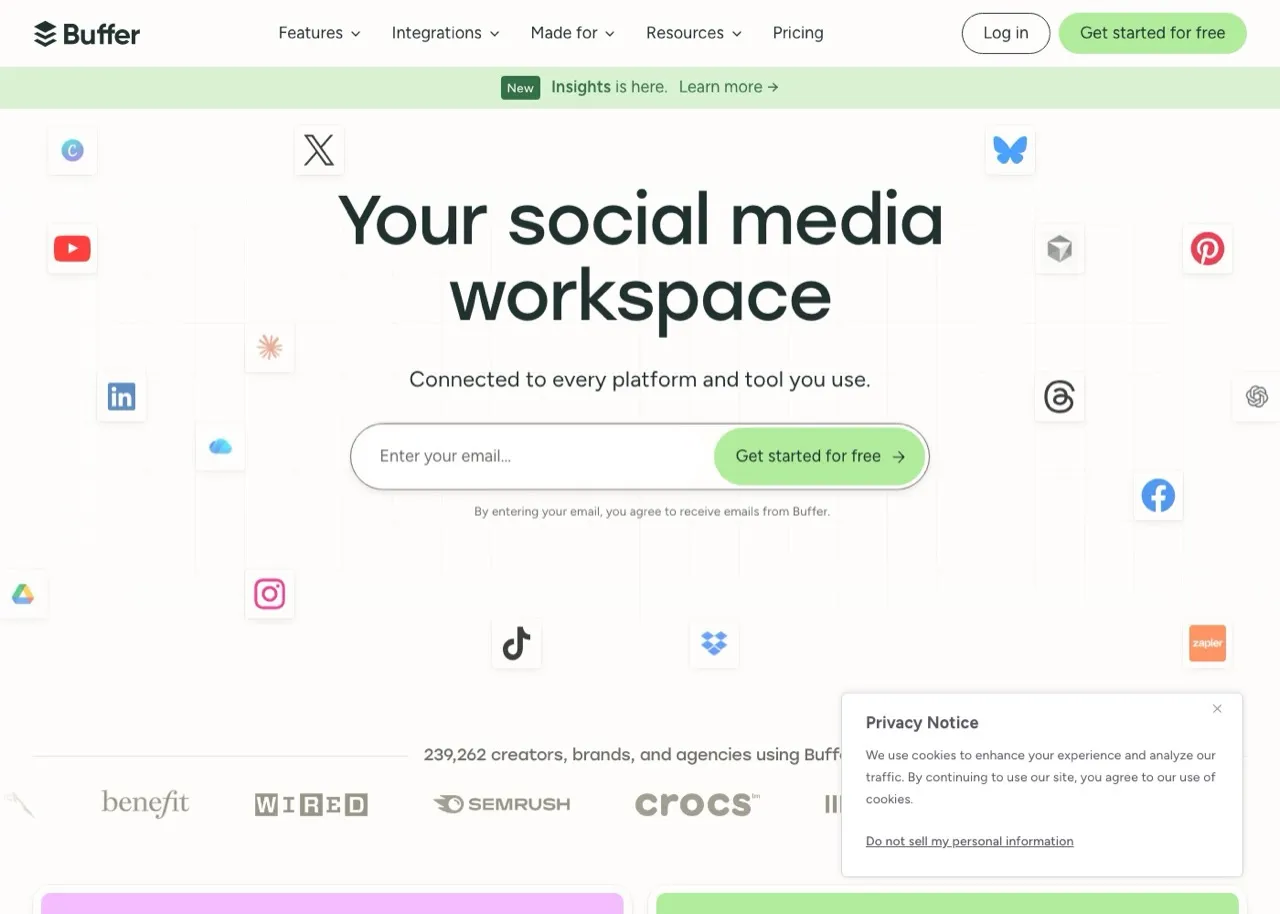
Buffer’s homepage: the most established scheduling dashboard on this list.
Buffer is the low-risk option and the most polished interface here by a distance. The free plan is permanent: 3 channels with 10 scheduled posts each, refillable. Paid plans bill per channel at $5/mo, which is cheap at three channels and expensive at twenty, so it is the mirror image of WoopSocial’s bundled account pricing. It runs an MCP server at mcp.buffer.com/mcp, and comment replies plus AI-assisted replies are available including a limited allowance on Free.
Buffer is the shallowest tool here on both analytics and platform count. It covers 11 platforms and its analytics history is capped at 30 days on the free plan. I ran the per-channel math against flat pricing in Blotato vs Buffer, and there is a broader Buffer alternatives list too.
Pros:
- Genuine permanent free plan with 3 channels
- The most refined scheduling UI of anything here
- Hosted MCP server plus AI reply assistance
Cons:
- Per-channel billing scales badly past a handful of accounts
- Analytics is shallow compared with Metricool
Pricing: Free (3 channels), Essentials $6/channel/mo ($5 annual, $60/yr per channel), Team $12/channel/mo ($10 annual). 14-day trial on paid plans.
Ideal for: Creators running a few channels who want it to look and feel finished.
Bottom line: The safest pick at three channels and the wrong one at twenty.
6. Ayrshare: Best for products that embed posting and engagement for isolated end users
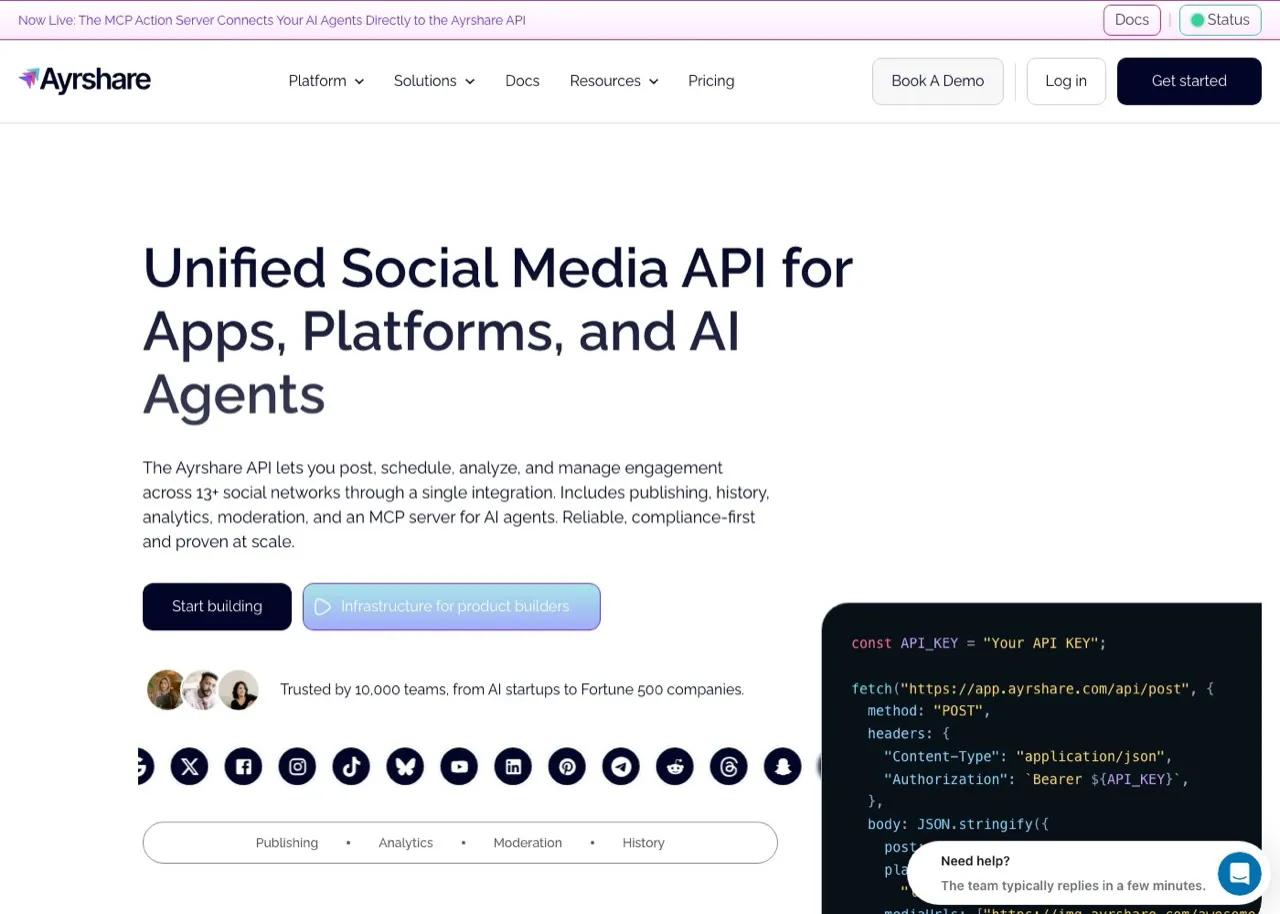
Ayrshare’s homepage: per-profile isolation with publishing, analytics, and moderation.
Ayrshare belongs here only for one reader: the person embedding social features inside their own product for many separate customers. Each end user gets an isolated credential boundary, comment and DM moderation is part of the platform rather than a separate purchase, and the Action MCP server at api.ayrshare.com/mcp exposes 27 tools. It is worth noting there is also a separate read-only documentation MCP that is easy to mistake for it.
The price is the story. Premium is $149/mo for a single profile, which is roughly eight times WoopSocial’s Pro tier for a fraction of the account count, and AI generation is a $300/mo Max Pack add-on on Business. See Blotato vs Ayrshare for the full comparison.
Pros:
- Per-end-user token isolation that no other tool here offers
- Comment and DM moderation is part of the platform, not an add-on product
- Proven across 14+ networks at production scale
Cons:
- $149/mo for one profile is a different budget category entirely
- AI generation costs an extra $300/mo on Business
Pricing: Premium $149/mo (1 profile), Launch $299/mo (up to 10), Business from $599/mo (30 profiles, then $8.99 each).
Ideal for: SaaS teams whose customers connect their own social accounts.
Bottom line: Overkill for one brand, and the clearest answer for hundreds.
How I Chose These WoopSocial Alternatives
I evaluated each tool on five things: whether analytics exists as a real product rather than a checkbox, whether the inbox and comment surface is covered natively, how AI usage is metered (credits, tiers, or unlimited), whether an agent can drive it through a documented API or hosted MCP server, and what happens to the bill as accounts grow. Pricing is current as of August 2026 and was read off each vendor’s own live pricing page. Capability claims come from vendor documentation, WoopSocial’s live OpenAPI spec, and direct MCP endpoint probes rather than from directory listings, and the note about the old reviews on that domain comes from the Internet Archive’s own captures.
How to Choose the Right WoopSocial Alternative
- If you just need to know what performed: Metricool, which goes deeper on reporting than anything else here.
- If you need to create the content too: Blotato generates writing, images, and video behind the publishing key. SocialBee covers writing if you never need API access.
- If 9 platforms is the constraint: Postiz covers 28 and can be self-hosted.
- If credit metering on X is what is hurting: compare Postiz and Buffer, which bill by channel rather than by post volume.
- If you are embedding this inside your own product: Ayrshare, and budget accordingly.
- If you want to spend nothing while you decide: Buffer’s free plan is permanent, and Metricool’s covers one brand with real analytics.
Final Recommendation
WoopSocial does one job and does it at a fair price, and the free tier including API and MCP access is genuinely better than what several larger competitors offer. The question is not whether it publishes well. It is whether publishing is the whole job. For most people running social seriously, measuring and replying show up within a month, and at that point you are either paying for two tools or you picked one that covered both. If that is where you are heading, Blotato is built for exactly that consolidation, and you can check the plans against what you are paying now.
WoopSocial Alternatives FAQs
Does WoopSocial have analytics?
Not in the product or the API as of August 2026. Checking the homepage, the full pricing comparison table and FAQ, the documentation, and all 19 paths in the live OpenAPI spec returns no analytics, inbox, comment, or reply endpoint. WoopSocial is a publish-only tool. If you need LinkedIn reporting or deeper analysis than per-post metrics, Metricool is the deepest option on this list. Blotato returns analytics on every other platform behind the same key it publishes with.
Is WoopSocial’s free plan really free?
Yes, and it is one of the better free tiers in this category. It covers 2 connected accounts, 1 seat, 1 GB of storage, 30 AI credits a month, and full API plus MCP access, with no card required and no trial expiry. That last part matters for builders: Blotato’s 7-day trial excludes the API, so WoopSocial is genuinely easier to evaluate programmatically at zero cost. The tradeoff is the 30-credit ceiling on AI usage and the publish-only scope.
How much independent review history does WoopSocial have?
Very little, and that is the honest answer in either direction. There is no meaningful third-party review corpus for the current product: no substantial Trustpilot or Capterra presence, no Product Hunt launch, and no Reddit discussion of any depth. The testimonials on woopsocial.com are vendor-published. The handful of one-star reviews that surface for the domain in search results are dated 2019 and 2020, which is years before this product, and the Internet Archive’s captures of the domain from that period carry a different product name, so read them with that in mind rather than as feedback on the API. If a track record matters to your decision, Buffer has a decade of operating history and Metricool and SocialBee both have large public review bases.
How many platforms does WoopSocial support?
WoopSocial’s marketing pages state 9: Facebook, Instagram, Threads, Bluesky, LinkedIn, X, Pinterest, TikTok, and YouTube. Worth a check before you commit, though: the live OpenAPI platform enum lists no Bluesky value and reaches nine only by counting LinkedIn and LinkedIn Pages separately. If Bluesky is important to your build, confirm it works programmatically before you rely on it. For comparison, Postiz covers 28 channels and Blotato covers 9.
Which WoopSocial alternative is best for AI agents?
Blotato, Postiz, Ayrshare, and Metricool all run MCP servers, so agent access alone does not separate them. The differences are in what the agent can reach. Blotato’s covers publishing, comments, DMs, analytics, and content generation. Postiz’s covers publishing and scheduling across 28 channels. Ayrshare’s Action server exposes 27 tools with per-profile isolation, and Metricool’s leans toward reporting. Choose by which surface your agent actually needs, not by which vendor ships MCP, because most of them now do.