How to Build a Personal Brand on Social Media That Drives Traffic to Your Startup
How I built a personal brand to 1.5M+ followers and drove traffic to my startup. The exact content engine, not vague advice.
Most advice about building a personal brand boils down to “post every day” and “be consistent.”
That worked before ChatGPT. Now everyone can write a decent-sounding LinkedIn post in 30 seconds. Consistency alone does not differentiate you anymore.
I grew from zero to over 1.4 million followers across platforms while building Blotato solo. No team, no paid ads, no video editors. I create content one day per week and use AI to repurpose it everywhere else.
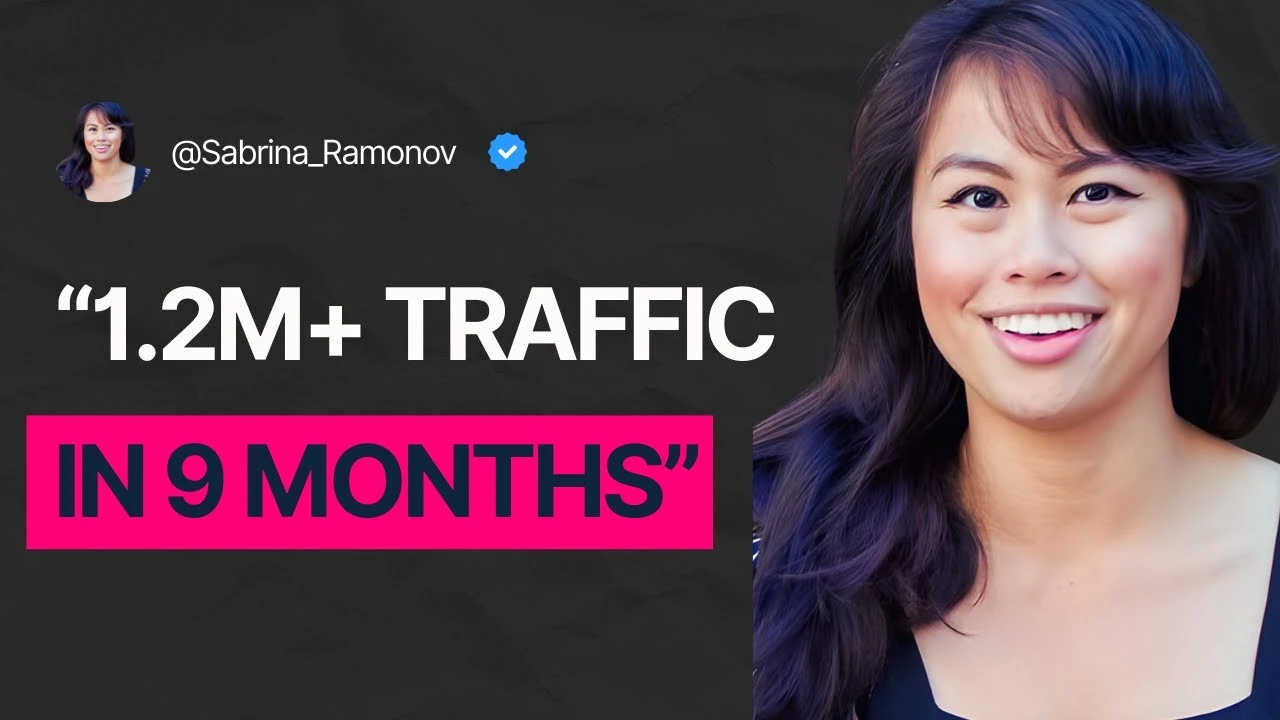
This year alone, my personal brand has driven 1.2 million website views to my startup. Here is the exact system I use.
How to Build a Personal Brand on Social Media (Video Guide)
If you’d rather watch the full walkthrough, this is the video version. The written guide below covers the same content engine with extra detail on my one-day-per-week schedule, the top-middle-bottom funnel, and the exact tools I use to repurpose and cross-post everywhere.
Why Posting Daily Is Not Enough Anymore
The courses tell you to post every single day. Consistency matters because most people quit too early. But with generative AI, it is now easy to have AI write a pretty good sounding post.
So how do you stand out when everyone is using ChatGPT to create content?
People care most about the results you can demonstrate. Social media growth, leads generated, revenue earned. The more concrete results you can share, the more credibility you build and the more you stand out among the noise.
If you have not achieved anything yet, document your journey toward a goal. If your goal is to make $20,000 per month with your new product, state that publicly and document what you are doing along the way. That is exactly how Sandy Lee grew a brand-new channel from 200 to 30,000 subscribers before she built anything to sell.
A common mistake I see: content creators building a personal brand focus too much on just the content and not enough on actually doing meaningful stuff that people want to follow. They want to follow your journey. They want to follow along with what you are learning, what you are experimenting with, what is failing.
Define Your Mission First
If you are building a personal brand, you need a clearly defined mission. What do you stand for that other people could latch onto?
My mission is to teach 10 million people AI. I started with 1 million, hit that goal, and added a zero. For me personally, my goal with all of my content is to inspire people to take action and start playing around with AI tools so they can form their own opinions.
I am also passionate about solopreneurship and tiny startups, which is why I am building Blotato solo. I want to see how far I can go solo, how far I can scale myself, and show what is actually possible. If you are still choosing a direction, these AI business ideas for solopreneurs are the gaps I would chase today.
Whatever your mission is, try to write it down. It is okay if it is fuzzy at first. You will get clarity on what is important to you and what feels genuine as you create more content.
The Constraints That Shape My Strategy
Before diving into my playbook, you need to understand the constraints I operate under:
- I do not pay for ads
- I do not have a team
- I do not have video editors
- I only create content one day per week
- I do not do collaborations, paid posts, or affiliate deals
- I do not care about production or video quality
- Nothing I promote earns me money except my own SaaS product
My philosophy as a content creator also building a product: maximize the time and effort I spend doing meaningful work building my company, then use AI to document what I have learned, challenges I am facing, and interesting observations.
I am very much not a full-time content creator. I only create content one day per week, which will shock you, but I will walk through my schedule exactly. If you want that morning broken into a repeatable system, I wrote up exactly how I create a week of content in one day.
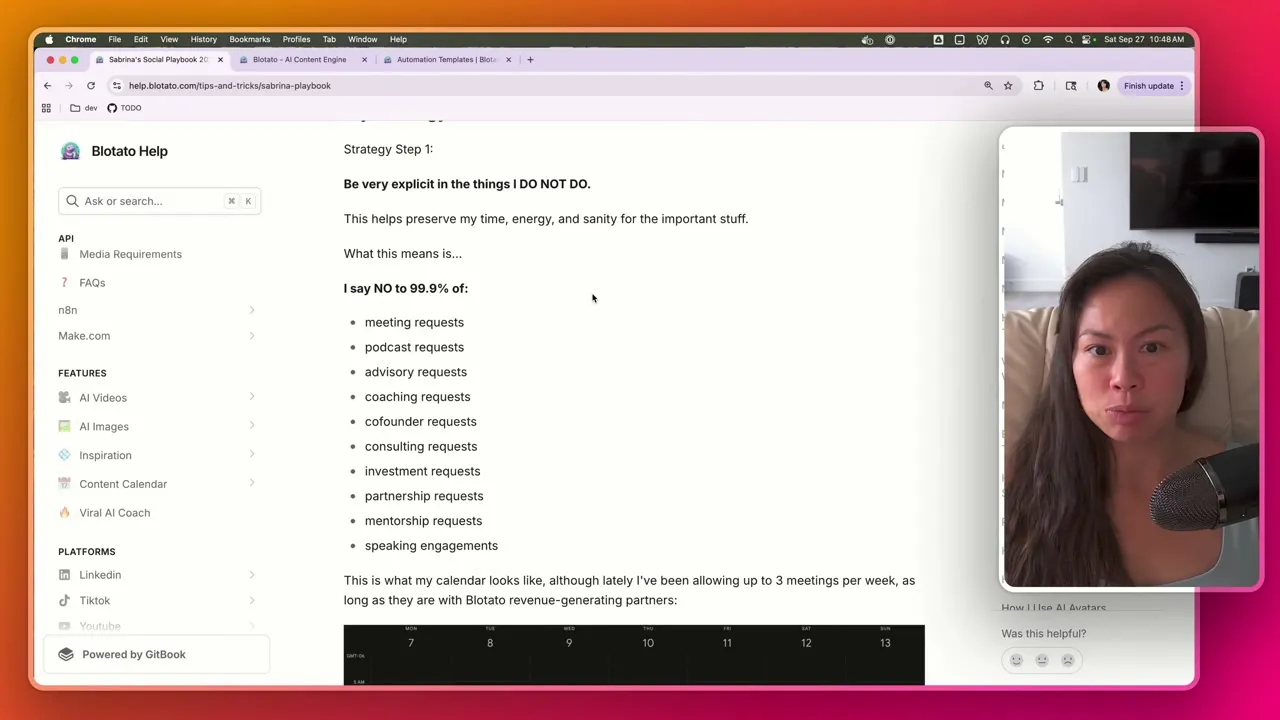
At a high level, my strategy mostly consists of saying no to a lot of things. Meeting requests, podcast invitations, advisory roles, coaching requests, consulting, investments, partnership inquiries, mentorship, speaking engagements. I say no to 99.9% of all of these requests.
This helps preserve my time, energy, and sanity to focus on making some high-quality content and building Blotato to be the best product possible.
One of the most common pitfalls I see: people trying to do way too much. Way overcommitted, trying to build three different businesses at the same time while also building a personal brand and two faceless content channels. Just choose one thing and say no to everything else.
My Simple Content Strategy
Once you are really good at saying no and protecting your time, you will have the bandwidth to actually run your strategy. Mine is simple:
- Focus on making high-quality original content on one to two platforms (YouTube for long form, TikTok for short form)
- Use a combination of AI and automation to repurpose my original content to multiple platforms
- Drive everyone to my email newsletter where I sometimes share how I use Blotato to grow on social media
I do not change the strategy every other month. It is all about execution quality and execution volume. Usually when my numbers are down, the issue is with volume or quality or both.
The Top-Middle-Bottom Funnel
My funnel is super simple:
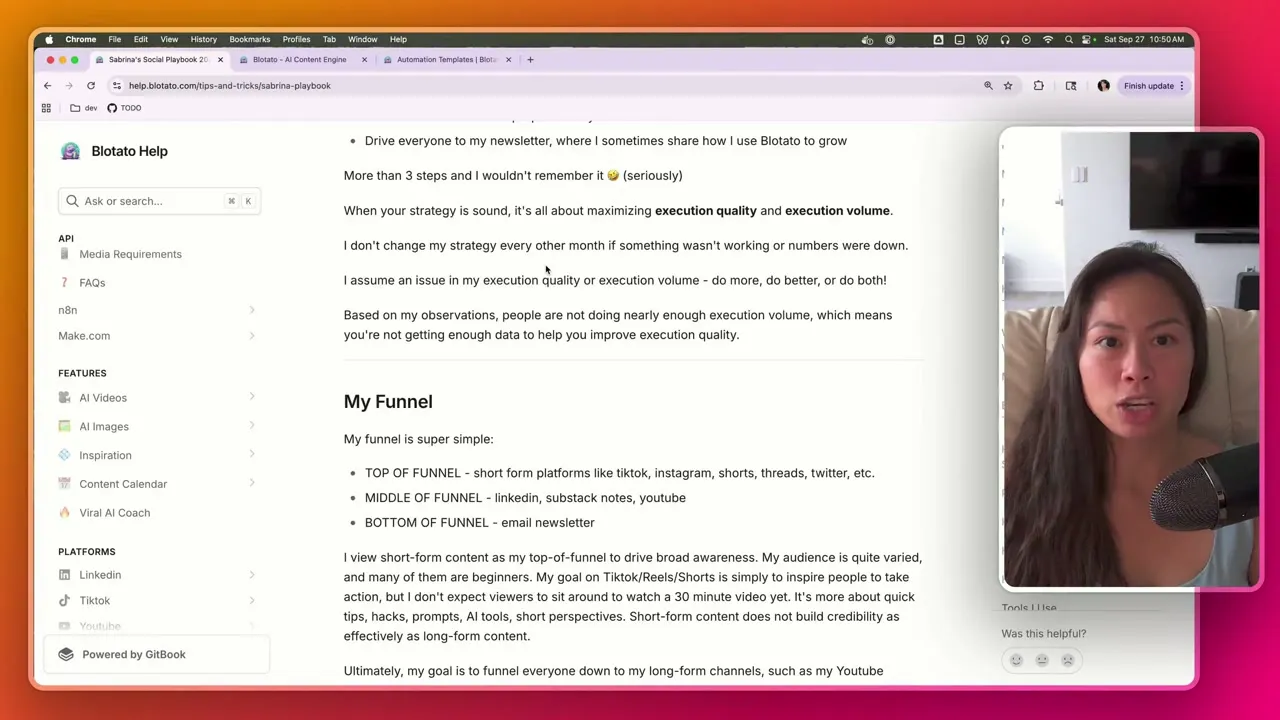
Top of funnel: Short form platforms like TikTok, Instagram, Shorts, Threads, and Twitter. These drive broad awareness. My audience is varied and many are beginners. My goal on TikTok, Reels, and Shorts is to inspire people to take action with quick tips, hacks, prompts, AI tools, and short perspectives.
Middle of funnel: LinkedIn, Substack Notes, and YouTube. Slightly longer form content that builds credibility. Short form content does not build credibility as effectively as long form content.
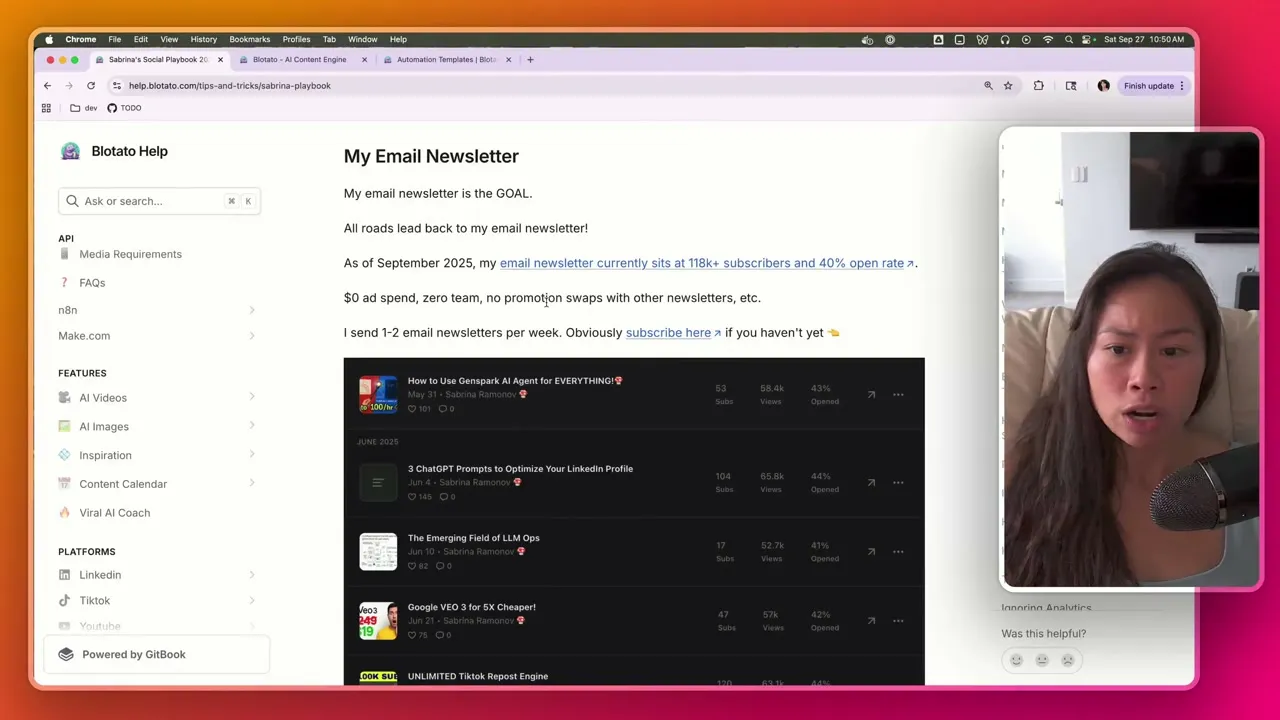
Bottom of funnel: Email newsletter. I currently have around 118,000 subscribers with a 40% open rate. Again, this is with zero ad spend and no team.
Whether or not you are building a separate product, if you are a creator, influencer, or thought leader, email is going to be your highest ROI channel. For most businesses, email is the channel. It is where you build a really deep, meaningful relationship with your audience.
Check the bio of all my social media profiles. They all direct you to my newsletter. I only have one link. It is not a Stan Store or a Linktree. I do not want to confuse people with five billion links.
You want to own your audience outside of social platforms. You want control over your audience, meaning you can reach them whenever you want, not dictated by the latest algorithm updates.
The only metric I actually look at every month is whether my email newsletter list is growing. As long as it is growing, I know my engine is working.
What Content Works on Each Platform
TikTok: ChatGPT prompts are still really popular because they are broadly applicable. If I talk about AI automations, only a tiny niche percentage of my audience understands what I am saying. But if I talk about a ChatGPT prompt like how to humanize AI writing, a lot more people can understand and try it for themselves. Listicles are also a tried-and-true format.
LinkedIn: Lead magnet giveaways work really well right now. You lead with a result you have achieved either for yourself or for a client, then say “comment this and I’ll send you a playbook.” A lot of people find this format cringey, but it depends how frequently you do it and the quality of results you are claiming plus the actual playbook you are delivering.
YouTube: My best performing video is actually a repurposed TikTok. I took one viral TikTok and just talked for three more minutes about the same topic. Workflow automations also do really well because there is a big community of n8n and Make.com users trying to learn how to build custom social media automations.
Substack: Quote cards do really well. Simple quote cards which are often reposted TikTok videos perform great.
My Typical Content Creation Day
I only create content on Saturday. Here is what a typical day looks like:
- Wake up, drink coffee
- Film one long form YouTube video (if it is a workflow automation, I build it first then film)
- Use Blotato to repurpose the YouTube video into a newsletter and social posts
- Take a lunch break
- Work on 20 short form TikTok videos, sometimes batched as AI slideshows, iterating on feedback from the Viral AI Coach
- Post to TikTok, which triggers an automation that downloads and cross-posts to other platforms
By the end of Saturday, I have one new YouTube tutorial, one newsletter from the YouTube tutorial, a few social posts promoting the tutorial, and 20 new TikTok videos that will be cross-posted everywhere.
How I Repurpose Content with AI
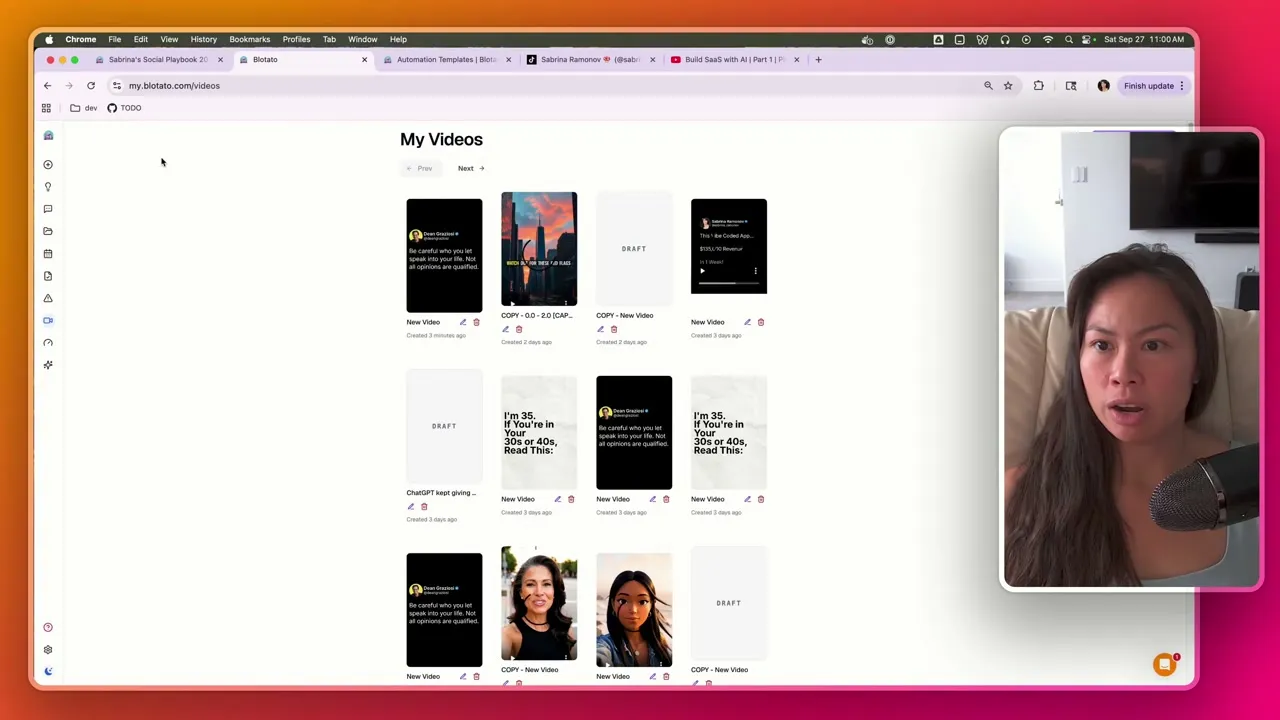
All I have to do is copy my YouTube link. In Blotato, I click add source. You can add many types of sources like YouTube videos, TikTok videos, podcasts, PDFs, text, or articles.
Blotato grabs the entire transcript of the video almost instantly. Then I choose which platforms I want to make posts for.
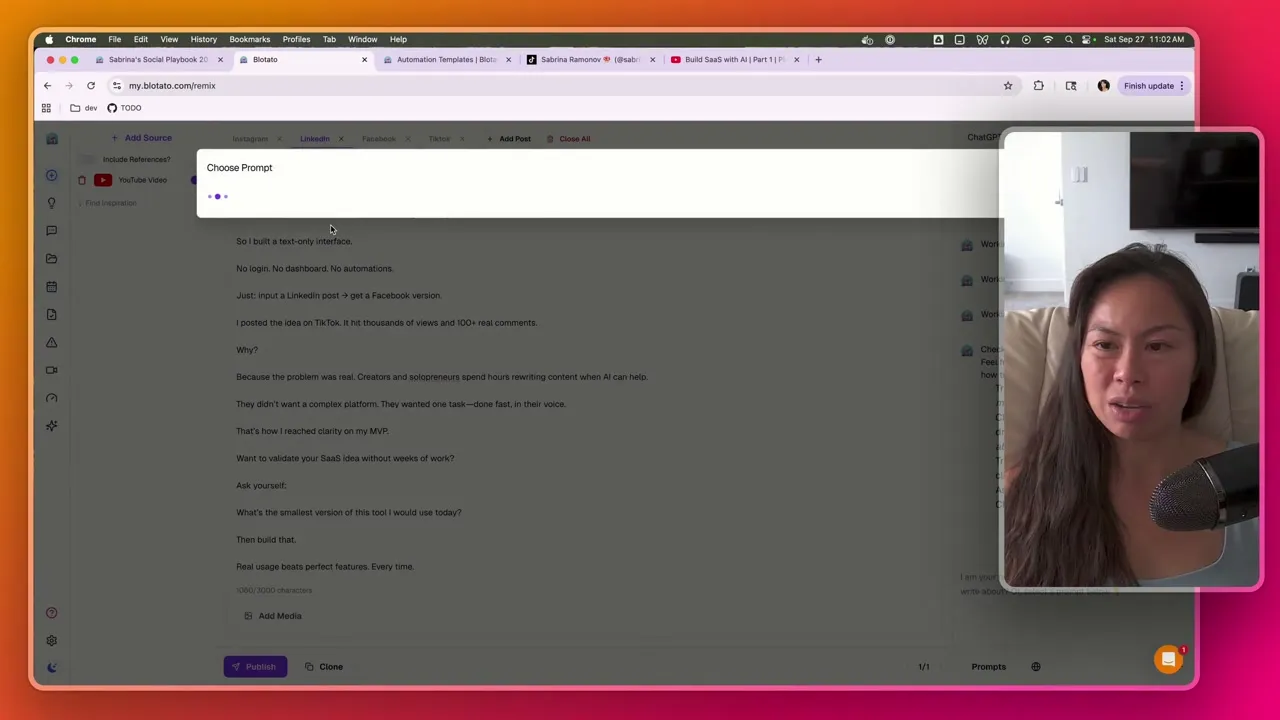
The default prompt is already optimized for each platform. When you click generate post, Blotato repurposes your original YouTube video into social posts for each platform. You can choose different prompts. For example, I like to use structured bullet points for LinkedIn.
What I love about repurposing content is it starts with your own high-quality original content. I do not frequently repurpose other people’s content. I just repurpose my own high-quality content into social posts and add small tweaks to make it sound truly more like me before I hit publish, which is how you sidestep the most common content repurposing mistakes that flatten your voice.
Iterating with the Viral AI Coach
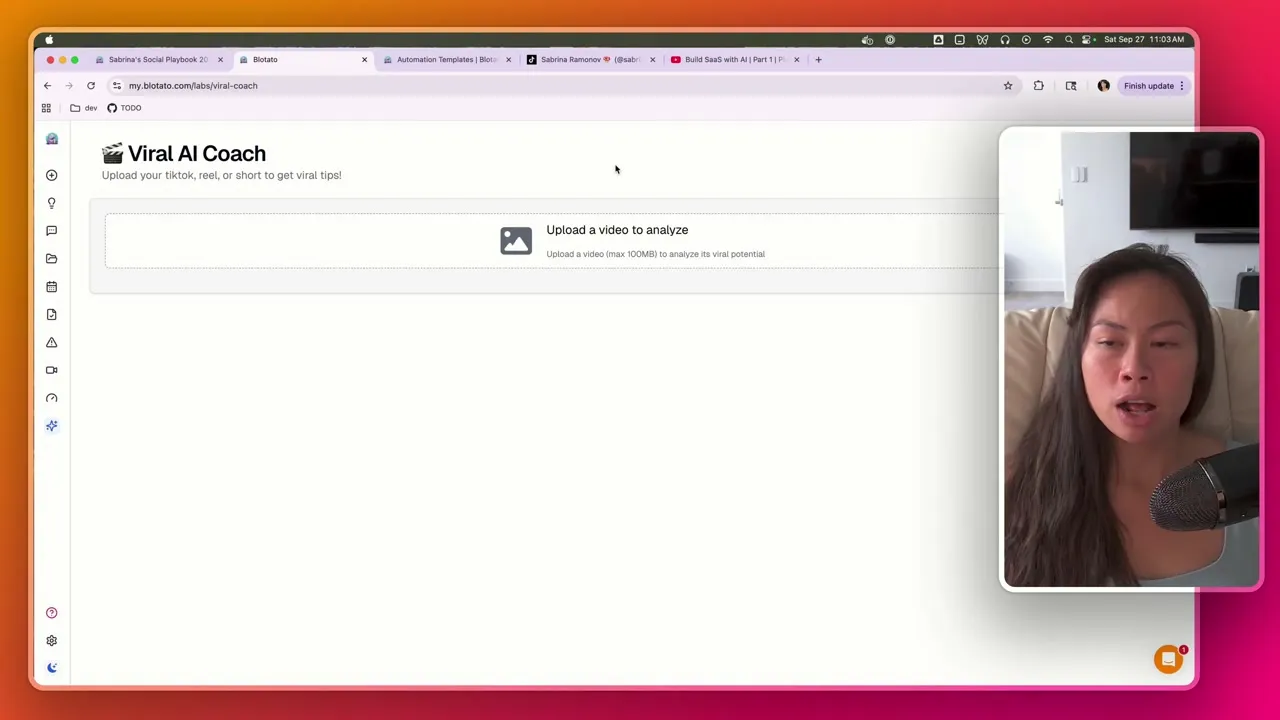
Blotato has a built-in Viral AI Coach where you can get really incredible feedback. I have watched a lot of videos on TikTok coaching and how to break out of 200 view jail. The feedback you get from this AI coach is worth at least $1,000 in coaches and custom consulting.
If you are brand new to content creation and upload a video, do not be concerned if your initial score is 15 or 20 out of 100. That is totally fine. Take the feedback, film it again with another hook, and eventually you will get your score up to the 50s and 60s range which is pretty good to start posting.
The Viral AI Coach analyzes your transcript and what you are saying, but also the visuals, especially in the first 10 seconds of your video. It gives you suggested hooks, feedback on your problem-benefit statement, sound on and off test scores, information density ratings, emotional resonance scores, and recommended hashtags.
Automating Cross-Posting
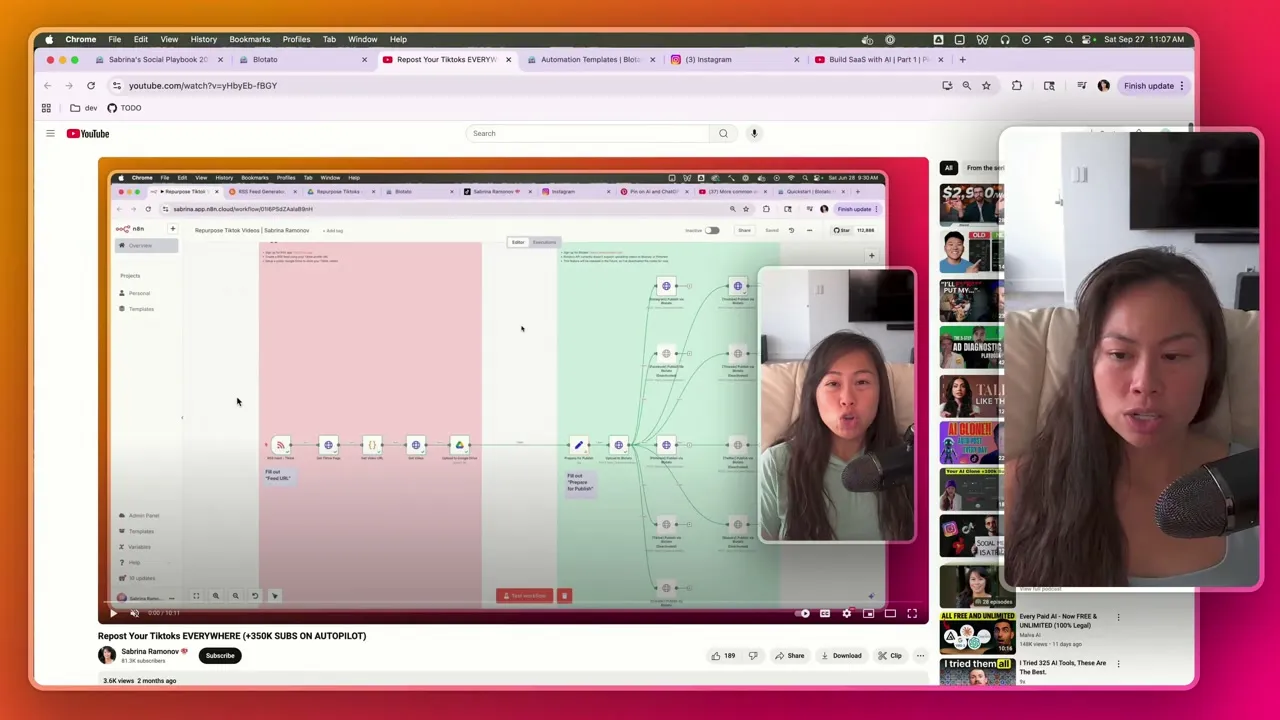
Whenever I post a TikTok video, it automatically downloads and cross-posts to other social media platforms. This uses a combination of Blotato and n8n.
The workflow uses an RSS tracker. Whenever I post a TikTok video, it downloads it, uploads to Google Drive for storage, then automatically cross-posts to multiple platforms.
The TikTok Playbook for Educational Content
If you are building a personal brand around education or thought leadership:
- Choose one niche. Create a main account and warm it up
- Create a second TikTok account just for research to get inspiration on hooks and topics
- Focus on quantity and consistency. Most people quit and stop making content before experiencing the momentum of having a video do well
- The hook is the most important part of every piece of content you put out. Whether it is a video, text post, or carousel, the hook is the single most important piece
Look at proven viral formats in your niche. Find those videos and basically copy that same format. It could be a listicle, a negative “stop doing this” angle, a tutorial “how I did this”, or breaking news.
For me personally, I do not do a ton of editing. That is just my style. It works really well on TikTok. I just use my front camera, TikTok mobile app, and I talk. No external mic, no external camera, no teleprompter most of the time. Truly absolutely nothing fancy.
The Key Takeaways
Building a personal brand while also building a startup comes down to a few principles:
- Say no to almost everything so you have time to focus on what matters
- Create original content on one to two platforms rather than trying to be everywhere at once
- Use AI to repurpose your best content across all other platforms
- Drive everyone to your email newsletter which is your highest ROI channel
- Document your journey rather than trying to position yourself as an expert before you have results
The specific tools and tactics will change. The strategy stays the same: make high-quality original content, repurpose it with AI and automation, and drive everyone to your email newsletter where you can build a real relationship and eventually share how your product can help them.
If you want to try the repurposing and Viral AI Coach features I showed, you can start with Blotato and test the system yourself.