Manychat Examples: 8 Real Social Media DM Funnels, Torn Down
Manychat examples from Jenna Kutcher, Amy Porterfield and Mindvalley, each social media DM funnel traced from its trigger to where the lead lands.
The most useful Manychat examples are whole funnels, not template names. Each starts with a comment, a DM keyword or a follow, and ends where the person lands. Below are eight real ones from Jenna Kutcher, Amy Porterfield, Mindvalley, a sourdough artist and a gym in Costa Rica. The numbers come from Manychat’s own case studies, so read them as vendor-reported.
What Most Example Lists Leave Out
Most lists of DM automation examples stop at the idea: “comment GUIDE, get the guide.” That is the trigger. A funnel has four more parts, and they are where the results come from.
- The trigger: the comment, DM keyword or follow that starts the conversation.
- The gate: anything the person has to do first, like follow or share an email.
- The offer: the link, freebie or discount the DM delivers.
- The destination: the place you own or can count, like a list, a checkout or a calendar.
- The result: the number someone measured, and where they measured it.
Every example below converts attention you already have, whether it shows up as comments, DMs or new followers. If none of that is happening yet, these funnels have nothing to convert. Keep posting until people ask you for things.
A note on where I stand. Blotato, the company I founded, runs reply-only DM automation on Instagram and Facebook, so it competes with Manychat on a narrower field. It cannot rebuild every funnel here, and each entry says which parts it can’t. If one of them fits your account, Blotato’s plans all include DM automations.
8 Manychat Examples, Traced From Trigger to Destination
Here are all eight Manychat funnels at a glance, then each one in detail.
| # | Who | Trigger | What the DM sends | Where the lead lands | Vendor-reported result |
|---|---|---|---|---|---|
| 1 | Jenna Kutcher | Comment a keyword on a post | Webinar registration link | Her webinar | 85% of commenters registered |
| 2 | Amy Porterfield | Comment BOOK on a Reel | Purchase link and bonus details | Book checkout | 924 confirmed purchases |
| 3 | Jenna Kutcher | Type TRAFFIC after tapping an ad | A question, then the webinar link | Her evergreen webinar | Cost per lead fell from $6.56 to $4.88 |
| 4 | Mindvalley | DM the keyword “energy” | Sign up or learn more, then questions | Masterclass registration | 522% more sign-ups |
| 5 | The Sourdough Mama | Comment “red” on a Reel | A picture gallery of products | Her Amazon Storefront | About 6 million views (reach) |
| 6 | The Sourdough Mama | A new follow | Welcome, a reel, a free recipe | Her email list | 2,000+ subscribers in months |
| 7 | Amy Porterfield | Comment a keyword during a Live | More info and an offer link | Her email list | 85% of commenters gave an email |
| 8 | Gold’s Gym Costa Rica | DM the keyword “citas” | A location question, then booking links | Calendly | 9X more Instagram bookings |
1. Jenna Kutcher: A Comment Keyword Fills a Webinar
Working with the agency School of Bots, Jenna Kutcher replaced her email sign-up ads with an Instagram DM funnel. A post asked people to comment a keyword, and Manychat sent the registration link to their DMs. Manychat’s write-up reports 12,489 webinar sign-ups, 55.6% of them from chat funnels, and says 85% of commenters registered, against a typical 30-40% on landing pages. Those are different audiences, not a controlled test.
Rebuild it in Blotato: a comment trigger plus a DM with a registration button, the simplest automation the product makes. Blotato counts runs, not registrations, so read the sign-ups on your webinar page.
Bottom line: For a free event, ask for nothing but the comment, and put the link where they already are.
2. Amy Porterfield: Comment BOOK, Get the Bonus
Amy Porterfield, also working with School of Bots, posted a Reel about her book with a limited-time bonus for buyers. The call to action was “Comment BOOK to get the bonus!”, and the DM carried the purchase link and the bonus details. Manychat reports 2,650 emails collected, 924 confirmed purchases and what it calls a 35% purchase conversion rate.
Rebuild it in Blotato: a comment trigger, then an email ask that repeats until it gets an address. Then one DM with two buttons, checkout and bonus details. Purchase tracking is not part of it. Confirm sales in your checkout, not in the automation.
Bottom line: A bonus turns “where do I buy it” into “comment and I’ll send it,” and the list grows on the way.
3. Jenna Kutcher: An Ad That Opens a DM
For her evergreen webinar, Jenna also ran paid ads that open Instagram Direct instead of a landing page. The ad said “Comment TRAFFIC to get my free webinar,” and people who tapped it were prompted to type TRAFFIC. The DM asked a follow-up question, collected a name and email, registered them, and sent the webinar link. Manychat reports her cost per lead fell from $6.56 to $4.88 and webinar sign-up conversion rose from 30% to 75%.
Rebuild it in Blotato: Blotato doesn’t run ads, and its docs don’t cover chats opened from an ad. If the typed word arrives as a normal DM, a message trigger on TRAFFIC can ask for the email and send the link. A webhook after the DM can pass the address to your webinar tool. The follow-up question and the name field don’t carry over.
Bottom line: An ad can open a DM that collects the registration details itself, with no landing page in between.
4. Mindvalley: DM a Word, Answer a Few Questions
Mindvalley promotes free masterclasses on Instagram every week. School of Bots moved the call to action into the DMs: for Donna Eden’s class on energy medicine, people messaged the keyword “energy.” The automation offered two paths, sign up or learn more, then asked about goals, challenges and experience, with a person on live chat. Manychat reports a 522% increase in masterclass sign-ups across the program and 7,296+ new contacts.
Rebuild it in Blotato: a message trigger on “energy” and one DM with two buttons, register and class details. The typed-answer questions and the branching don’t carry over, because a Blotato automation runs one fixed path. A person can still step in from Blotato’s Instagram and Facebook inbox.
Bottom line: A DM keyword lets people ask for the class without commenting in public, which suits Stories.
5. The Sourdough Mama: Comment “red” for the Shopping List
Katrina Niesen bakes sourdough art, and her red bow loaf had people asking about the red powder. She set a keyword on the reel before posting: comment “red,” get the links. Manychat’s story says she used its gallery feature to show each product as a picture. The reel reached about 6 million views and boosted her Amazon Storefront sales.
Rebuild it in Blotato: a comment trigger scoped to that one post and a DM with up to three link buttons, each a text label of 20 characters or fewer. The web app’s post picker lists only posts published through Blotato. For a reel posted in the Instagram app, an agent can scope the trigger once its first comment arrives, or the keyword watches every post. Either way, pick a longer keyword than “red,” since Blotato matches a keyword anywhere in the comment.
Bottom line: When a post makes people ask “what is that,” the comment is the shopping intent, so answer it with the link.
6. The Sourdough Mama: Every New Follower Gets a Recipe
Her bigger win, by her own account in Manychat’s story, is Follow to DM. Each new follower gets a welcome message, a pinned “get to know me” reel, a free recipe and a yes-or-no email invite. They get the recipe even if they say no. Her list took four years to reach about 2,500, and this flow added at least 2,000 more in a few months.
Rebuild it in Blotato: you can’t. Blotato has no follow trigger, so it cannot message someone for following you. Its follow gate runs the other way, asking a commenter to follow before the DM.
Bottom line: Sending the freebie whether or not they join makes an email ask feel like an offer rather than a toll.
7. Amy Porterfield: Pin a Keyword to Your Live
Amy pinned a comment with her keyword during Instagram Lives. Even viewers who dropped in for a few seconds could opt in. Anyone who commented got a DM with more information and the offer link. The same write-up says 85% of the people who commented gave their email in the DMs.
Rebuild it in Blotato: not as described. Blotato documents its comment trigger for posts and reels, not Live video, so treat Lives as unsupported. A Reel cut from the Live can carry the same keyword afterward.
Bottom line: A Live audience comes and goes, so pin the keyword early for viewers who arrive late.
8. Gold’s Gym Costa Rica: Type “citas,” Book a Class
In this 2021 funnel, people tapped Message on Gold’s Gym’s Instagram profile and typed “citas,” Spanish for appointments. The automation asked which of its three locations they wanted, then sent Calendly booking links. Its agency, TBS Marketing, had people type the location, because quick-reply buttons didn’t show on every device. Manychat’s case study reports a 9X lift in Instagram bookings, and Instagram made up 40% of all bookings.
Rebuild it in Blotato: a message trigger on “citas” and one DM with three link buttons, one booking link per location. Instagram shows those buttons in the mobile app only, a close cousin of the problem TBS worked around. If your audience books from a laptop, put the three links in the message text.
Bottom line: For a local business, a typed keyword can do the front desk’s booking job inside Instagram.
Three Patterns Behind the Numbers
- Every offer was one specific thing. A webinar seat, a book bonus, a product list, a recipe, a class booking. Each keyword promised one thing, and the DM delivered exactly that.
- The ask grows with the stakes. Jenna’s organic webinar post asked only for a comment. Her paid TRAFFIC ad, where every lead had a price, collected a name and email in the DM first. Gates carry a policy tension: Meta’s spam policy lists “Requiring or claiming that users are required to engage with content (e.g., liking, sharing) before they are able to view or interact with promised content.” I cover how that clause reads for comment bots separately.
- Short keywords need a matching check. BOOK, red, citas and TRAFFIC are easy to type on a phone. Some tools fire on a keyword anywhere inside a comment. Then “red” also catches “shared,” and BOOK catches “Facebook.”
When an AI Agent Builds the Funnel
Every Manychat funnel above was built by people in Manychat’s builder, six of the eight by agencies. If an AI agent runs your accounts, the question is whether it can build and edit these. Manychat’s public Page API has 34 endpoints, and for flows it offers only getFlows and sendFlow, so nothing writes a flow. Manychat also documents no first-party MCP server, though third-party ones exist, as my endpoint-by-endpoint read of Manychat’s API shows.
| Job | In Manychat | Through Blotato’s MCP server |
|---|---|---|
| Create a keyword automation | The Flow Builder | blotato_create_automation, saved as a draft |
| Point 20 automations at a new offer | Edit in the web app, since no API endpoint writes a flow | blotato_list_automations, then blotato_update_automation on each |
| Channels covered | Instagram, Messenger, WhatsApp, TikTok, Telegram, SMS and email | Instagram and Facebook only |
My own comment funnel runs on Blotato today, so here is what one looks like there. When someone comments my keyword, the automation asks for a follow, then an email, then sends the guide. Each email then goes to n8n for a validity check, and only clean addresses join my list. My longer post covers the gate order and the n8n check.
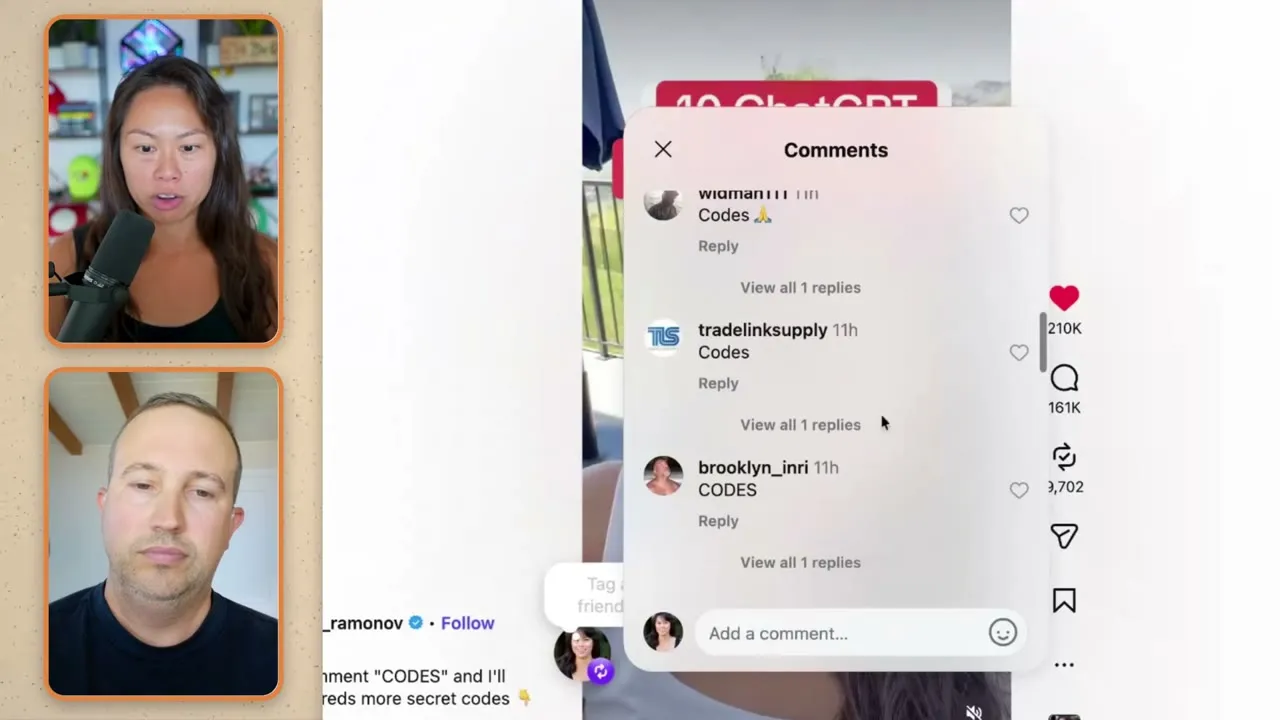
Agents can run the whole build, too. Calvin Hia never built his comment automations by hand, since his agents did. He reports more than 3,000 leads in a month from the system his agent runs.
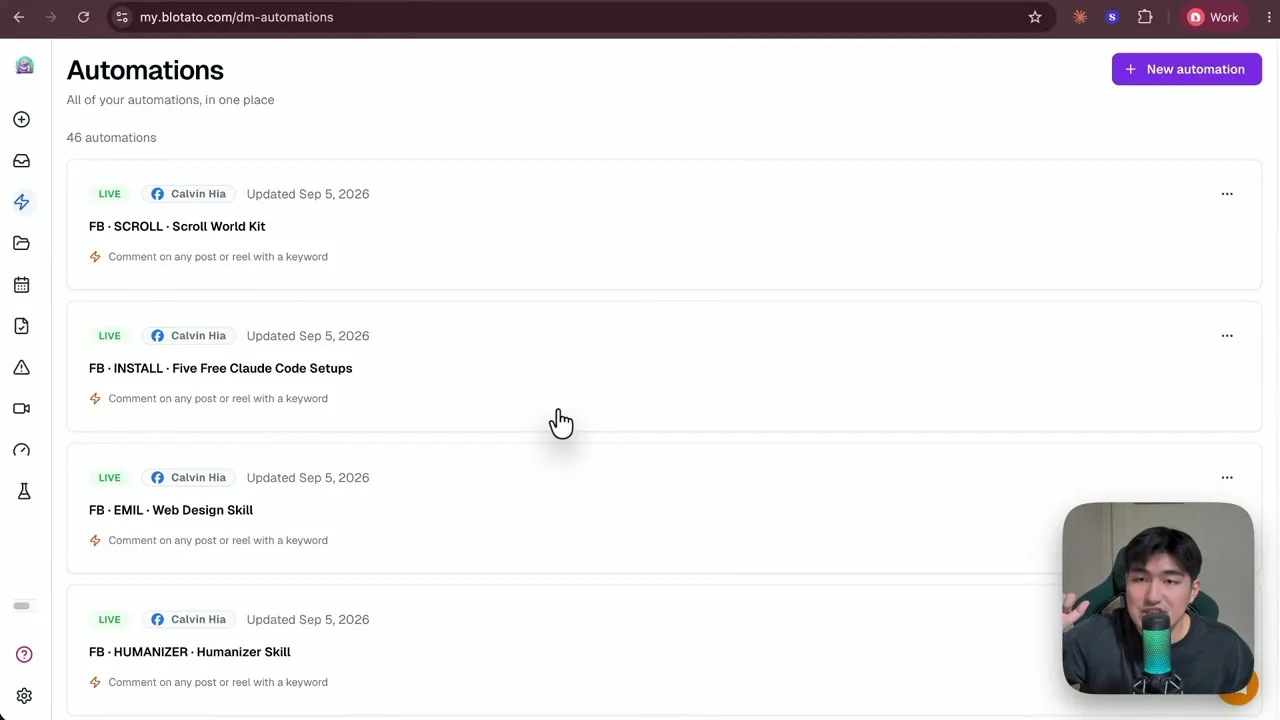
Some DM-only tools also ship MCP servers, so agent access alone shouldn’t decide this. What Blotato adds is that one key also publishes the post each funnel runs on. One catch for agent builders: API and MCP access need a paid plan. The free trial leaves them out, and generating an API key switches you onto Starter.
Which Funnel to Copy First
Match the Manychat examples above to what you already sell:
- A free webinar or masterclass: copy Jenna’s comment keyword, or Mindvalley’s DM keyword for Stories.
- Paid traffic to a webinar: copy Jenna’s TRAFFIC ad.
- A product or a book: copy Amy’s BOOK Reel, bonus and all.
- Affiliate links: copy the “red” gallery, or tag products natively once your account clears the follower bar for Instagram’s own affiliate tags.
- A local service: copy the gym’s booking keyword.
For a comment funnel, start with the post that already draws the most comments. For a DM, ad or follow funnel, test that entry point from a second account first.
The Handoff Is the Funnel
Across these examples, the conversation tied one specific offer to a destination someone could count. Some sent a link at once, and others collected details first. Pick the example closest to your offer, build that one handoff, and count the result where it lands. Six of the eight can be rebuilt on a Blotato plan, fully or in part, and each entry above says which parts.
Manychat Examples FAQs
What can you use Manychat for?
Manychat automates conversations on Instagram, Messenger, WhatsApp, TikTok, Telegram, SMS and email. The common jobs are the ones in this post. It sends links when someone comments a keyword, collects emails, fills webinars, sells products and books appointments. The simplest version is a single comment keyword that sends one link.
How much does Manychat cost per month?
Manychat has a free plan with 25 Active Contacts a month and up to 4 active automations. Essential, Pro, Business and Advanced cost $17, $39, $99 and $199 a month, or $14, $29, $69 and $139 billed annually. Essential includes 250 Active Contacts and Pro 2,500, with a per-contact charge past each pool. Our Manychat pricing breakdown works out the bill at higher counts.
Can you make money with Manychat?
Manychat itself doesn’t pay you. It moves people from a comment to something that does, like a checkout, an affiliate storefront or a paid course. In Manychat’s case study, Amy Porterfield’s book funnel produced 924 confirmed purchases. The money comes from the offer, and the automation removes the steps between interest and the buy button.
Is there anything better than Manychat?
It depends on the job. Manychat covers seven channels and branching flows, which suits a business built on conversations. Flat-priced DM-only tools can cost less for a single comment-to-link funnel. Manychat’s API can’t create funnels for an AI agent, and this Manychat alternatives comparison weighs the options on price and channels.
What is a good keyword for a Manychat automation?
Use one short word tied to the offer, like BOOK, TRAFFIC or citas, that is easy to type on a phone. Check how your tool matches it. A short word can also fire inside longer ones, the way “red” sits inside “shared.” Say the exact word on screen and in the caption, and pin it on a Live.